Medford–Grants Pass | ||
|---|---|---|
| Medford–Grants Pass, OR Combined Statistical Area | ||
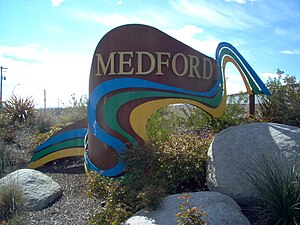 Welcome sign near the north end of Medford | ||
 Interactive map of Medford–Grants Pass, OR CSA | ||
| Coordinates: 42°25′56″N122°43′43″W / 42.4322°N 122.7286°W | ||
| Country |  United States United States | |
| State |  Oregon Oregon | |
| Largest city | Medford | |
| Other cities | Grants Pass Ashland Central Point Eagle Point | |
| Highest elevation | 7,047 ft (2,148 m) | |
| Lowest elevation | 430 ft (131 m) | |
| Population | ||
• Total | 285,919 | |
| • Rank | 205th in the U.S. | |
| • Density | 70/sq mi (26/km2) | |
| GDP | ||
| • Grants Pass MSA | $3.877 billion (2023) | |
| • Medford MSA | $12.853 billion (2023) | |
| Time zone | UTC−8 (PST) | |
| • Summer (DST) | UTC−7 (PDT) | |
The Medford metropolitan area is a metropolitan area in the U.S. state of Oregon centered on the principal city of Medford, Oregon. [3] The U.S. Office of Management and Budget (OMB) identifies it as the Medford, OR Metropolitan Statistical Area, a metropolitan statistical area used by the United States Census Bureau (USCB) and other entities. [3] The OMB defines the area as comprising all of Jackson County, including Medford, Ashland and Central Point. [4] The Medford metropolitan area also includes Grants Pass in neighboring Josephine County, though the OMB excludes it.
