Related Research Articles

The common footman is a moth of the family Erebidae. The species was first described by Johann Leopold Theodor Friedrich Zincken in 1817. It is distributed throughout Europe and east through the Palearctic to Lake Baikal.
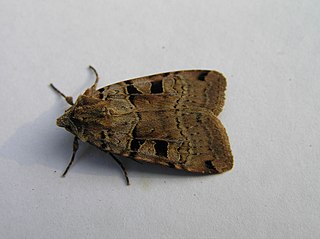
The double square-spot is a moth of the family Noctuidae. It is distributed through most of Europe except Portugal, the Mediterranean islands and northernmost Fennoscandia. In the East, the species ranges East across the Palearctic to Siberia and in the South-East to the Black Sea and in Iran. It rises to a height of about 2000 metres in the Alps.

The poplar grey is a moth of the family Noctuidae. It is found throughout Europe.

The miller is a moth of the family Noctuidae. It is found throughout Europe apart from the far south-east.The range extends from the South of Spain, Central Italy and Bulgaria to Scotland and Central Scandinavia, crossing the Arctic circle in Finland and Norway. Outside Europe it is only known in North Africa. In the Eastern Palearctic and the Nearctic realm it is replaced by Acronicta vulpina, formerly known as Acronicta leporina subspecies vulpina.

Lygephila pastinum, the blackneck, is a moth of the family Erebidae. The species was first described by Georg Friedrich Treitschke in 1826. It is found in Europe and across the Palearctic Siberia, the Russian Far East, Japan and China.

Colocasia coryli is a moth of the family Noctuidae. It is found in Europe. Western Asia. In the North, the distribution area includes northern Scandinavia, in the South the moth is limited to montane areas of Western and Northern Spain, Sicily, Greece and Asia minor. In the East the range extends across the Palearctic to Lake Baikal. In the Alps coryli rises up to 1600 m. asl.
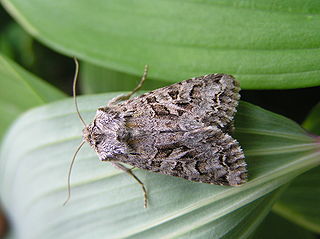
Hada plebeja, the shears, is a moth of the family Noctuidae. It is found in Europe and across the Palearctic to Asia Minor, Armenia, Turkestan, Central Asia, Mongolia, Siberia. Also Kashmir.
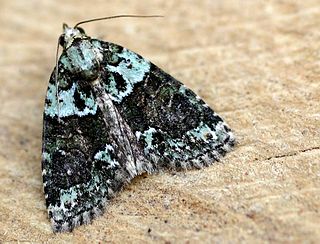
Cryphia algae is a moth of the family Noctuidae. It is found in Mediterranean parts of Europe and the Near East.

Cucullia chamomillae, the chamomile shark, is a species of moth of the family Noctuidae. It is found in Central Europe, Southern Europe, the Near East and North Africa.
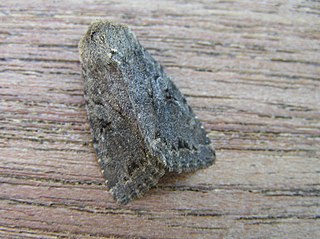
Fissipunctia ypsillon, the dingy shears, is a species of moth of the family Noctuidae. It is found in the Palearctic realm.
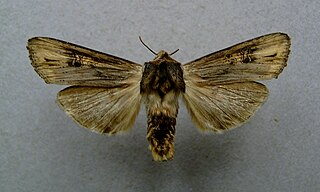
Xylena exsoleta, the sword-grass, is a species of moth of the family Noctuidae.

Phragmatobia fuliginosa, the ruby tiger, is a moth of the family Erebidae.

Dicallomera fascelina, the dark tussock, is a moth in the family Erebidae. The species was first described by Carl Linnaeus in his 1758 10th edition of Systema Naturae. It is found in most of Europe, through the Palearctic to Central Asia to Korea.

Cleorodes is a monotypic moth genus in the family Geometridae described by Warren in 1894. Its single species, Cleorodes lichenaria, the Brussels lace, was first described by Johann Siegfried Hufnagel in 1767.
Oretopsis is a genus of moths belonging to the subfamily Drepaninae. It contains the single species Oretopsis vohilava, described by Pierre Viette in 1954. It is found in Madagascar.

Apamea zeta is a moth of the family Noctuidae. It has a Holarctic distribution, and can be found throughout the Northern Hemisphere. It occurs throughout Europe and the northern half of North America.

Cucullia absinthii, the wormwood, is a moth of the family Noctuidae. It is found from Europe to the Caucasus, Turkey, northern Iran, western Siberia, the Altai mountains, Tien-Shan and Tarbagatai.
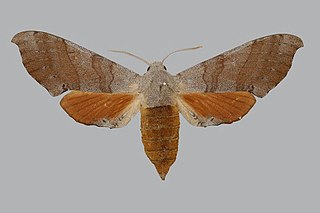
Polyptychus coryndoni is a moth of the family Sphingidae. It is known from Brachystegia woodland from Zimbabwe to Malawi, Zambia, the Democratic Republic of the Congo and Tanzania. It has also been recorded from northern Nigeria.

Pantophaea favillacea is a moth of the family Sphingidae. It is known from savanna and bush from eastern Kenya to Tanzania, Zambia, Angola, Zimbabwe and Mozambique.
Eucosmophyes icelitodes is a moth of the family Tortricidae first described by Edward Meyrick in 1913. It is found in Sri Lanka.
References
- ↑ "GlobIZ search". Global Information System on Pyraloidea. Retrieved 2011-09-29.
- ↑ * Mémoires Orstom, no 37, 1970. Deux Nouvelles Pyrales Inédites Récoltées Dans Le Massif Du Tsaratanana
 | This Phycitini-related article is a stub. You can help Wikipedia by expanding it. |