
Analytical chemistry studies and uses instruments and methods to separate, identify, and quantify matter. In practice, separation, identification or quantification may constitute the entire analysis or be combined with another method. Separation isolates analytes. Qualitative analysis identifies analytes, while quantitative analysis determines the numerical amount or concentration.

Atomic absorption spectroscopy (AAS) is a spectroanalytical procedure for the quantitative measurement of chemical elements. AAS is based on the absorption of light by free metallic ions that have been atomized from a sample. An alternative technique is atomic emission spectroscopy (AES).

Nitric acid is an inorganic compound with the formula HNO3. It is a highly corrosive mineral acid. The compound is colorless, but samples tend to acquire a yellow cast over time due to decomposition into oxides of nitrogen. Most commercially available nitric acid has a concentration of 68% in water. When the solution contains more than 86% HNO3, it is referred to as fuming nitric acid. Depending on the amount of nitrogen dioxide present, fuming nitric acid is further characterized as red fuming nitric acid at concentrations above 86%, or white fuming nitric acid at concentrations above 95%.
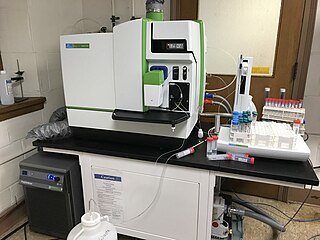
Inductively coupled plasma mass spectrometry (ICP-MS) is a type of mass spectrometry that uses an inductively coupled plasma to ionize the sample. It atomizes the sample and creates atomic and small polyatomic ions, which are then detected. It is known and used for its ability to detect metals and several non-metals in liquid samples at very low concentrations. It can detect different isotopes of the same element, which makes it a versatile tool in isotopic labeling.
Gold fingerprinting is a method used to identify and authenticate gold items by analyzing the unique composition of impurities or trace elements within the metal. While gold itself is an inert and relatively uniform element, gold found in natural or processed items often contains small amounts of other elements, such as silver or lead. These trace elements, which vary depending on the source and refining process, serve as a "fingerprint" for the gold. By comparing the elemental composition of a gold sample to databases of known sources, experts can determine where the gold was likely mined or processed. This technique is applied in fields such as archaeology, geology, and forensic science, as it provides insights into the provenance of historical artifacts, mined gold, or stolen items.

Gravimetric analysis describes a set of methods used in analytical chemistry for the quantitative determination of an analyte based on its mass. The principle of this type of analysis is that once an ion's mass has been determined as a unique compound, that known measurement can then be used to determine the same analyte's mass in a mixture, as long as the relative quantities of the other constituents are known.

Maltodextrin is a name shared by two different families of chemicals. Both families are glucose polymers, but have little chemical or nutritional similarity.
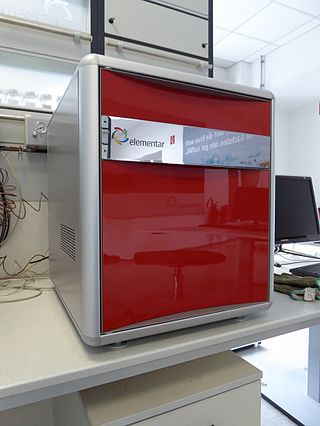
Elemental analysis is a process where a sample of some material is analyzed for its elemental and sometimes isotopic composition. Elemental analysis can be qualitative, and it can be quantitative. Elemental analysis falls within the ambit of analytical chemistry, the instruments involved in deciphering the chemical nature of our world.
Vapour phase decomposition (VPD) is a method used in the semiconductor industry to improve the sensitivity of total-reflection x-ray fluorescence spectroscopy by changing the contaminant from a thin layer to a granular residue. When using granular residue the limits of detection are improved because of a more intense fluorescence signal in angles smaller than the isokinetic angle.
Graphite furnace atomic absorption spectroscopy (GFAAS), also known as electrothermal atomic absorption spectroscopy (ETAAS), is a type of spectrometry that uses a graphite-coated furnace to vaporize the sample. Briefly, the technique is based on the fact that free atoms will absorb light at frequencies or wavelengths characteristic of the element of interest. Within certain limits, the amount of light absorbed can be linearly correlated to the concentration of analyte present. Free atoms of most elements can be produced from samples by the application of high temperatures. In GFAAS, samples are deposited in a small graphite or pyrolytic carbon coated graphite tube, which can then be heated to vaporize and atomize the analyte. The atoms absorb ultraviolet or visible light and make transitions to higher electronic energy levels. Applying the Beer-Lambert law directly in AA spectroscopy is difficult due to variations in the atomization efficiency from the sample matrix, and nonuniformity of concentration and path length of analyte atoms. Concentration measurements are usually determined from a working curve after calibrating the instrument with standards of known concentration. The main advantages of the graphite furnace comparing to aspiration atomic absorption are the following:

Inductively coupled plasma atomic emission spectroscopy (ICP-AES), also referred to as inductively coupled plasma optical emission spectroscopy (ICP-OES), is an analytical technique used for the detection of chemical elements. It is a type of emission spectroscopy that uses the inductively coupled plasma to produce excited atoms and ions that emit electromagnetic radiation at wavelengths characteristic of a particular element. The plasma is a high temperature source of ionised source gas. The plasma is sustained and maintained by inductive coupling from electrical coils at megahertz frequencies. The source temperature is in the range from 6000 to 10,000 K. The intensity of the emissions from various wavelengths of light are proportional to the concentrations of the elements within the sample.

Chloroplatinic acid (also known as hexachloroplatinic acid) is an inorganic compound with the formula [H3O]2[PtCl6](H2O)x (0 ≤ x ≤ 6). A red solid, it is an important commercial source of platinum, usually as an aqueous solution. Although often written in shorthand as H2PtCl6, it is the hydronium (H3O+) salt of the hexachloroplatinate anion (PtCl2−
6). Hexachloroplatinic acid is highly hygroscopic.
In a chemical analysis, the internal standard method involves adding the same amount of a chemical substance to each sample and calibration solution. The internal standard responds proportionally to changes in the analyte and provides a similar, but not identical, measurement signal. It must also be absent from the sample matrix to ensure there is no other source of the internal standard present. Taking the ratio of analyte signal to internal standard signal and plotting it against the analyte concentrations in the calibration solutions will result in a calibration curve. The calibration curve can then be used to calculate the analyte concentration in an unknown sample.
The Kjeldahl method or Kjeldahl digestion (Danish pronunciation:[ˈkʰelˌtɛˀl]) in analytical chemistry is a method for the quantitative determination of a sample's organic nitrogen plus ammonia/ammonium. (NH3/NH4+). Without modification, other forms of inorganic nitrogen, for instance nitrate, are not included in this measurement. Using an empirical relation between Kjeldahl nitrogen and protein, it is an important method for indirectly quantifying protein content of a sample. This method was developed by Johan Kjeldahl in 1883.
Applied spectroscopy is the application of various spectroscopic methods for the detection and identification of different elements or compounds to solve problems in fields like forensics, medicine, the oil industry, atmospheric chemistry, and pharmacology.
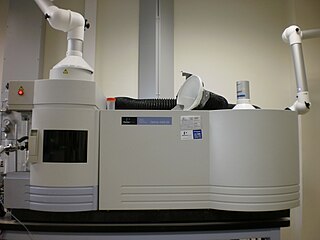
Atomic emission spectroscopy (AES) is a method of chemical analysis that uses the intensity of light emitted from a flame, plasma, arc, or spark at a particular wavelength to determine the quantity of an element in a sample. The wavelength of the atomic spectral line in the emission spectrum gives the identity of the element while the intensity of the emitted light is proportional to the number of atoms of the element. The sample may be excited by various methods.

Peroxide fusion is used to prepare samples for inductively coupled plasma (ICP), atomic absorption (AA) analysis and wet chemistry. Sodium peroxide (Na2O2) is used to oxidize the sample that becomes soluble in a diluted acid solution. This method allows complete dissolution of numerous refractory compounds like chromite, magnetite, ilmenite, rutile, and even silicon, carbides, alloys, noble metals and materials with high sulfide contents.

Compounds of lead exist with lead in two main oxidation states: +2 and +4. The former is more common. Inorganic lead(IV) compounds are typically strong oxidants or exist only in highly acidic solutions.
The term "lignin characterization" refers to a group of activities within lignin research aiming at describing the characteristics of a lignin by determination of its most important properties. Most often, this term is used to describe the characterization of technical lignins by means of chemical or thermo-chemical analysis. Technical lignins are lignins isolated from various biomasses during various kinds of technical processes such as wood pulping. The most common technical lignins include lignosulphonates, kraft lignins, organosolv lignins, soda lignins and lignin residue after enzymatic treatment of biomass.

Thulium(III) nitrate is an inorganic compound, a salt of thulium and nitric acid with the chemical formula Tm(NO3)3. The compound forms dark-green crystals, readily soluble in water, also forms crystalline hydrates.
