
Fejervarya is a genus of frogs in the family Dicroglossidae found in Asia. First proposed in 1915 by István József Bolkay, a Hungarian naturalist, the genus did not see widespread adoption at first. As late as the 1990s it was generally included in Rana, but more recent studies have confirmed its distinctness.
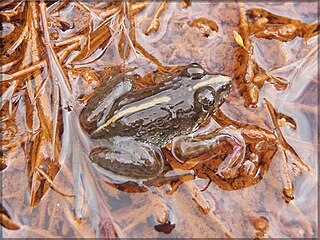
Minervarya greenii is a species of frog that is endemic to the hills of central Sri Lanka. It lives in wetland habitats within montane tropical moist forests. It is threatened by habitat loss, pollution, desiccation of wetlands, forest fires as well as predation by introduced rainbow trout.

Minervarya keralensis is a species of frog from India. Originally described by Albert Günther in 1876, its present-day specific epithet, keralensis, meaning "of Kerala", was introduced as replacement name by Alain Dubois in 1981.

Minervarya nepalensis is a small-sized frog native to northern and northeastern India, Bangladesh, and Nepal. It has recently been reported also from Bhutan. Having distinct and narrow middorsal line (MDL); indistinct skin fringe on outer side of 5th toe; relative finger length (RFL) is 2<1<4<3, 1st finger scarcely longer than 2nd; laterally dark and medially pale throat in males; body tubercles oblong, arranged in longitudinal folds; and snout jutting over jaw.
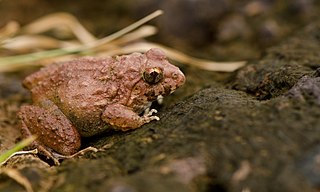
Minervarya rufescens is a species of frog that is endemic to the Western Ghats, India. It occurs in Maharashtra, Karnataka, Goa, and Kerala states. It is a locally common species associated with riparian and forest edge habitats in open and lightly degraded tropical moist semi-evergreen forests.
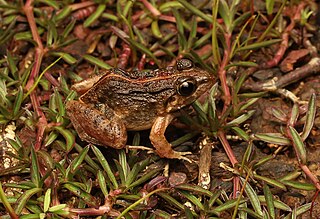
Minervarya syhadrensis, commonly known as long-legged cricket frog, Syhadra frog, Bombay wart frog, and many others, is a species of frog in the family Dicroglossidae found in India, Bangladesh, and Nepal at low to moderate elevations. It is the type species of genus Minervarya. In view of its wide distribution and stable population trend, IUCN assessors listed it as Least Concern in 2009 and 2016.

Minervarya teraiensis is a species of frog that is found in southern Nepal, adjacent Sikkim and northeastern India, and southeastern and central Bangladesh. It has recently been reported also from Bhutan. It is a common species associated with open grasslands, often found close to permanent pools and streams.
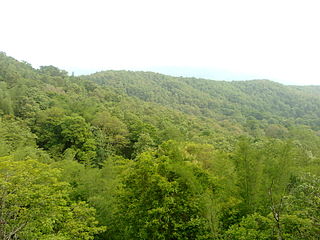
Parambikulam Tiger Reserve, which also includes the erstwhile Parambikulam Wildlife Sanctuary, is a 643.66 square kilometres (248.5 sq mi) protected area lying in Palakkad district and Thrissur district of Kerala state, South India. The Wildlife Sanctuary, which had an area of 285 square kilometres (110 sq mi) was established in part in 1973 and 1984. It is in the Sungam range of hills between the Anaimalai Hills and Nelliampathy Hills. Parambikulam Wildlife Sanctuary was declared as part of the Parambikulam Tiger Reserve on 19 February 2010. Including the buffer zone, the tiger reserve has a span of 643.66 km2. The Western Ghats, Anamalai Sub-Cluster, including all of Parambikulam Wildlife Sanctuary, has been declared by the UNESCO World Heritage Committee as a World Heritage Site. The Tiger Reserve is the home of four different tribes of indigenous peoples including the Kadar, Malasar tribe, Muduvar and Mala Malasar settled in six colonies. Parambikulam Tiger Reserve implements the Project Tiger scheme along with various other programs of the Government of India and the Government of Kerala. The operational aspects of administering a tiger reserve is as per the scheme laid down by the National Tiger Conservation Authority. People from tribal colonies inside the reserve are engaged as guides for treks and safaris, and are provided employment through various eco-tourism initiatives. Parambikulam Tiger Reserve is among the top-ten best managed Tiger Reserve in India. The tiger reserve hosts many capacity building training programmes conducted by Parambikulam Tiger Conservation Foundation in association with various organisations.

Minervarya kirtisinghei is a species of frog in the family Dicroglossidae. It is endemic to Sri Lanka where it is found in the montane south-central to lowland southwestern areas.

Minervarya pierrei is a species of frog in the family Dicroglossidae. It is found in Nepal, adjacent India, and eastern Bangladesh. It has recently been reported also from Bhutan. It is a common species associated with paddy fields.

Minervarya sahyadris, also known as the small cricket frog, is a species of frog in the family Dicroglossidae. It is endemic to central Western Ghats of kerala& Karnataka in India.
Minervarya is a genus of frogs in the family Dicroglossidae from south Asia, and Nepal and Bhutan. They are also known as cricket frogs or rice frogs.
Minervarya charlesdarwini is a species of frogs in the family Dicroglossidae. It is endemic to the Andaman Islands, India, and is known from the South Andaman Island, Long Island, and North Andaman Island.

The frog family Dicroglossidae occurs in tropical and subtropical regions of Asia and Africa, with most genera and species being found in Asia. The common name of the family is fork-tongued frogs.
Minervarya asmati is a species of frogs found in the Chittagong and Dhaka, Bangladesh. Its type locality is on the University of Chittagong campus. It was described by Mohammad Sajid Ali Howlader in 2011.
Minervarya marathi is a species of frog native to Maharashtra, India. They live near areas of water like paddy fields and also grasslands. The species was discovered by researchers from the Zoological Survey of India and Savitribai Phule Pune University.

Bangavax, also known as Bancovid, is a COVID-19 vaccine candidate developed by a Bangladeshi pharmaceutical company Globe Biotech Limited. The vaccine was initially called Bancovid. On 23 November 2021, Globe Biotech has received ethical authorization from the Bangladesh Medical Research Council to conduct the first human trial.
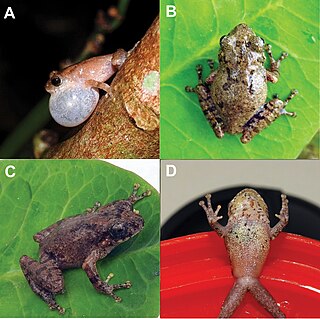
Raorchestes rezakhani is a species of cryptic bush frog from northeastern Bangladesh. It has been observed in habitats containing evergreen trees.
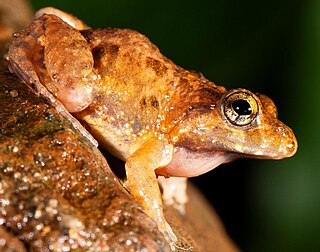
Minervarya pentali, or Pental's Minervaryan frog, is a species of frog in the fork-tongued frog family, Dicroglossidae. It is endemic to the Western Ghats in India.

Minervarya gomantaki, previously in the genus Fejervarya, is a species of frog, endemic to the Western Ghats region of India. It is also known as the Goan cricket frog or the Gomantak white lipped cricket Frog.
