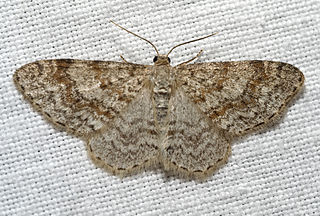
Larentiinae is a subfamily of moths containing roughly 5,800 species that occur mostly in the temperate regions of the world. They are generally considered a subfamily of the geometer moth family (Geometridae) and are divided into a few large or good-sized tribes, and numerous very small or even monotypic ones which might not always be valid. Well-known members are the "pug moths" of the Eupitheciini and the "carpets", mainly of the Cidariini and Xanthorhoini. The subfamily was described by Philogène Auguste Joseph Duponchel in 1845.

Mocis frugalis, the sugarcane looper, is a moth of the family Erebidae. The species was first described by Johan Christian Fabricius in 1775. It is found in several parts of the world, including India, Sri Lanka, West African countries and other Oriental regions. The adult is a fruit piercer and a major pest of crops.
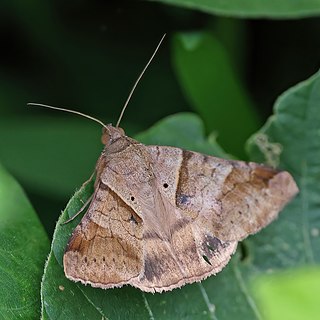
Mocis undata, the brown-striped semilooper, is a moth of the family Erebidae. The species was first described by Johan Christian Fabricius in 1775. It is found in the Afrotropical and Oriental regions, including India and Sri Lanka.

Camptogramma bilineata, the yellow shell, is a colourful moth of the family Geometridae. The species was first described by Carl Linnaeus in his 1758 10th edition of Systema Naturae. It can be found in Europe and east across the Palearctic to the Altai Mountains.
Camptogramma is a genus of moths in the family Geometridae erected by James Francis Stephens in 1831. It is considered by some to be a synonym of Euphyia.

Orthonama obstipata, the gem, is a moth of the family Geometridae. The species was first described by Johan Christian Fabricius in 1794. It is a cosmopolitan species. In continental Europe though in the northeast, its range does not significantly extend beyond the Baltic region and it is absent from northern Russia. This well-flying species is prone to vagrancy and able to cross considerable distances of open sea; it can thus be regularly found on the British Isles and even on Iceland.
Mocis proverai is a moth of the family Erebidae first described by Alberto Zilli in 2000. It is found in Africa and the Arabian Peninsula.

Mocis is a genus of moths in the family Erebidae. The genus was erected by Jacob Hübner in 1823.

Mocis disseverans, the yellow mocis moth, is a moth of the family Erebidae. It is found in the Caribbean and parts of the southern United States, including Mississippi, Florida and Texas.
Mocis diffluens is a moth of the family Erebidae. It is found from Mexico south through Central America to South America as well as on the Antilles.

Mocis trifasciata is a moth of the family Erebidae. It is found in the south-west Pacific region, including Samoa, Fiji, Hawaii, New Zealand, the Society Islands and Queensland.
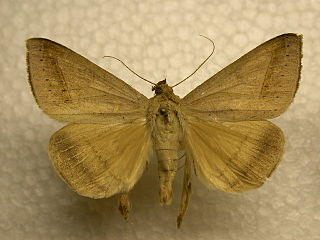
Mocis marcida, the withered mocis, is a species of moth of the family Erebidae. It is found from the coast of North Carolina to Florida, west to Texas, rarely straying northward as far as New York.

Mocis repanda, the striped grass looper, is a species of moth of the family Erebidae. It was described by Johan Christian Fabricius in 1794. It is found in Central America and the Caribbean, including Cuba, the Dominican Republic, Guadeloupe, Guatemala, Jamaica, Puerto Rico and Saint Thomas. Strays can be found in the United States, up to southern Texas as well as subtropical Africa south of the Sahara, including the islands of the Indian Ocean.
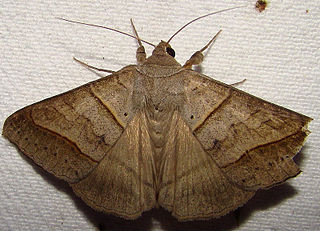
Mocis texana, the Texas mocis, is a species of moth of the family Erebidae. It is found in eastern North America, from southern Ontario, south to Florida, west to Texas to Minnesota.

Xanthorhoini is a tribe of geometer moths under subfamily Larentiinae. The tribe was described by Pierce in 1914.
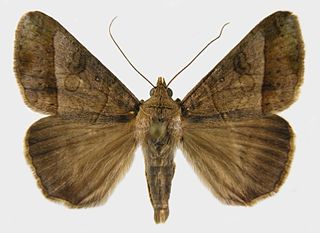
Mocis latipes, the small mocis moth or striped grass looper, is a species of moth of the family Erebidae. It is found from North America (from southern Ontario and Quebec to Florida, west to Arizona, north to Minnesota and south through Central to South America.

Mocis mayeri is a species of moth in the family Erebidae first described by Jean Baptiste Boisduval in 1833. It has a wide range in Africa, which includes Cameroon, Cape Verde, the Comoros, the Democratic Republic of the Congo, Eritrea, Ghana, Kenya, Réunion, Madagascar, Malawi, Mauritius, Mozambique, Nigeria, Senegal, the Seychelles, Sierra Leone, South Africa, Sudan, Tanzania, the Gambia, Uganda, Zambia and Zimbabwe. It is also found in Saudi Arabia and Yemen.
Mocis mutuaria is a species of moth of the family Erebidae. It is found in the Democratic Republic of Congo, Kenya, Madagascar, Malawi, Mozambique, Namibia, Nigeria, Rwanda, South Africa, Tanzania, Uganda, Zambia and Zimbabwe.
Aroga camptogramma is a moth of the family Gelechiidae. It is found in North America, where it has been recorded from Texas and Arizona.

