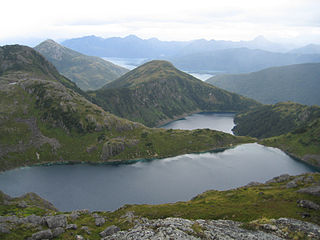
The Chugach Mountains of southern Alaska are the northernmost of the several mountain ranges that make up the Pacific Coast Ranges of the western edge of North America. The range is about 250 miles (402 km) long and 60 miles (97 km) wide, and extends from the Knik and Turnagain Arms of the Cook Inlet on the west to Bering Glacier, Tana Glacier, and the Tana River on the east. It is bounded on the north by the Matanuska, Copper, and Chitina rivers. The highest point of the Chugach Mountains is Mount Marcus Baker, at 13,094 feet (3,991 m), but with an average elevation of 4,006 feet (1,221 m), most of its summits are not especially high. Even so, its position along the Gulf of Alaska ensures more snowfall in the Chugach than anywhere else in the world, an annual average of over 1500 cm (800 in).
The Advisory Committee on Antarctic Names is an advisory committee of the United States Board on Geographic Names responsible for recommending commemorative names for features in Antarctica.

The Wenatchee Mountains are a range of mountains in central Washington State, United States of America. A major subrange of the Cascade Range, extending east 50 miles (80 km) from the Cascade crest, the Wenatchee Mountains separate the drainage basins of the Yakima River from the Wenatchee River. The crest of the range forms part of the boundary between Chelan and Kittitas Counties.

The Neptune Range is a mountain range, 112 km (70 mi) long, lying WSW of Forrestal Range in the central part of the Pensacola Mountains in Antarctica. The range is composed of Washington Escarpment with its associated ridges, valleys and peaks, the Iroquois Plateau, and the Schmidt and Williams Hills. It was discovered and photographed on 13 January 1956 on a US Navy transcontinental plane flight from McMurdo Sound to Weddell Sea and return.
The Churchill Mountains are a mountain range group of the Transantarctic Mountains System, located in the Ross Dependency region of Antarctica. They border on the western side of the Ross Ice Shelf, between Byrd Glacier and Nimrod Glacier.
The Prince Olav Mountains is a mountain range of the Queen Maud Mountains in Antarctica stretching from Shackleton Glacier to Liv Glacier at the head of the Ross Ice Shelf.

The Usarp Mountains are a major Antarctic mountain range, lying west of the Rennick Glacier and trending north to south for about 190 kilometres (118 mi). The feature is bounded to the north by Pryor Glacier and the Wilson Hills.
The Cutler River is a stream located in the White Mountains of New Hampshire in the United States.
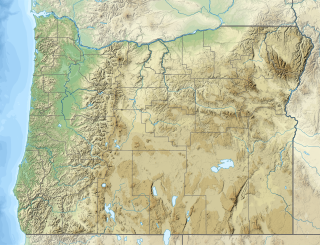
Mount Ireland is a mountain in Grant County of the U.S. state of Oregon. It is about 5 miles (8 km) east-northeast of Granite, Oregon. It is the shortest and westernmost 8000'+ peak in the Elkhorn Range of the Blue Mountains at 8,321 feet (2,536 m), and Oregon's 71st highest peak with at least a 500' clean prominence. For a period of several years, this mountain peak was referred to as Bald Mountain, but in 1917 it was changed to Ireland Mountain--in commemoration of the late Henry Ireland, who for 10 years was supervisor of the Whitman National Forest in which the mountain is located--before formally becoming known as Mount Ireland. The name change was brought about by a cooperative effort of local citizens and the US Forest Service to honor Henry Ireland, who had died in 1916.

The canyons of the Teton Range lie almost entirely within Grand Teton National Park in the U.S. state of Wyoming. Ranging from 9 miles (14 km) to less than 1 mile (1.6 km) in length and up to 6,000 feet (1,800 m) deep, the canyons were carved primarily by glaciers over the past 250,000 years. The canyons in the Teton Range descend in altitude generally west to east and many have lakes at their outlets. The lakes were created by terminal moraines left behind by the now retreated glaciers. A few of the canyons have small glaciers that were created mostly during the Little Ice Age (1550-1850). Fast retreating Schoolroom Glacier is a tiny glacier located at the head of the South Cascade Canyon. Most of the canyons have streams from which rain and snowmelt flow towards Jackson Hole valley, and due to the sometimes rapid altitude descent, waterfalls are common. The canyons offer the easiest hiking access into the Teton Range.

Mount Valhalla, elevation (12,135 ft), is a glaciated summit located 34 mi (55 km) northwest of Valdez in the Chugach Mountains of the U.S. state of Alaska. It's set on land managed by Chugach National Forest. This remote mountain, fourth-highest in the Chugach range, is situated 6 mi (10 km) northeast of Mount Witherspoon, and 7.1 mi (11 km) north of Mount Einstein. It is named after Valhalla, the seat of the gods in Norse mythology. The mountain was named in 1957 by Lawrence E. Nielsen because the peak is "a fitting throne of the gods." Nielsen was a member of the first ascent party on July 1, 1957. The mountain's name was officially adopted in 1965 by the U.S. Board on Geographic Names.

Lake Valhalla is a glacial lake located in the Okanogan-Wenatchee National Forest of the state of Washington. Positioned adjacent to the Pacific Crest Trail, the lake and its surrounding areas are popular for hiking, climbing and other recreational activities.
Lichtenberg Mountain is a 5,844-foot (1,781-metre) mountain summit located 2.8 miles (4.5 km) north of Stevens Pass in the Okanogan-Wenatchee National Forest of the U.S state of Washington. It rises steeply above the east shore of Lake Valhalla, and less steeply above the west shore of Lichtenwasser Lake. Surface runoff from the mountain drains into tributaries of Nason Creek which in turn is a tributary of the Wenatchee River


