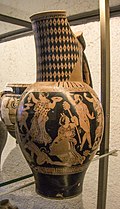
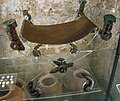
The National Archaeological Museum of Cerveteri (also known as the National Museum of Cerveteri (Italian: Museo Nazionale Cerite) or the Archaeological Museum of Cerveteri) is the archaeological museum of the city of Cerveteri, in the Metropolitan City of Rome Capital area in northern Lazio. It is dedicated to Etruscan art, primarily from the necropolises of the ancient Etruscan city of Caere, including that of Banditaccia. It is housed in the Ruspoli Castle in the historic centre of the city overlooking Piazza Santa Maria, and is named after Princess Claudia Ruspoli.[2]
Since December 2014, the Italian Ministry of Culture has managed the museum through the Polo Museale del Lazio (Museum Centre of Lazio), which became the Regional Museum Directorate in December 2019.
Collections
Its collections, structured on two levels, primarily include thematic displays on the remains of the ancient city's numerous necropolises: the Villanovan period for the Sorbo burial ground; the Hellenistic period: the Tasmie tomb and the Banditaccia sarcophagi tomb; various bucchero ceramics, amphorae, funerary vases, and even some figurative sarcophagus lids (original or reproduced). Notable pieces from these archaeological areas are also preserved at the National Etruscan Museum in the Villa Giulia in Rome, and the Louvre in Paris.
Since 2015, the museum has housed two extraordinary finds: the Euphronios Krater and Euphronios Kylix. These are two Atticred-figure pottery pieces from the late 6th century BC, magnificent examples of the finest Athenian ceramic production. Both vases were stolen during illegal excavations in the Cerveteri area and taken abroad, where they were long exhibited: the Krater at the Metropolitan Museum of Art in New York and the Kylix at the Getty Villa in Malibu. Finally returned to the Italian state, after an initial placement in the National Etruscan Museum, the two masterpieces were permanently relocated to the National Archaeological Museum of Cerveteri.
↑"Museo Archeologico Nazionale Cerite"[National Archaeological Museum of Cerveteri]. PACT - Parco Archeologico di Cerveteri e Tarquinia (in Italian). Retrieved 4 December 2025.
Further reading
M. Pallottino, La necropoli di Cerveteri, Roma 1939;
B. Pace et al., Caere. Scavi di R. Mengarelli, Monumenti Antichi dei Lincei, XLII, 1955;
AA.VV., Cerveteri. Scavi della Banditaccia, Notizie degli Scavi, 1955, 46–113;
F. Prayon, Früetruskische Grab- und Hausarchitektur, Heidelberg 1975;
M. Moretti, Cerveteri, Roma 1977;
F. Enei, La via degli Inferi, Archeologia, 1985, 11–14;
G. Proietti, Cerveteri, Roma 1986;
M. Cristofani et al., Caere 1. Il parco archeologico, Roma 1988;
M. Cristofani, Cerveteri. Tre itinerari archeologici, Roma 1991;
M. Cristofani et al., Caere 3.1. Lo scarico arcaico della Vigna Parrocchiale, Roma 1992;
M. Cristofani et al., Caere 3.2. Lo scarico arcaico della Vigna Parrocchiale, Roma 1993;
R. Cosentino, Cerveteri e il suo territorio, Roma 1995;
A.M. Moretti Sgubini, Veio, Cerveteri, Vulci. Città d'Etruria a confronto, Catalogo della Mostra, Roma 2001;
M. Cristofani et al., Caere 4. Vigna Parrocchiale: scavi 1983–1989. Il santuario, la 'residenza' e l'edificio ellittico, Roma 2003;
L. Drago, Cerveteri, Roma 2006;
M. Torelli, A.M. Sgubini Moretti, Etruschi. le antiche metropoli del Lazio, Catalogo della Mostra, Milano 2008;
AA.VV., Munera Ceretana in ricordo di Mauro Cristofani, Mediterranea, V, 2008.
External links
"Museo Archeologico Nazionale Cerite"[National Archaeological Museum of Cerveteri]. PACT - Parco Archeologico di Cerveteri e Tarquinia (in Italian). Retrieved 4 December 2025.
This page is based on this Wikipedia article Text is available under the CC BY-SA 4.0 license; additional terms may apply. Images, videos and audio are available under their respective licenses.