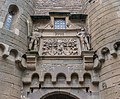
Neuenstein Castle

Last updated
Neuenstein Castle, winter 2006 Neuensteinschloss.jpg
Neuenstein Castle, winter 2006

Neuenstein Castle (German : Schloss Neuenstein) is a castle in the middle of the town of Neuenstein. Built as the seat of the Hohenlohe-Neuenstein noble family, it now houses a castle museum and, with the Neuenstein Hohenlohe Central Archives, the shared house archive of the House of Hohenlohe, which is looked after by the State of Baden-Württemberg. [1]

Contents

History

Colored wood engraving, Otto Baisch [de], 1880 Otto Baisch, Schloss Neuenstein (Hohenlohe), 1880.jpg
Colored wood engraving, Otto Baisch  [ de ], 1880

The origins of the present castle can be found in a Hohenstaufen moated castle from the early 13th century. It stood on a sandbank in a swampy area near an old long-distance trade route that led from the Rhine via Wimpfen east to the Danube.

Aerial view, 2015 Schloss Neuenstein 2015-09-06.JPG
Aerial view, 2015

Around 1230, the complex was owned by the Lords of Stein, whose descendants later called themselves "von Neuenstein". Around 1300, the Neuenstein estate came to the House of Hohenlohe, which still owns the castle today. Gottfried von Hohenlohe, who lived at Weikersheim Castle, was a follower of Emperor Frederick II and tutor to his son Conrad IV. He allegedly survived a murder plot in Regensburg in 1250, the mastermind of which was Albert I, the Bishop of Regensburg. King Konrad gave Gottfried fiefdoms in Regensburg in gratitude for his help. This also included the bailiwick of the canons' monastery of Öhringen, founded in 1037, as well as the castles and manors in Neuenstein and Waldenburg. The different castles were divided many times between the respective generations. Louis Casimir, Count of Hohenlohe-Neuenstein (1517–1568) founded the Neuenstein line (with the possessions of Langenburg, Ingelfingen, Öhringen and Kirchberg), one of the two main lines of the House of Hohenlohe that still exist today; the other (the Waldenburg line) was founded by his half-brother Eberhard, Count of Hohenlohe-Waldenburg (1535–1570) (with Waldenburg, Bartenstein and Schillingsfürst) in the main state division of 1551. [2] After the complex had already been expanded in the 15th century, [3] Count Louis Casimir had the castle redesigned into a castle in the Renaissance style by the Heilbronn master builder Balthasar Wolff. [4] [5] The expansion lasted until the beginning of the 17th century. [6]

After Wolfgang Julius von Hohenlohe-Neuenstein died in 1698, the family moved their residence to Öhringen to the former canons' monastery, which was renovated in baroque style in keeping with contemporary taste. Neuenstein Castle subsequently stood empty and rapidly fell into disrepair. Later it served as a breeding and workhouse, a retirement home and an orphanage. [7]

1800 to present

The castle, 2018 Neuenstein Castle.jpg
The castle, 2018

From 1870 onwards, renovation work was carried out in the Imperial Hall in order to then lay the foundation for a family museum of the House of Hohenlohe with a collection of antiques from Kirchberg Castle. [8] It was one of the first private museums in Germany and was open to the public from 1878. [6]

At the beginning of the 20th century, Prince Christian Kraft Herzog zu Hohenlohe-Öhringe commissioned the architect and castle researcher Bodo Ebhardt to carry out a comprehensive restoration of the castle. [9] The work took place between 1906 and 1925. [6] In the course of this, the complex was expanded by another floor, which, as a new building, enabled greater living comfort than the Renaissance floors. After the expropriation of their Silesian residence Sławięcice Palace in 1945 and the sales of the Kirchberg and Ingelfingen castles in 1952 and Öhringen in 1961 (as well as the Friedrichsruhe hunting lodge in Zweiflingen in 2005), Neuenstein Castle is now both a museum and residence of the owner, Prince of Hohenlohe-Oehringen (b. 1933).

Architecture

The Renaissance style castle is a closed four-wing building with six floors. At its northwest corner stands the Romanesque keep of the former castle. Two further corners are occupied by high round towers. A bridge leads to the entrance, which is decorated with the coats of arms of Louis Casimir, Count of Hohenlohe-Neuenstein, and his wife Anna von Solms-Laubach. [10]

Related Research Articles

<span class="mw-page-title-main">Friedrich Ludwig, Prince of Hohenlohe-Ingelfingen</span> Prussian general (1746–1818)

Frederick Louis, Prince of Hohenlohe-Ingelfingen was a Prussian general.

<span class="mw-page-title-main">Hohenlohe-Kirchberg</span>

Hohenlohe-Kirchberg was a German County and later Principality located in northeastern Baden-Württemberg, Germany, around Kirchberg. It was ruled by a Protestant branch of the House of Hohenlohe.

<span class="mw-page-title-main">Hohenlohe-Waldenburg-Schillingsfürst</span>

Hohenlohe-Waldenburg-Schillingsfürst was a County, and later Principality in northeastern Baden-Württemberg, Germany. The name Hohenlohe derives from the castle of Hohenloch near Uffenheim in Mittelfranken, which came into the possession of the descendants of Conrad of Weikersheim by 1178.

<span class="mw-page-title-main">Hohenlohe-Langenburg</span> Former German county of northeastern Baden-Württemberg

Hohenlohe-Langenburg was a German county and later principality in the Holy Roman Empire. It was located around Langenburg in what is now northeastern Baden-Württemberg, Germany. Starting in medieval times and continuing until 1806, this small state was ruled by a branch of the House of Hohenlohe, first as lords, then as counts and ultimately as ruling princes of the Holy Roman Empire after 1764. The princely House of Hohenlohe-Langenburg still owns and lives in Langenburg Castle today.

<span class="mw-page-title-main">Hohenlohe</span> German princely dynasty

The House of Hohenlohe is a German princely dynasty. It formerly ruled an immediate territory within the Holy Roman Empire, which was divided between several branches. In 1806, the area of Hohenlohe was 1,760 km² and its estimated population was 108,000. The motto of the house is Ex flammis orior. The Lords of Hohenlohe were elevated to the rank of Imperial Counts in 1450, and from 1744, the territory and its rulers were princely. In 1825, the German Confederation recognized the right of all members of the house to be styled as Serene Highness, with the title of Fürst for the heads of its branches, and the title of prince/princess for the other members. From 1861, the Hohenlohe-Öhringen branch was also of ducal status as dukes of Ujest.

<span class="mw-page-title-main">Öhringen</span> Town in Baden-Württemberg, Germany

Öhringen is the largest town in Hohenlohe (district) in the state of Baden-Württemberg, in southwest Germany, near Heilbronn. Öhringen is on the railline to Schwäbisch Hall and Crailsheim.

<span class="mw-page-title-main">Neuenstein, Baden-Württemberg</span> Town in Baden-Württemberg, Germany

Neuenstein is a town in the Hohenlohe district, in Baden-Württemberg, Germany. It is situated 12 km southwest of Künzelsau, and 27 km east of Heilbronn.
<span class="mw-page-title-main">Castle Road</span> Theme route in Germany and the Czech Republic

The Castle Road is a theme route in southern Germany and a small portion in the Czech Republic, between Mannheim and Prague.

<span class="mw-page-title-main">Kupferzell</span> Municipality in Baden-Württemberg, Germany

Kupferzell is a small German town in the district of Hohenlohe in Baden-Württemberg, Germany named after the Kupfer river flowing through it. The largest neighbouring towns are Künzelsau and Schwäbisch Hall.

Hohenlohe is a German princely family and a district in Baden-Württemberg, Germany.

Friedrich Karl Wilhelm, Fürst (prince) zu Hohenlohe-Ingelfingen was a general in the military service of the House of Habsburg during the French Revolutionary Wars and the Napoleonic Wars. He was born in Ingelfingen, in southwest Germany, on 16 February 1752.

<span class="mw-page-title-main">Johann Friedrich II of Hohenlohe-Öhringen</span> German noble

Johann Friedrich II (1683–1764) was a ruler of the principality of Hohenlohe-Öhringen from 1708 to 1764 and prince from 1764.
<span class="mw-page-title-main">August, Prince of Hohenlohe-Öhringen</span> Prince of Hohenlohe-Öhringen

Frederick August Charles, Prince of Hohenlohe-Öhringen was a German general of the Napoleonic Wars and nobleman of the house of Hohenlohe.

Sophie Amalie Caroline of Saxe-Hildburghausen, was a princess of Saxe-Hildburghausen and by marriage Princess of Hohenlohe-Neuenstein-Oehringen.
<span class="mw-page-title-main">Henry Frederick, Count of Hohenlohe-Langenburg</span>

Henry Frederick, Count of Hohenlohe-Langenburg was the youngest child of Count Philip Ernest of Hohenlohe-Langenburg and his wife Countess Anna Maria of Solms-Sonnewalde.

Wolfgang, Count of Hohenlohe-Weikersheim was the first Count of Hohenlohe-Weikersheim. He was the son of Louis Casimir of Hohenlohe-Waldenburg, who styled himself Count of Neuenstein, Langenburg, Weikersheim, Künzelsau, Kirchberg and Ingelfingen and his wife, Anna of Solms-Lich.

<span class="mw-page-title-main">Hugo zu Hohenlohe-Öhringen</span> 4th Prince of Hohenlohe-Öhringen

Friedrich Wilhelm Eugen Karl Hugo, Prince of Hohenlohe-Öhringen, Duke of Ujest was a German nobleman, politician, mining industrialist and general in the armies of the kingdom of Württemberg and the kingdom of Prussia.

<span class="mw-page-title-main">Sławięcice Palace</span> Historic palace in Upper Silesia, Poland

Schloss Slawentzitz was a stately home in Sławięcice, in the historic Silesia region in Poland. It served as the main residence of the princes of Hohenlohe-Öhringen, a branche of the House of Hohenlohe. It was heavily damaged in the Second World War and has subsequently been demolished. Only a portico remains.

Hans Heinrich Georg Herzog, Prince of Hohenlohe-Oehringen, Duke of Ujest was a German nobleman and diplomat.

References

  1. Röhl, John C. G. (19 August 2004). Wilhelm II: The Kaiser's Personal Monarchy, 1888-1900. Cambridge University Press. p. 1172. ISBN   978-0-521-81920-6 . Retrieved 16 January 2024.
  2. Schultz, Nancy Lusignan (26 April 2011). Mrs. Mattingly's Miracle: The Prince, The Widow, and the Cure That Shocked Washington City. Yale University Press. p. 85. ISBN   978-0-300-17170-9 . Retrieved 16 January 2024.
  3. Osten, Gert von der; Vey, Horst (1969). Painting and Sculpture in Germany and the Netherlands, 1500 to 1600. Penguin. p. 257. ISBN   978-0-14-056031-2 . Retrieved 16 January 2024.
  4. Das Königreich Württemberg: eine Beschriebung von Land, Volk und Staat (in German). W. Kohlhammer. 1884. p. 282. Retrieved 16 January 2024.
  5. Baedeker (Firm), Karl (1925). Württemberg und Hohenzollern: schwäbische Alb, Bodensee, Württembergischer Schwarzwald. Handbuch für Reisende (in German). K. Baedeker. p. 42. Retrieved 16 January 2024.
  6. 1 2 3 "Schloss Neuenstein". www.fuersthohenlohe.de (in German). Fürst zu Hohenlohe-Oehringen. Retrieved 16 January 2024.
  7. Todd, Charles Burr (1896). "German Castles--VII | The Palace". The American Architect and Building News. James R. Osgood & Company: 51–53. Retrieved 16 January 2024.
  8. Hudson, Kenneth; Nicholls, Ann (18 June 1985). The Directory of Museums & Living Displays. Springer. p. 368. ISBN   978-1-349-07014-5 . Retrieved 16 January 2024.
  9. Württembergische Vierteljahrshefte für Landesgeschichte (in German). W. Kohlhammer. 1920. p. 200. Retrieved 16 January 2024.
  10. Schiffer, Peter (2003). Zum ewigen Gedächtnis: Beiträge einer Arbeitstagung des Württembergischen Landesmuseums Stuttgart ... (in German). Thorbecke. p. 34. ISBN   978-3-7995-7651-2 . Retrieved 16 January 2024.

49°12′15″N9°34′44″E / 49.2041°N 9.5788°E / 49.2041; 9.5788