North Face (Everest)

Last updated
North Face of Mount Everest Mount Everest North Face.jpg
North Face of Mount Everest

The North Face of Mount Everest is the northern aspect of the highest mountain in the world. [1] It can partly be seen from North Base Camp. George Mallory's body was found on the North Face during the 1999 Mallory and Irvine Research Expedition. [1] Major features of the face are the Hornbein Couloir and the Norton Couloir. Notable on the left end, the northeast ridge of Everest, are the Three Steps and the Three Pinnacles.

Contents

Views

Everest's North Face, lit up by the setting sun Everest Sunset memes 2008.JPG
Everest's North Face, lit up by the setting sun
View from the North Base Camp Everest North Face toward Base Camp Tibet Luca Galuzzi 2006.jpg
View from the North Base Camp
View from the northeast IMG 2124 Everest.jpg
View from the northeast

Routes

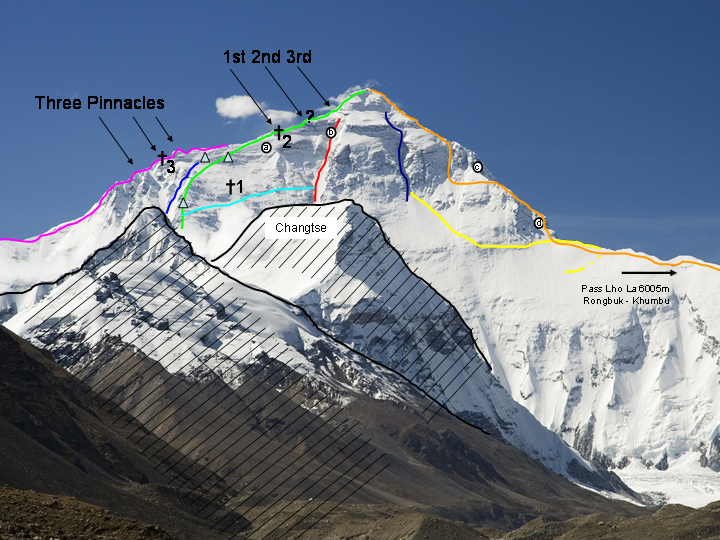
North face marked.png
  Green line
Standard route from north, mainly identical with Mallory's route in 1924; high camps on c.7700 m and 8300 m (indicated by two triangles), present day camp on 8300 m is located a bit further west (for general reference, the route's topographic map and elevation profile can be found here).
  Navy blue line
Zakharov Couloir.
  Light blue line
Messner's traverse from north ridge to Norton Couloir in 1980 ("Everest Solo by Fair Means") w/o O2.
  Red line
Great Couloir or Norton Couloir.
  Purple line
Complete northeast ridge with Three Pinnacles ; Japanese route to the top. Climbed before by Russell Brice & Comp., but only the purple-marked part of the ridge, without going to the summit; descent via standard route.
  Yellow line and
  Dark blue line
American 1963, "The West Ridge" on the 1963 American Mount Everest expedition.
  Orange line
Yugoslavian route, 1979.
  Dark blue line
Hornbein Couloir.
1Resting place of Mallory's body, discovered in 1999 (graveyard with more than 15 bodies, according to Conrad Anker).
21st Step, resting place of Francys Arsentiev, "Green Boots", David Sharp.
32nd Pinnacle, resting place of Peter Boardman (+1982) in 1992.
?2nd step, base at 8605 m, c.30 m high, (difficulty: 5–9/10).
(a)Point at ca. 8321 m, reached by George Ingle Finch with supplementary oxygen in 1922.
(b)Point at 8572.8 m on the western side of the Couloir, reached by Edward Felix Norton 1924 without supplementary oxygen (Norton preferred climbing the wall rather than climbing the ridge).
(c)Area left out by the Yugoslavian party on their "complete West Ridge" ascent in 1979.
(d)Difficult area that forced Americans, Tom Hornbein and Willi Unsoeld, to traverse from the west ridge to the north face in 1963.
Changtse is in the foreground

Location

Himalaya annotated.jpgSouth Col route
Southern and northern climbing routes as seen from the International Space Station. (The names on the photo are links to corresponding pages.)

View from above

View from above of all sides, including the northern face The World's Tallest Mountain (15473492788).jpg
View from above of all sides, including the northern face

See also

References

  1. 1 2 Dickinson, Matt (October 5, 2011). "The Other Side of Everest: Climbing the North Face Through the Killer Storm". Crown via Google Books.