This article's lead sectionmay be too short to adequately summarize the key points. Please consider expanding the lead to provide an accessible overview of all important aspects of the article.(November 2024)
The PSA PF1 platform is a global subcompact automobile platform originally developed by the French automaker PSA, now Stellantis. It has been the foundation for a wide range of B-segment (subcompact) cars produced since the early 2000s.[1]
The PF1 platform was designed to underpin small cars, offering flexibility to support various body styles such as hatchbacks, sedans, crossovers, and small vans. Its layout typically features a transverse front-engine, front-wheel-drive configuration, though some derivatives were engineered with all-wheel drive.[2]
While PF1 was primarily used for passenger vehicles, it also served as the basis for light commercial vehicles (LCVs), reflecting PSA’s strategy of maximizing economies of scale.[3]
Applications
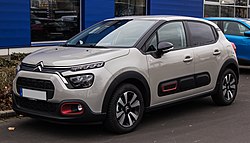
Vehicles based on the PF1 platform include several popular models across the Peugeot, Citroën, DS, Opel, and Vauxhall brands. Notable examples include:[4]
This widespread adoption made PF1 one of PSA’s most commercially important architectures for over a decade.[5]
Successor platforms
As automotive technology and regulatory requirements evolved, PF1 began to be phased out in favor of more modern and modular architectures. Its direct successor is the CMP (Common Modular Platform), co-developed by PSA and the Chinese manufacturer Dongfeng.[6] CMP supports both internal combustion engine (ICE) and electric powertrains (eCMP), enabling Stellantis brands to transition into electrification.
Larger PSA models during the PF1 era were based on the PF2 and PF3 platforms, covering compact and mid-size segments respectively.[3]
Legacy
The PF1 platform played a significant role in establishing PSA’s presence in key global markets, especially in Europe, South America, and select Asian regions. Its derivatives helped Peugeot and Citroën maintain strong positions in the subcompact market, a vital segment in terms of sales volume.[7]
↑"Bubbly fun in Citroën's C3". CARmag.co.za. 22 April 2012. Archived from the original on 19 April 2016. Retrieved 11 April 2016. The C3 is the first model to use PSA/Peugeot-Citroën's new small PF1 platform.
↑Flynn, Malcolm (13 March 2013). "PSA Planning Upmarket Peugeot Push, Citroen To Volume Sales". The Motor Report. Archived from the original on 15 March 2013. Retrieved 5 April 2013. Currently the Peugeot 207 and 208 share their PSA PF1 platform with the Citroen C3 and DS3, and the 308, 3008 and RCZ's PF2 platform with the C4, DS4, and DS5 models.
↑Bal, Claire (23 May 2014). "Citroen C4 Cactus brings Madrid factory back to life". Automotive News Europe. Retrieved 11 April 2016. Despite being a compact car, the Citroen C4 Cactus is underpinned by the PSA group's PF1 subcompact platform. Citroen says the small platform helps to keep the model light and makes it more fuel efficient. It is the same platform that underpins many other group models, including the C3, DS3 and Peugeot 207, 208 and 2008.
This page is based on this Wikipedia article Text is available under the CC BY-SA 4.0 license; additional terms may apply. Images, videos and audio are available under their respective licenses.