While the thermoelectric generator converts heat, a broad spectrum of phonon and electron energy, to electricity, the pV cell converts only a narrow band of phonon energy, i.e., only the most energetic optical phonon modes. A narrow band of excited optical phonons has much less entropy than heat. Thus, the pV cell can exceed the thermoelectric efficiency.[1][3] However, exciting and harvesting the optical phonon poses a challenge.
Satisfying the laws of thermodynamics
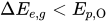
By the first law of thermodynamics, the excitation driving electron generation in both photo- and phonovoltaic cells, i.e., the photon or phonon, must have more energy than the semiconductorband gap.[1] For a PV cell, many materials are available with a band gap () well matched to the solar photon spectrum, like Silicon or Gallium Arsenide. For a pV cell, however, no current semiconducting materials have a band gap smaller than the energy of their most energetic (optical) phonon modes (). Thus, novel materials are required with both energetic optical phonon modes ( meV, e.g., graphene, diamond, or boron nitride) and a small band gap (, e.g., graphene).
By the second law of thermodynamics, the excitation must be "hotter" than the cell for power generation to occur. In a PV, the light comes from an outside source, for example, the sun, which is nearly 6000 kelvins, whereas the PV is around 300 kelvins. Thus, the second law is satisfied and energy conversion is possible. However, the crystal vibrations driving power generation in a pV are intrinsic to the material itself. As such, they can not be imported from an outside source like the sun, but must instead be excited by some other process until they are hotter than the cell. The temperature of the optical phonon population is calculated by comparing the number of optical phonon to the number expected at a given temperature, which comes from the Bose–Einstein statistics.
Non-equilibrium optical phonon population and the nanoscale requirement
Local and spatial thermal non-equilibrium for the optical phonon and electron populations ( and ) for variations in the length. If the distance (L) between excitation and collection is very small with respect to the cooling length (), the local non-equilibrium is much larger than the spatial non-equilibrium. The opposite occurs when the length is very large compared to the cooling length.
There are a number of ways to excite a population of vibrations, i.e., create a hot optical phonon population. For example, if the electron population is excited, using a laser or electric field, they will typically relax by emitting optical phonons. Additionally, a hot molecular gas can impart its vibrations to a crystal when chemisorbed. Regardless of method, the conversion efficiency is limited by the optical phonon temperature achieved as compared to the electron temperature within the device due to Carnot's theorem.
In a nanoscale device, this temperature is approximately equal to the temperature of the device itself.[1][4] However, in a macroscale device the generated electrons accumulate faster than they are collected. Thus, the electron population is heated up to the optical phonon temperature and further generation is inhibited. The down-conversion is simultaneously inhibited as the acoustic phonon population is heated to the optical phonon temperature. Thus, the large pV cell develops a near-equilibrium state where it is heated. At best, it will act like a thermoelectric generator and exhibit thermoelectric effects. Such a device is called a thermovoltaic,[5][6] rather than a phonovoltaic.
Entropy generation and efficiency
The efficiency of the phonovoltaic cell for variations in the figure of merit, Carnot limit, and band gap.
Entropy generation and inefficiency in a PV cell is the result of photons more energetic than the band gap producing electrons with kinetic energy in addition to the potential energy provided by the band gap. Similarly, optical phonon energy in excess of the band gap generates an entropy flow in the pV cell, rather than electric power. The energy efficiency () is quantified by the ratio of the band gap and optical phonon energy, that is[1]
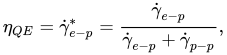
In addition this typical inefficiency, hot optical phonon populations tend to downconvert into multiple low-energy, acoustic phonon modes (whereas photons typically do not downconvert into low energy infrared waves). This efficiency () is quantified by the tendency of a hot optical phonon to downconvert rather than generate an electron-hole pair, that is[1]
where is the rate of generation and is the rate of downconversion, i.e., the rate at which an optical phonon produces multiple low-energy, acoustic phonons. This provides a second entropy flow reducing the efficiency of a pV cell.
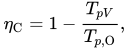
Finally, entropy is generated in both pV and PV cells due to the inefficient separation of the generated electrons and holes. This efficiency () is limited by the Carnot efficiency given by[1]
where is the temperature of the pV cell and is the temperature of the optical phonon population, as dictated by the Bose–Einstein statistics. This efficiency is reduced the smaller the band gap is in comparison to the thermal energy (, where is the Boltzmann constant and is the temperature). Indeed, the p-n junction efficiency is approximately[1]
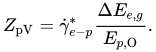
where the temperature independent terms become the material figure of merit (),[1]
If the band gap and optical phonon mode are resonant, and the optical phonon tends to generate electrons, the phonovoltaic cell can approach the Carnot limit as .
The electron-phonon coupling
Illustration of the electron-phonon coupling between valence and conduction states in real and momentum space.
The electron-phonon coupling is responsible for electron generation in the pV cell. In this phenomenon, the phonon leads to ion motion which perturbs the highest occupied valence state (HOS). This state begins to overlap with the lowest unoccupied conduction state (LUS), and the electron can switch states if energy and momentum are conserved. If it does, an electron-hole pair is generated.
Using a taylor expansion of the change in electron potential, , due to the ionic displacement of a phonon provides a matrix element for use in Fermi's golden rule, and the derivation of a generation rate. This Taylor expansion gives the following matrix element [7]
where is the energy of an electron in band i and momentum , is the corresponding electron occupation, and is the phonon occupancy.
The phonon-phonon coupling
Competing with the generation of electrons is the downconversion of optical phonons into multiple acoustic phonons. The coupling arises from the crystal Hamiltonian (H) expanded in terms of the ionic displacement () from the equilibrium position () of atom i in direction in direction, i.e.,[2][8]
where is the ground-state Hamiltonian, the linear term vanishes (as the ground state is found by minimizing the energy in terms of the ionic position), and and are the second- and third-order force constants between atoms i, j, and k when moved in along coordinate , , and . The second order term is primarily responsible for the phonon dispersion, while the anharmonic (third order and higher) terms are responsible for thermal expansion as well as the phonon up- (multiple low-energy optical phonons combine to form a high-energy phonon) and downconversion (a high-energy phonon splits into multiple low-energy phonons).
Typically, up- and down-conversion is dominated by the third-order interaction. Thus, the perturbation Hamiltonian used in Fermi's golden rule for phonon up- and downconversion is [9]
where is the direction of displacement for atom i due to the phonon. The resulting downconversion rate, from Fermi's golden rule, is
where two phonons are produced with polarization and and momentum and .
The suitability of graphene as a phonovoltaic material
The phonon energy and density of states for various semiconductors and semimetals.The band gap of various semiconductors and semimetals.
As outlined above, an efficient pV cell requires a material with an optical phonon mode more energetic than the bandgap, which in turn is much more energetic than the thermal energy at the intended operating temperature . Furthermore, the pV cell requires a material wherein a hot optical phonon prefers to produce an electron rather than multiple low energy acoustic phonons ().
Very few materials offer this combination of properties. Indeed, the vast majority of crystals have optical phonon energies limited to below 50 meV, and those with more energetic optical phonons tend to have much more energetic band gaps. In general, a material with a first-row element (periodic table) is required to have a highly energetic optical phonon. However, the high electronegativity of a first-row elements tends to create a very large band gap, as in diamond and the boron nitride allotropes.[10]Graphene is one of the few materials which diverges from this trend, with no bandgap and an exceptionally energetic optical phonon mode near 200 meV.[11][12] Thus, graphene has been the initial target for development of a phonovoltaic material through the opening and tuning of its bandgap.[13][3]
Opening and tuning the bandgap of graphene has received substantial attention, and numerous strategies have been suggested and investigated. These include the use of uniaxial strain,[14] electric fields,[15] and chemical doping and functionalization.[16] In general, these mechanisms work by either changing the symmetry of graphene (both Carbon atoms in the unit cell are identical) or hybridization ().
In the first phonovoltaic material investigations, it has been suggested that the latter technique destroys the electron-phonon coupling while the former preserves it.[13][3] In particular, these investigations predict that hydrogenating graphene, to produce graphane, reduces the electron-phonon coupling so substantially that the material figure of merit vanishes;[13] and that doping graphene with boron nitride maintains the strong electron-phonon coupling in graphene, such that its figure of merit is predicted to reach 0.65 and enable heat harvesting with twice the efficiency of a typical thermoelectric generator.[3]
In particle physics, the Dirac equation is a relativistic wave equation derived by British physicist Paul Dirac in 1928. In its free form, or including electromagnetic interactions, it describes all spin-1⁄2 massive particles such as electrons and quarks for which parity is a symmetry. It is consistent with both the principles of quantum mechanics and the theory of special relativity, and was the first theory to account fully for special relativity in the context of quantum mechanics. It was validated by accounting for the fine details of the hydrogen spectrum in a completely rigorous way.
In the special theory of relativity, four-force is a four-vector that replaces the classical force.
In the general theory of relativity, the Einstein field equations relate the geometry of spacetime to the distribution of matter within it.
In differential geometry, the Einstein tensor is used to express the curvature of a pseudo-Riemannian manifold. In general relativity, it occurs in the Einstein field equations for gravitation that describe spacetime curvature in a manner that is consistent with conservation of energy and momentum.
The rigid rotor is a mechanical model of rotating systems. An arbitrary rigid rotor is a 3-dimensional rigid object, such as a top. To orient such an object in space requires three angles, known as Euler angles. A special rigid rotor is the linear rotor requiring only two angles to describe, for example of a diatomic molecule. More general molecules are 3-dimensional, such as water, ammonia, or methane.
In differential geometry, the four-gradient is the four-vector analogue of the gradient from vector calculus.
In electromagnetism, the electromagnetic tensor or electromagnetic field tensor is a mathematical object that describes the electromagnetic field in spacetime. The field tensor was first used after the four-dimensional tensor formulation of special relativity was introduced by Hermann Minkowski. The tensor allows related physical laws to be written very concisely.
In quantum mechanics, the Hellmann–Feynman theorem relates the derivative of the total energy with respect to a parameter, to the expectation value of the derivative of the Hamiltonian with respect to that same parameter. According to the theorem, once the spatial distribution of the electrons has been determined by solving the Schrödinger equation, all the forces in the system can be calculated using classical electrostatics.
In continuum mechanics, the finite strain theory—also called large strain theory, or large deformation theory—deals with deformations in which strains and/or rotations are large enough to invalidate assumptions inherent in infinitesimal strain theory. In this case, the undeformed and deformed configurations of the continuum are significantly different, requiring a clear distinction between them. This is commonly the case with elastomers, plastically-deforming materials and other fluids and biological soft tissue.
A quasiprobability distribution is a mathematical object similar to a probability distribution but which relaxes some of Kolmogorov's axioms of probability theory. Quasiprobabilities share several of general features with ordinary probabilities, such as, crucially, the ability to yield expectation values with respect to the weights of the distribution. They can however violate the σ-additivity axiom: integrating them over does not necessarily yield probabilities of mutually exclusive states. Indeed, quasiprobability distributions also counterintuitively have regions of negative probability density, contradicting the first axiom. Quasiprobability distributions arise naturally in the study of quantum mechanics when treated in phase space formulation, commonly used in quantum optics, time-frequency analysis, and elsewhere.
In directional statistics, the Kent distribution, also known as the 5-parameter Fisher–Bingham distribution, is a probability distribution on the unit sphere. It is the analogue on S2 of the bivariate normal distribution with an unconstrained covariance matrix. The Kent distribution was proposed by John T. Kent in 1982, and is used in geology as well as bioinformatics.
The Newman–Penrose (NP) formalism is a set of notation developed by Ezra T. Newman and Roger Penrose for general relativity (GR). Their notation is an effort to treat general relativity in terms of spinor notation, which introduces complex forms of the usual variables used in GR. The NP formalism is itself a special case of the tetrad formalism, where the tensors of the theory are projected onto a complete vector basis at each point in spacetime. Usually this vector basis is chosen to reflect some symmetry of the spacetime, leading to simplified expressions for physical observables. In the case of the NP formalism, the vector basis chosen is a null tetrad: a set of four null vectors—two real, and a complex-conjugate pair. The two real members asymptotically point radially inward and radially outward, and the formalism is well adapted to treatment of the propagation of radiation in curved spacetime. The Weyl scalars, derived from the Weyl tensor, are often used. In particular, it can be shown that one of these scalars— in the appropriate frame—encodes the outgoing gravitational radiation of an asymptotically flat system.
There are various mathematical descriptions of the electromagnetic field that are used in the study of electromagnetism, one of the four fundamental interactions of nature. In this article, several approaches are discussed, although the equations are in terms of electric and magnetic fields, potentials, and charges with currents, generally speaking.
In physics, magnetization dynamics is the branch of solid-state physics that describes the evolution of the magnetization of a material.
In continuum mechanics, a compatible deformation tensor field in a body is that unique tensor field that is obtained when the body is subjected to a continuous, single-valued, displacement field. Compatibility is the study of the conditions under which such a displacement field can be guaranteed. Compatibility conditions are particular cases of integrability conditions and were first derived for linear elasticity by Barré de Saint-Venant in 1864 and proved rigorously by Beltrami in 1886.
In continuum mechanics, an Arruda–Boyce model is a hyperelastic constitutive model used to describe the mechanical behavior of rubber and other polymeric substances. This model is based on the statistical mechanics of a material with a cubic representative volume element containing eight chains along the diagonal directions. The material is assumed to be incompressible. The model is named after Ellen Arruda and Mary Cunningham Boyce, who published it in 1993.
The table of chords, created by the Greek astronomer, geometer, and geographer Ptolemy in Egypt during the 2nd century AD, is a trigonometric table in Book I, chapter 11 of Ptolemy's Almagest, a treatise on mathematical astronomy. It is essentially equivalent to a table of values of the sine function. It was the earliest trigonometric table extensive enough for many practical purposes, including those of astronomy. Centuries passed before more extensive trigonometric tables were created. One such table is the Canon Sinuum created at the end of the 16th century.
Heat transfer physics describes the kinetics of energy storage, transport, and energy transformation by principal energy carriers: phonons, electrons, fluid particles, and photons. Heat is energy stored in temperature-dependent motion of particles including electrons, atomic nuclei, individual atoms, and molecules. Heat is transferred to and from matter by the principal energy carriers. The state of energy stored within matter, or transported by the carriers, is described by a combination of classical and quantum statistical mechanics. The energy is different made (converted) among various carriers. The heat transfer processes are governed by the rates at which various related physical phenomena occur, such as the rate of particle collisions in classical mechanics. These various states and kinetics determine the heat transfer, i.e., the net rate of energy storage or transport. Governing these process from the atomic level to macroscale are the laws of thermodynamics, including conservation of energy.
The Optical Metric was defined by German theoretical physicist Walter Gordon in 1923 to study the geometrical optics in curved space-time filled with moving dielectric materials. Let ua be the normalized (covariant) 4-velocity of the arbitrarily-moving dielectric medium filling the space-time, and assume that the fluid’s electromagnetic properties are linear, isotropic, transparent, nondispersive, and can be summarized by two scalar functions: a dielectric permittivity ε and a magnetic permeability μ. Then optical metric tensor is defined as
In physics, relativistic angular momentum refers to the mathematical formalisms and physical concepts that define angular momentum in special relativity (SR) and general relativity (GR). The relativistic quantity is subtly different from the three-dimensional quantity in classical mechanics.
↑ da Silva, L. (2004). "Micro-thermoelectric cooler: interfacial effects on thermal and electrical transport". Int. J. Heat Mass Trans. 47 (10–11): 2417. doi:10.1016/j.ijheatmasstransfer.2003.11.024.
This page is based on this Wikipedia article Text is available under the CC BY-SA 4.0 license; additional terms may apply. Images, videos and audio are available under their respective licenses.