Related Research Articles
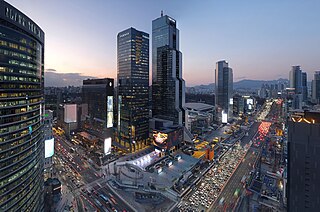
Gangnam District is one of the 25 districts of Seoul, South Korea. The term Gangnam translates to "South of the [Han] River". Gangnam District is the third largest district in Seoul, with an area of 39.5 km2 (15.3 sq mi). As of the 2024 census, Gangnam District had a population of 556,570. There is a high concentration of wealth in the district, with prices for an apartment as of 2024 more than double those in the rest of Seoul. Gangnam District is part of Gangnam School District Eight, along with the Seocho District. This district shares half of Gangnam-daero Gangnam Station area with Seocho District, which is one of the most crowded places in South Korea.
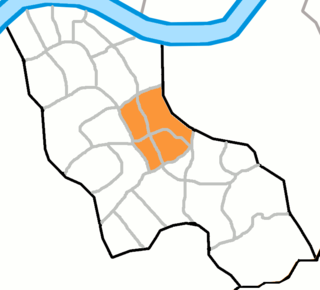
Daechi-dong (Korean: 대치동) is an affluent neighborhood in Gangnam District, Seoul, South Korea. Daechi-dong is divided into three different "dongs" which are Daechi 1-dong, 2-dong, and 4-dong. Daechi-dong is predominantly considered the residential area of Gangnam. As a result, real estate in the area is highly competitive and expensive compared to other parts of Gangnam. The Yangjaecheon is a stream that runs through the heart of Daechi-dong.

Seocho District is one of the 25 local government districts which make up the city of Seoul, South Korea. Seocho is a part of the Gangnam region, along with the Gangnam district of Seoul. Seocho District ranks as one of the richest neighborhoods in South Korea and among the most expensive areas in Seoul with an average sales price of 47.75 million South Korean won per 3.3 square meters. Many of the wealthiest residents are concentrated in the three Gangnam districts including Seocho, known as Gangnam School District Eight.
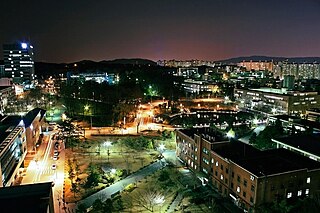
Nowon District (Nowon-gu) is a residential district of Seoul, South Korea, located in the most northeastern part of the metropolitan city. It has the highest population density in Seoul, with 619,509 people living in the area of 35.44 km².

Seongdong District (Seongdong-gu) is one of the 25 gu which make up the city of Seoul, South Korea. It is situated on the north bank of the Han River. It is divided into 20 dong (neighbourhoods).

Seocho-dong is a dong, or neighborhood of the greater Gangnam area Seocho-gu district of the South Korean city of Seoul. Seocho-dong is divided into 4 different dong which are Seocho 1-dong, 2-dong, 3-dong and 4-dong. The main street is Teheranno. There is Gangnam Station in Seocho-dong, which is one of the biggest stations in Korea.

Cheongdam-dong (Korean: 청담동) is a ward of Gangnam District, Seoul, South Korea. The area is best known in South Korea as an affluent neighborhood populated by a disproportionately high number of high-income individuals and for having some of the most expensive real estate in the country. It is known as an upmarket shopping area, with the main shopping street dubbed Cheongdam Fashion Street. Along with Apgujeong's Rodeo Street in Apgujeong-dong and Garosu-gil in Sinsa-dong, which are connected by the main Apgujeong-ro, they are seen as fashionable and trendsetting destinations.

Yeoksam-dong (Korean: 역삼동) is a ward of Gangnam-gu, Seoul, South Korea. Teheranno runs through Yeoksam-dong and has some of the tallest buildings in Seoul, comprising a collection of corporate headquarters and high-rise office buildings.

Samseong-Dong is an affluent neighborhood or ward of Gangnam-gu in Seoul, South Korea.
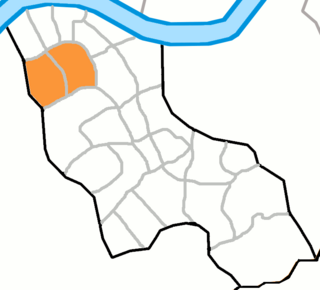
Nonhyeon-dong (Korean: 논현동) is a ward of Gangnam-gu in Seoul, South Korea. It borders Apgujeong and Sinsa-dong on the north, Samseong-dong on the northeast, and Yeoksam-dong to the south.

Gaepo-dong (Korean: 개포동) is a ward of Gangnam District, Seoul, South Korea, south of Dogok-dong and Daechi-dong. Gaepodong is divided into three "dong": Gaepo 1, 2, and 4 dong. Gaepo 3-dong had been merged with Gaepo 2-dong in 2009.

Irwon-dong is a ward of Gangnam-gu in South Korea.

Segok-dong is a ward of Gangnam-gu in Seoul, South Korea. It is the most rural neighbourhood in Gangnam-gu.

Sinsa-dong (Korean: 신사동) is a ward of Gangnam District, Seoul, South Korea. This district contains many department stores, hairshops, churches, boutiques, cafes and restaurants.

Suseo-dong is a ward of Gangnam-gu in Seoul, South Korea. The name, Suseo originated from the feature of Han River running through the western part of the region. Suseo-dong is also home to the Tancheon park.

Jamwon-dong is a dong, neighbourhood of the greater Gangnam area Seocho-gu in Seoul, South Korea. Until 1988, Jamwon-dong was under the jurisdiction of Gangnam-gu. Jamwon-dong is popular for its mulberry trees and silkworms, whose cocoon is used to make fabric for clothing. As a legal-status neighborhood, Jamwon-dong includes Banpo 3-dong and Jamwon-dong.

Banpo-dong is a dong, neighborhood of Seocho District, the greater Gangnam area in Seoul, South Korea. Banpo-dong is divided into five different dong which are Banpobon-dong, Banpo 1-dong, 2-dong, 3-dong and 4-dong.

Yangjae-dong is a dong, neighbourhood of the greater Gangnam area Seocho District in Seoul, South Korea. Yangjae-dong is divided into 2 different dong which are Yangjae 1-dong and 2-dong.

Pyeongchang-dong is a dong, neighbourhood of Jongno-gu in Seoul, South Korea.
Pandora TV (판도라TV) was a video sharing website that hosted user-generated content. Founded in October 2004, Pandora TV is the first video sharing website in the world to attach advertisement to user-submitted video clips and to provide unlimited storage space for users to upload. The operating company, Pandora TV Co., Ltd., has its headquarters in the Seoul-Gangnam Building in Yeoksam-dong, Gangnam-gu, Seoul.
References
- ↑ "포이동 (Poi-dong 浦二洞)" (in Korean). Doosan Encyclopedia . Retrieved 2008-04-16.[ permanent dead link ]
- ↑ "The origin of the names: Poi-dong" (in Korean). Gangnam-gu official site. Archived from the original on 2012-07-20. Retrieved 2008-04-14.

