
Brazil, officially the Federative Republic of Brazil, is the largest and easternmost country in South America and in Latin America. Brazil is the world's fifth-largest country by area and the seventh most populous. Its capital is Brasília, and its most populous city is São Paulo. The federation is composed of the union of the 26 states and the Federal District. It is the only country in the Americas to have Portuguese as an official language. Brazil is one of the most multicultural and ethnically diverse nations, due to over a century of mass immigration from around the world.

The economy of Brazil is historically the largest in Latin America and the Southern Hemisphere in nominal terms. The Brazilian economy is the second largest in the Americas. It is an upper-middle income developing mixed economy. In 2024, according to International Monetary Fund (IMF), Brazil has the 8th largest gross domestic product (GDP) in the world and has the 8th largest purchasing power parity in the world. In 2024, according to Forbes, Brazil was the 7th largest country in the world by number of billionaires. According to International Monetary Fund (IMF), Brazilian nominal GDP was US$2.331 trillion, the country has a long history of being among the largest economies in the world and the GDP per capita was US$11,178 per inhabitant.

Transport infrastructure in Brazil is characterized by strong regional differences and lack of development of the national rail network. Brazil's fast-growing economy, and especially the growth in exports, will place increasing demands on the transport networks. However, sizeable new investments that are expected to address some of the issues are either planned or in progress. It is common to travel domestically by air because the price is low. Brazil has the second highest number of airports in the world, after the USA.

South America is a continent entirely in the Western Hemisphere and mostly in the Southern Hemisphere, with a considerably smaller portion in the Northern Hemisphere. It can also be described as the southern subregion of the Americas.

São Paulo is one of the 26 states of the Federative Republic of Brazil and is named after Saint Paul of Tarsus. It is located in the Southeast Region and is limited by the states of Minas Gerais to the north and northeast, Paraná to the south, Rio de Janeiro to the east and Mato Grosso do Sul to the west, in addition to the Atlantic Ocean to the southeast. It is divided into 645 municipalities and its total area is 248,219.481 square kilometres km², which is equivalent to 2.9% of Brazil's surface, being slightly larger than the United Kingdom. Its capital is the municipality of São Paulo.

São Luís is the capital and largest city of the Brazilian state of Maranhão. The city is located on Upaon-açu Island or Ilha de São Luís, in the Baía de São Marcos, an extension of the Atlantic Ocean which forms the estuary of Pindaré, Mearim, Itapecuru and other rivers. Its coordinates are 2.53° south, 44.30° west. São Luís has the second largest maritime extension within Brazilian states. Its maritime extension is 640 km. The city proper has a population of some 1,108,975 people. The metropolitan area totals 1,536,017, ranked as the 15th largest in Brazil.
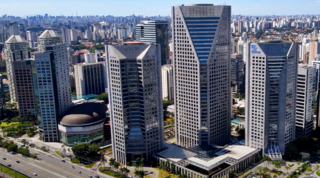
The economy of South America comprises approximately 434 million people living in the 12 sovereign states and three dependent territories of South America, which encompasses 6 percent of the world's population. South America ranks fifth in terms of nominal GDP by continent, behind North America and after Oceania.

The Brazilian Highway System is a network of trunk roads administered by the Ministry of Transport of Brazil. It is constructed, managed and maintained by the National Department of Transport Infrastructure (DNIT), federal agency linked to the Ministry of Infrastructure, and the public works departments of state governments.

The Port of Santos is in the city of Santos, state of São Paulo, Brazil. As of 2006, it is the busiest container port in Latin America. In 2016, it was considered the 39th largest port in the world for container handling, and the 35th per ton, according to the AAPA - American Association of Port Authorities ranking, being the busiest in Latin America.
The following outline is provided as an overview of and topical guide to Brazil:
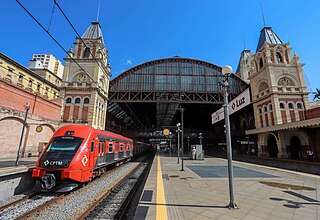
Rail transport in Brazil began in the 19th century and there were many different railway companies. The railways were nationalized under RFFSA in 1957. Between 1999 and 2007, RFFSA was broken up and services are now operated by a variety of private and public operators, including Rumo Logística, Companhia Paulista de Trens Metropolitanos and SuperVia.

Lebanese Brazilians, are Brazilians of full or partial Lebanese ancestry, including Lebanese-born immigrants to Brazil. According to the Brazilian Institute of Geography and Statistics, they form some of the largest Asian communities in the country, along with other West Asian and East Asian descendants.
Empresa de Transportes Aéreos Aerovias Brasil S/A was a Brazilian airline founded in 1942. It was merged into Varig in 1961, when Varig bought the Consórcio Real-Aerovias-Nacional, of which Aerovias Brasil was one of the partners.
Santos Brasil Participações S/A is a Brazilian logistics company, streamlining operations with containers. Currently the organization is publicly traded, listed on Level 2 of Bovespa's Corporate Governance, has a brAAA rating according to Standard & Poor's, and it has invested R$3 billion, calculated at present value, in the three container terminals that it administers. Among them is Tecon Santos, the largest container handler in Brazil and Latin America in yearly average with 80 MPH, which is located on the left margin of the Port of Santos, administered by the Companhia Docas do Estado de São Paulo (CODESP) under supervision of the Special Ports Department (SEP/PR), which is responsible for most of the incoming and outgoing flow of goods in Brazil. Headquartered in São Paulo, it was established in 1997 and has a concession to operate not only Tecon Santos, but also Tecon Imbituba at the Port of Imbituba in Santa Catarina, Tecon Vila do Conde in the city of Barcarena in the state of Pará, the TEV - Vehicle Terminal at the Port of Santos, as well as the General Cargo Terminal, also in Imbituba. The company also has two distribution centers: the DCs São Bernardo in the city of São Bernardo do Campo in the Greater São Paulo City Region, and in Jaguaré, also in the city of São Paulo. It also has a logistics operator, Santos Brasil Logística, that administers the Industrial Logistics and Customs Clearance Centers - CLIA Guarujá and CLIA Santos on the coast. The company develops various projects of social-environmental responsibility and focused on sports, and is recognized as a Company Friends of Sports by the Ministry of Sports.

Events in the year 1981 in Brazil.
The busiest airports by continent is based on the busiest airports in all continents except Antarctica and Oceania.
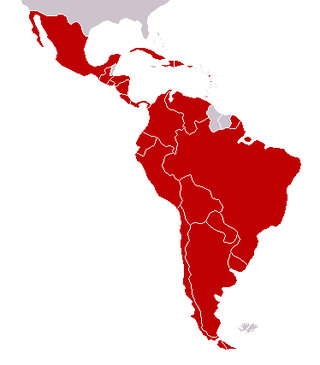
Latin America as a region has multiple nation-states, with varying levels of economic complexity. The Latin American economy is an export-based economy consisting of individual countries in the geographical regions of North America, Central America, South America, and the Caribbean. The socioeconomic patterns of what is now called Latin America were set in the colonial era when the region was controlled by the Spanish and Portuguese empires. Up until independence in the early nineteenth century, colonial Latin American regional economies thrived and worked things out. Many parts of the region had favorable factor endowments of deposits of precious metals, mainly silver, or tropical climatic conditions and locations near coasts that allowed for the development of cane sugar plantations. In the nineteenth century following independence, many economies of Latin America declined. In the late nineteenth century, much of Latin America was integrated into the world economy as an exporter of commodities. Foreign capital investment, construction of infrastructure, such as railroads, growth in the labor sector with immigration from abroad, strengthening of institutions, and expansion of education aided industrial growth and economic expansion. A number of regions have thriving economies, but "poverty and inequality have been deeply rooted in Latin American societies since the early colonial era."
The China-Brazil Fund is a bilateral investment cooperation fund established by the Chinese and Brazilian governments to funnel Chinese infrastructure and industrial investment into Brazil. The fund is seen as mutually beneficial as infrastructure has lagged in Brazil while China purchases Brazilian grain that is transported to port before shipment to China.
