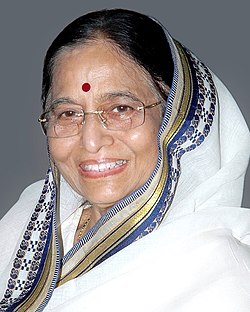
| Official portrait, 2007 | |
| Presidency of Pratibha Patil 25 July 2007 –25 July 2012 | |
| Party | Indian National Congress |
|---|---|
| Election | 2007 Indian presidential election |
| Seat | Rashtrapati Bhawan |

Presidency of Pratibha Patil was started on 25 July 2007 [1] when she took the oath as the twelfth and the first woman president of India. [2]
The presidency of Pratibha Patil began on 25 July 2007,when Pratibha Patil took the oath as the twelfth president of India,administered by Chief Justice K. G. Balakrishnan. Patil was the Indian National Congress (Congress)-led United Progressive Alliance (UPA) and Left Front nominee and defeated the National Democratic Alliance (NDA) nominee and sitting Vice President of India,Bhairon Singh Shekhawat. Prior to her presidency,she served as the governor of Rajasthan and was a member of both the Rajya Sabha and the Lok Sabha. Patil secured nearly two-thirds of the electoral college vote,becoming the first woman to hold the office of the President of India. During her presidency,she undertook 13 state visits comprising 24 countries across four continents. [3] Shortly after starting her term,Mohammad Hamid Ansari won the 2007 Indian vice presidential election;President Patil administered the oath of office to him on 11 August 2007. [4] In 2009,she administered the oath of office to Manmohan Singh upon his re-election as Prime Minister. [5] Her tenure was marked by a strong emphasis on women's empowerment,social inclusion,and the promotion of trade during her international travels. In 2019,post her presidency,she was conferred with the Order of the Aztec Eagle,the highest civilian award of Mexico for foreigners. [6]
The presidential election took place on 19 July 2007, and the results were announced on 21 July 2007. President A. P. J. Abdul Kalam, whose term was due to expire on 24 July 2007, initially expressed willingness to consider a second term if there was a certainty of winning, but later decided not to contest. The United Progressive Alliance (UPA) and Left parties nominated Pratibha Patil, the then Governor of Rajasthan, as their candidate. She resigned from her gubernatorial post on 21 June 2007 to contest the election.
| Party (Alliance) | Candidate | Electoral Votes | Vote Percentage | States carried |
|---|---|---|---|---|
| INC (UPA) | Pratibha Patil | 638,116 | 65.82% | 22 |
| BJP (NDA) | Bhairon Singh Shekhawat | 331,306 | 34.18% | 8 |
Patil won the election, securing nearly two-thirds of the electoral college votes. [7] She defeated the sitting Vice President and National Democratic Alliance (NDA) candidate, Bhairon Singh Shekhawat. With this victory, she became the first woman to be elected as the President of India, a milestone in the country's democratic history. [8] The election saw significant cross-voting in favor of Patil in several states, including some where the NDA had a strong presence. The Shiv Sena, despite being an NDA ally, supported Patil citing her Maharashtrian background. [9]
Patil disposed of 39 mercy petitions during her tenure, commuting 35 and rejecting 4. [10]
Under Article 356 of the Constitution of India, if a state government fails to function in accordance with constitutional provisions, the Union government may impose President's rule. During her presidency, President Pratibha Patil imposed President's rule in states experiencing political instability.
President's rule was imposed in Jharkhand from 19 January 2009, following the resignation of Chief Minister Shibu Soren after he lost a vote of confidence in the legislative assembly. As no party was able to form a stable government, the state was placed under central rule until 12 September 2009, when an elected government was sworn in after assembly elections. [11] [12]
In Andhra Pradesh, President's rule was imposed from 24 February 2010, following the resignation of Chief Minister K. Rosaiah amid prolonged political uncertainty after the death of Chief Minister Y. S. Rajasekhara Reddy. President's rule remained in force until 25 November 2010, when N. Kiran Kumar Reddy assumed office as the new Chief Minister. [13] [14]
President Pratibha Patil administered the oath of office to the following officers and officials during her tenure (2007–2012):
| Date | Name | Office | Reference |
|---|---|---|---|
| 11 August 2007 | Mohammad Hamid Ansari | 13th Vice President of India | [15] |
| 7 January 2008 | Vinod Rai | Comptroller and Auditor General of India | [16] |
| 22 May 2009 | Manmohan Singh | Prime Minister of India (second term) | [17] |
| 22 May 2009 | Union Council of Ministers | Union Council of Ministers | [18] |
| 12 May 2010 | S. H. Kapadia | 38th Chief Justice of India | [19] |
| 7 September 2010 | P. J. Thomas | Central Vigilance Commissioner | [20] |
On 25 July 2007, President Pratibha Patil addressed the Parliament after being sworn in as India's first woman President. In her inaugural speech, she emphasized the importance of socially inclusive economic growth and called for a relentless campaign against poverty, ignorance, and disease. She highlighted the need for women's empowerment and the light of modern education for every child. She cherished the values of the Indian independence struggle led by Mahatma Gandhi and pledged to protect the democratic ideals and secular fabric of the nation. [21]
On 4 June 2009, President Patil addressed the first joint sitting of the 15th Lok Sabha. She outlined the government's focus on the "Aam Aadmi" (common man) and spoke in favor of strengthening flagship schemes like the NREGA and the Sarva Shiksha Abhiyan. She also announced the government's commitment to the Women's Reservation Bill and the creation of a "National Mission for Empowerment of Women" to ensure better coordination of women-centric programs. [22]
On 21 February 2011, President Patil addressed the joint sitting of Parliament. She praised India's resilience during the global economic slowdown and highlighted the Right to Education Act as a milestone. She discussed the need for food security and mentioned the government's efforts to bring a comprehensive Food Security Bill. She also touched upon internal security and the importance of addressing challenges in Jammu and Kashmir and the North-East. [23]
On 12 March 2012, in her final address to the joint sitting, President Patil noted the healthy 7% growth rate of the economy despite global uncertainties. She emphasized transparency in governance and mentioned the introduction of several anti-corruption bills, including the Lokpal Bill and the Judicial Standards and Accountability Bill. She also congratulated the citizens on the successful completion of the 2011 Census, noting that India was poised to reap a "demographic dividend" through skill development. [24]
On 13 May 2012, President Patil addressed a special joint sitting to mark the 60th anniversary of the first sitting of the Parliament of India. She described the Parliament as the "repository of the will of the people" and paid tribute to the living members of the first Lok Sabha. She urged members to maintain the dignity of the house and ensure that the chariot of democracy continues to surmount all challenges. [25]