
Leucopogon juniperinus, commonly known as prickly beard-heath, is a species of flowering plant in the heath family Ericaceae and is endemic to south-eastern continental Australia. It is an erect, densely-branched shrub with oblong to more or less egg-shaped leaves with the narrower end towards the base, and white, tube-shaped flowers arranged singly in upper leaf axils.
Homoranthus tricolor, is a flowering plant in the family Myrtaceae and is endemic to a small area in south-east Queensland. It is an upright shrub with linear to lance-shaped leaves and green, red and black flowers arranged singly or in pairs in upper leaf axils.
Thryptomene remota is a species of flowering plant in the family Myrtaceae and is endemic to the northern part of the Northern Territory. It is an erect shrub with linear to lance-shaped leaves with the narrower end towards the base, and white or cream-coloured flowers with ten stamens.
Bossiaea barbarae is a species of flowering plant in the family Fabaceae and is endemic to Western Australia. It is an erect, compact, spiny shrub with egg-shaped to elliptic or oblong leaves, and deep yellow and bright red flowers.
Bossiaea concinna is a species of flowering plant in the pea family Fabaceae and is endemic to the south-west of Western Australia. It is an erect, spiny, more or less glabrous shrub with oblong leaves and bright yellow and red flowers.

Leucopogon clelandii, commonly known as Cleland's bearded-heath, is a species of flowering plant in the heath family Ericaceae and is endemic to the south-east of continental Australia. It is weak, open shrub with broadly egg-shaped leaves and white flowers arranged singly or in pairs in leaf axils near the ends of the branches.
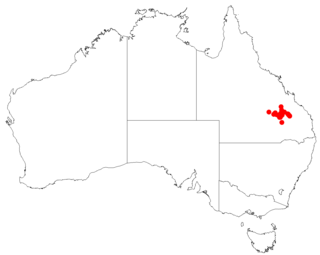
Leucopogon grandiflorus is a species of flowering plant in the heath family Ericaceae and is endemic to Carnarvon National Park in south-eastern Queensland. It is a shrub with softly-hairy branchlets, oblong leaves and white flowers.

Cryptandra longistaminea is a species of flowering plant in the family Rhamnaceae and is endemic to eastern Australia. It is a shrub with many branches, egg-shaped or elliptic to linear leaves, and clusters of white, tube-shaped flowers.
Cryptandra triplex is a species of flowering plant in the family Rhamnaceae and is endemic to the north of the Northern Territory. It is a hairy shrub with narrowly elliptic to lance-shaped or egg-shaped leaves and white to cream-coloured or yellowish, tube-shaped flowers arranged singly or in groups of up to 5 in leaf axils, near the ends of branches.

Leucopogon rodwayi is a species of flowering plant in the heath family Ericaceae and is endemic to coastal New South Wales. It is an erect to spreading shrub with narrowly egg-shaped to elliptic leaves, and pendent, white, tube-shaped flowers arranged in groups of 6 to 15 in leaf axils, forming a spike up to 8 mm (0.31 in) long.

Leucopogon tenuicaulis is a species of flowering plant in the heath family Ericaceae and is endemic to the far southwest of Western Australia. It is an erect or sprawling shrub with thin stems, upright triangular to narrowly egg-shaped or narrowly elliptic leaves and erect, white or pale pink, tube-shaped flower arranged in large groups on the ends of branches and in upper leaf axils.
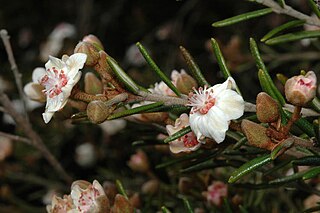
Ricinocarpos bowmanii, commonly known as western wedding bush or Bowman jasmine, is a species of flowering plant in the family Euphorbiaceae and is endemic to New South Wales. It is usually a monoecious shrub with linear to oblong leaves and three to six male flowers around each female flower.
Ricinocarpos brevis is a species of flowering plant in the family Euphorbiaceae and is endemic to inland Western Australia. It is a monoecious, densely-branched shrub with narrowly oblong leaves and male and female flowers arranged singly or in small groups.
Ricinocarpos crispatus is a species of flowering plant in the family Euphorbiaceae and is endemic to south-western Queensland. It is a monoecious or dioecious shrub with linear leaves and white flowers, arranged either singly, with two to four male flowers, or a single female flower surrounded by one or two male flowers.
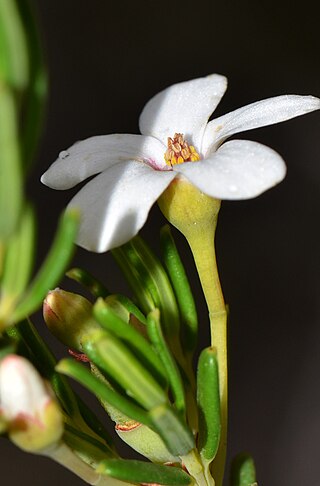
Ricinocarpos cyanescens is a species of flowering plant in the family Euphorbiaceae and is endemic to the south-west of Western Australia. It is a compact, monoecious shrub with narrowly oblong leaves and male and female flowers arranged singly or in small groups.
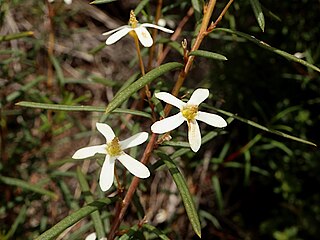
Ricinocarpos glaucus is a species of flowering plant in the family Euphorbiaceae and is endemic to the south-west of Western Australia. It is an erect, monoecious or dioecious shrub with linear or narrowly oblong leaves and male and female flowers arranged singly or in small groups.
Ricinocarpos graniticus is a species of flowering plant in the family Euphorbiaceae and is endemic to the southwest of Western Australia. It is a monoecious shrub with linear leaves and creamy white flowers, arranged either singly, or with a single female flower surrounded by one or two male flowers.
Micromyrtus albicans is a species of flowering plant in the myrtle family, Myrtaceae and is endemic to a small area of south-eastern Queensland. It is a slender shrub with overlapping, egg-shaped leaves and small white flowers.

Ricinocarpos linearifolius is a species of flowering plant in the family Euphorbiaceae and is endemic to eastern Australia. It is a monoecious or dioecious shrub with hairy young branchlets, linear leaves and white flowers, arranged either singly, with two to four male flowers, or a single female flower surrounded by up to three male flowers.
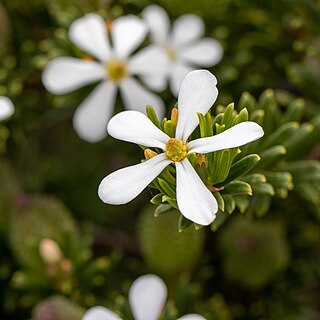
Ricinocarpos megalocarpus is a species of flowering plant in the family Euphorbiaceae and is endemic to the south coast of Western Australia. It is a compact, rounded, usually monoecious shrub with linear leaves and white flowers, arranged either singly, or male flowers in groups, or with a single female flower surrounded by up to six male flowers.
