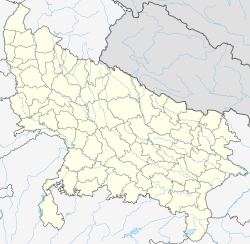
Rankhandi is a village in Saharanpur district of Uttar Pradesh, located seven kilometers from Deoband. It served as a research site for the Cornell University researchers in Anthropology / Sociology. Cornell maintains research documents on the Rankhandi project in its archives.[1]
The village is largely inhabited by the PundirRajputs and has been a major centre of education in the area for many years. Its intermediate level school is the Thakur Phool Singh Memorial Intercollege (formerly Kissan Vidyalya). Other castes in the village include the Pal, Kori, Gosain, Barhai and Ranghar, Pandit.
Cornell also helped establish a hostel, called the Cornell Hostel, for the Thakur Phool Singh School. Now there is also a degree college called Kripal Singh memorial providing graduation and master's degree in various courses. In village there are many popular old temples. There is an interesting fact about the village that village Rankhandi was chosen to fight the battle of Mahabharata but later changed. There used to be battles at this place and so the name derived form it Ran means battle khandi means place that stands for place of battles .
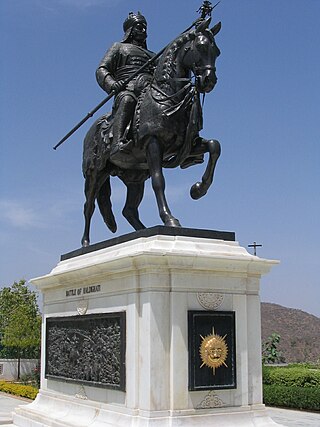
Maharana Pratap - The idol of Maharana pratap installed in Rankhandi in 2020.
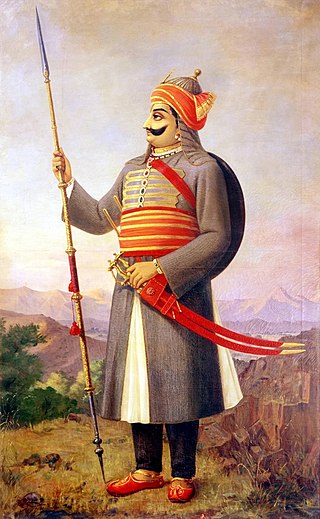
Pratap Singh I, popularly known as Maharana Pratap, was a king of Kingdom of Mewar, in north-western India in the present-day state of Rajasthan. He is notable for leading the Rajput resistance against the expansionist policy of the Mughal Emperor Akbar including the Battle of Haldighati.
Chhatri are semi-open, elevated, dome-shaped pavilions used as an element in Indo-Islamic architecture and Indian architecture. They are most commonly square, octagonal, and round. Originating as a canopy above tombs, they largely serve as decorative elements as opposed to functional elements. The earliest examples of chhatri being used in the Indian Subcontinent were found in the Shrine of Ibrahim in Bhadreswar, constructed between 1159 and 1175 AD.
Haldighati is a historical mountain pass between Khamnore and Balicha village situated at Aravalli Range of Rajasthan in western India which connects Rajsamand and Udaipur districts. Haldighati also known as Haldighati Darra.The pass is located at a distance of 44 kilometres from Udaipur and 367 kilometres from Jaipur. The name 'Haldighati' is believed to have originated from the turmeric-coloured yellow soil of the area..
Gogunda is a town and tehsil headquarters of Gogunda Tehsil in Udaipur district, located about 35 km (22 mi) in north-west from Udaipur city in the Indian state of Rajasthan. It is situated on a high mountain in Aravalli hills and is reached by crossing a difficult mountain pass.
Bhama Shah (1547–1600) was a noted general, minister and close aide of Maharana Pratap Singh. The financial support provided by him allowed Maharana Pratap to restore his army and reclaim much of his lost territory.
Kunwar Pratap Singh Barhath, also known as ‘Kunwar Ji’, was an Indian anti-British activist known for his role in the revolutionary plot to assassinate the Viceroy of India, Charles Hardinge, in 1912. He was a prominent member of the Revolutionary Party led by Rash Behari Bose.
Jaswantpura is a tehsil in the Jalore district of Rajasthan, India. It is the headquarters of Panchayat Samiti (block) and a part of the Jaswantpura subdivision; before 1947, it was the headquarters of the Pargana. The village was declared a tehsil in the Rajasthan budget 2012–13, and is named after the ruler of Marwar, Jodhpur: Maharaja Jaswant Singh
Hakim Khan Sur An ethnic Pashtun, was a descendant of Sher Shah Suri and a general in Rana Pratap's army. He fought with him in the Battle of Haldighati and died in 1576. In Haldighati Battle, he commanded an army of Afghans who were against the rising power of Mughal Empire.
Chetak or Cetak is the name given in traditional literature to the horse ridden by Maharana Pratap at the Battle of Haldighati, fought on 18 June 1576 at Haldighati, in the Aravalli Mountains of Rajasthan, in western India.
The Kingdom of Mewar, also called Medapata, was an independent kingdom that existed in the Rajputana region of the Indian Subcontinent and later became a dominant state in medieval India. The kingdom was initially founded and ruled by the Guhila dynasty followed by the Sisodiya Dynasty. The earliest kingdom was centered around the south-central part of Rajasthan, state of India. It was bordered by the Aravali Range to the northwest, Ajmer to the north, Gujarat, Vagad and Malwa regions to the south and the Hadoti region to the east.
Dursa Arha was a 16th-century warrior and Rajasthani (Dingal) poet from India. He earned the epithet of the 'First Nationalist Poet Of India' or Rashtrakavi because of his nationalist stance in his bold Dingal poems commending Maharana Pratap of Mewar in his struggle against the Mughal Empire. He is one of the most highly regarded poets of the time, who was also a valuable and respectable part of the Mughal court. He was a renowned litterateur, historian, war general, consultant, administrator, feudal lord, and magistrate. He had close relations with the rulers of many erstwhile kingdoms. On the basis of wealth, fame, and honor Dursa Arha acquired in his lifetime and his contribution to medieval Indian history and literature, the historians and litterateurs consider him as one of the greatest poets. Dursa Arha attained heights of opulence and grandeur reached by no other poet in history.
Thakur Kesari Singh Barhath was an Indian revolutionary leader, freedom fighter, and educator from the state of Rajasthan. He was the patriarch of the Barhath family, members of which participated in anti-British activities Barhath was also known as Rajasthan Kesari.
Maharana Pratap: The First Freedom Fighter is an Indian epic film based on Maharana Pratap of Mewar .The film is directed and produced by Dr. Pradeep Kumawat from Udaipur, Rajasthan. It is the first time that a film has been made on the history of Maharana Pratap. The film's sound track includes one of the last songs sung by Late Jagjit Singh.
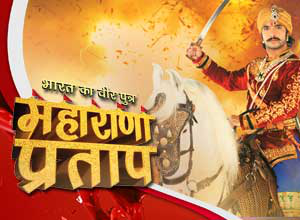
Bharat Ka Veer Putra – Maharana Pratap is an Indian historical fiction series produced by Contiloe Entertainment. It is based on the life of Maharana Pratap, a sixteenth century ruler of Mewar kingdom. It starred Sharad Malhotra, Rachana Parulkar, Faisal Khan and Roshni Walia.
Panarwa was a thikana of Solanki Rajputs, in the former Mewar State in present-day Rajasthan, India. It was founded c. 1478.
Akhil Bharatiya Kshatriya Mahasabha also known as All India Kshatriya Mahasabha was founded in the year 1897 It was formed to promote, protect and fight for rights and interests of Kshatriya community of the Indian society.
Sauda is a clan of the Charanas. They are also known as Sauda-Barhath. Sauda Charans came to prominence in the kingdom of Mewar with the establishment of Sisodia dynasty in 1326.
Raj Prashasti is a Sanskrit text and inscription commemorating the construction of the Rajsamand Lake in 1676 by Maharana Raj Singh. The text of the Prashasti was authored by Ranchhod Bhatt Tailang at the orders of his patron Raj Singh. It was inscribed on the stone slabs by the order of Maharana Jai Singh in 1687. It is the largest and longest stone inscription in India and is engraved on 25 black stones pillars of the nine outposts at Rajsamand Lake. It states that the Rajsamand Lake was constructed as part of famine relief works. The Prashasti provides historical achievements of Mewar rulers from Bappa Rawal to Raj Singh, details of the construction work, measurements, and costs associated with the Rajsamand lake and dam as well as reports on the rituals performed and gifts and charities donated to the Charanas and Brahmins on the consecration ceremony. The prashasti text was first published in the history of Mewar written by Kaviraja Shyamaldas, in Vir Vinod.
Chetavani ra Chungatya is a patriotic Dingal poem composed by Thakur Kesari Singh Barhath in 1903 and addressed to Maharana of Mewar, Fateh Singh, exhorting him to uphold the traditions of his lineage and to not attend the Delhi Durbar. The couplets had the desired effect on the Maharana who decided not to attend the durbar despite being present in Delhi. The work remains one of the great literary works produced during the freedom struggle. It consists of 13 stanzas or sortha (saurashtra-duha).
This page is based on this Wikipedia article Text is available under the CC BY-SA 4.0 license; additional terms may apply. Images, videos and audio are available under their respective licenses.


 India
India