
Food is any substance consumed by an organism for nutritional support. Food is usually of plant, animal, or fungal origin, and contains essential nutrients, such as carbohydrates, fats, proteins, vitamins, or minerals. The substance is ingested by an organism and assimilated by the organism's cells to provide energy, maintain life, or stimulate growth. Different species of animals have different feeding behaviours that satisfy the needs of their metabolisms that have evolved to fill a specific ecological niche within specific geographical contexts.
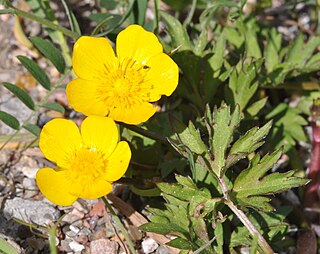
Flowering plants are plants that bear flowers and fruits, and form the clade Angiospermae, commonly called angiosperms. They include insect-pollinated herbs such as buttercups, pond plants such as water lilies, wind-pollinated grasses, and trees such as apple and oak. The term "angiosperm" is derived from the Greek words ἀγγεῖον /angeion and σπέρμα / sperma ('seed'), meaning that the seeds are enclosed within a fruit. They are by far the most diverse group of land plants with 64 orders, 416 families, approximately 13,000 known genera and 300,000 known species. Angiosperms were formerly called Magnoliophyta.

The Arecaceae is a family of perennial, flowering plants in the monocot order Arecales. Their growth form can be climbers, shrubs, tree-like and stemless plants, all commonly known as palms. Those having a tree-like form are called palm trees. Currently, 181 genera with around 2,600 species are known, most of which are restricted to tropical and subtropical climates. Most palms are distinguished by their large, compound, evergreen leaves, known as fronds, arranged at the top of an unbranched stem. However, palms exhibit an enormous diversity in physical characteristics and inhabit nearly every type of habitat within their range, from rainforests to deserts.

Robert Anthony Plant is an English singer and songwriter, best known as the lead singer and lyricist of the rock band Led Zeppelin for all of its existence from 1968 until 1980. Regarded by many as one of the greatest singers in rock music, he is known for his flamboyant persona and raw stage performances. In 1995, Plant was inducted with the band into the Rock and Roll Hall of Fame.

Horticulture is the cultivation of plants in gardens or greenhouses, as opposed to the field-scale production of crops characteristic of agriculture. It includes the cultivation of fruits, vegetables, nuts, seeds, herbs, sprouts, mushrooms, algae, flowers, seaweeds and non-food crops such as grass and ornamental trees and plants. It also includes plant conservation, landscape restoration, landscape and garden design, construction, and maintenance, and arboriculture, ornamental trees and lawns.
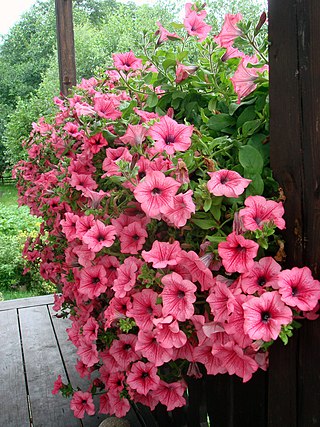
Ornamental plants or garden plants are plants that are primarily grown for their beauty but also for qualities such as scent or how they shape physical space. Many flowering plants and garden varieties tend to be specially bred cultivars that improve on the original species in qualities such as color, shape, scent, and long-lasting blooms. There are many examples of fine ornamental plants that can provide height, privacy, and beauty for any garden. These ornamental perennial plants have seeds that allow them to reproduce. One of the beauties of ornamental grasses is that they are very versatile and low maintenance. Almost any types of plant have ornamental variety/varieties: trees, shrubs, climbers, grasses, succulents, aquatic plants, herbaceous perennials and annual plants. Non-botanical classifications include houseplants, bedding plants, hedges, plants for cut flowers and foliage plants. The cultivation of ornamental plants comes under floriculture and tree nurseries, which is a major branch of horticulture.

A legume is a plant in the family Fabaceae, or the fruit or seed of such a plant. When used as a dry grain, the seed is also called a pulse. Legumes are grown agriculturally, primarily for human consumption, for livestock forage and silage, and as soil-enhancing green manure. Well-known legumes include beans, soybeans, chickpeas, peanuts, lentils, lupins, mesquite, carob, tamarind, alfalfa, and clover. Legumes produce a botanically unique type of fruit – a simple dry fruit that develops from a simple carpel and usually dehisces on two sides.

Northern America is the northernmost subregion of North America. The boundaries may be drawn slightly differently. In one definition, it lies directly north of Middle America. Northern America's land frontier with the rest of North America then coincides with the Mexico–United States border. Geopolitically, according to the United Nations' scheme of geographical regions and subregions, Northern America consists of Bermuda, Canada, Greenland, Saint Pierre and Miquelon and the United States.
Psychotria densinervia is a species of plant in the family Rubiaceae. It is endemic to Cameroon. Its natural habitat is subtropical or tropical moist lowland forests. It is threatened by habitat loss.

Rhodospatha is a genus of plant in family Araceae. It is native to South America, Central America, and southern Mexico.
Rhodospatha dissidens is a species of plant in the family Araceae. It is endemic to Ecuador. Its natural habitat is subtropical or tropical moist lowland forests. It is threatened by habitat loss.
Rhodospatha robusta is a species of plant in the family Araceae. It is endemic to Ecuador. Its natural habitat is subtropical or tropical moist lowland forests. It is threatened by habitat loss.
Rhodospatha statutii is a species of plant in the family Araceae. It is endemic to Ecuador. Its natural habitat is subtropical or tropical moist montane forests. It is threatened by habitat loss.

Plants are predominantly photosynthetic eukaryotes, forming the kingdom Plantae. Many are multicellular. Historically, the plant kingdom encompassed all living things that were not animals, and included algae and fungi. All current definitions exclude the fungi and some of the algae. By one definition, plants form the clade Viridiplantae which consists of the green algae and the embryophytes or land plants. The latter include hornworts, liverworts, mosses, lycophytes, ferns, conifers and other gymnosperms, and flowering plants. A definition based on genomes includes the Viridiplantae, along with the red algae and the glaucophytes, in the clade Archaeplastida.

Monsteroideae is a subfamily of flowering plants in the family Araceae.
Castanopsis densinervia is a tree in the family Fagaceae. The specific epithet densinervia is from the Latin meaning "dense nerves", referring to the leaf venation.
Plants of the World Online (POWO) is an online database published by the Royal Botanic Gardens, Kew. It was launched in March 2017 with the ultimate aim being "to enable users to access information on all the world's known seed-bearing plants by 2020". The initial focus was on tropical African Floras, particularly Flora Zambesiaca, Flora of West Tropical Africa and Flora of Tropical East Africa.
Stellantis N.V. is a multinational automotive manufacturing corporation formed in 2021 on the basis of a 50–50 cross-border merger between the Italian-American conglomerate Fiat Chrysler Automobiles (FCA) and the French PSA Group. The company is headquartered in Amsterdam. Stellantis is the fourth largest automaker by sales behind Toyota, Volkswagen Group, and Hyundai Motor Group.
Thomas Bernard Croat is an American botanist and plant collector, noteworthy as one of botanical history's "most prolific plant collectors". He has collected over 85,000 species of plants, particularly in the family Araceae, in his career at the Missouri Botanical Garden.

