
Look up roll in Wiktionary, the free dictionary.
Roll may refer to:
Roll may refer to:

Pitch may refer to:
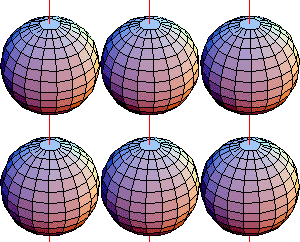
Rotation or rotational motion is the circular movement of an object around a central line, known as an axis of rotation. A plane figure can rotate in either a clockwise or counterclockwise sense around a perpendicular axis intersecting anywhere inside or outside the figure at a center of rotation. A solid figure has an infinite number of possible axes and angles of rotation, including chaotic rotation, in contrast to rotation around a fixed axis.

Flight dynamics is the science of air vehicle orientation and control in three dimensions. The three critical flight dynamics parameters are the angles of rotation in three dimensions about the vehicle's center of gravity (cg), known as pitch, roll and yaw. These are collectively known as aircraft attitude, often principally relative to the atmospheric frame in normal flight, but also relative to terrain during takeoff or landing, or when operating at low elevation. The concept of attitude is not specific to fixed-wing aircraft, but also extends to rotary aircraft such as helicopters, and dirigibles, where the flight dynamics involved in establishing and controlling attitude are entirely different.

Aircraft flight control surfaces are aerodynamic devices allowing a pilot to adjust and control the aircraft's flight attitude.

Dihedral angle is the upward angle from horizontal of the wings or tailplane of a fixed-wing aircraft. "Anhedral angle" is the name given to negative dihedral angle, that is, when there is a downward angle from horizontal of the wings or tailplane of a fixed-wing aircraft.

The metacentric height (GM) is a measurement of the initial static stability of a floating body. It is calculated as the distance between the centre of gravity of a ship and its metacentre. A larger metacentric height implies greater initial stability against overturning. The metacentric height also influences the natural period of rolling of a hull, with very large metacentric heights being associated with shorter periods of roll which are uncomfortable for passengers. Hence, a sufficiently, but not excessively, high metacentric height is considered ideal for passenger ships.
Yaw or yaws may refer to:

Aerobatic maneuvers are flight paths putting aircraft in unusual attitudes, in air shows, dogfights or competition aerobatics. Aerobatics can be performed by a single aircraft or in formation with several others. Nearly all aircraft are capable of performing aerobatics maneuvers of some kind, although it may not be legal or safe to do so in certain aircraft.

A motion simulator or motion platform is a mechanism that creates the feelings of being in a real motion environment. In a simulator, the movement is synchronised with a visual display of the outside world (OTW) scene. Motion platforms can provide movement in all of the six degrees of freedom (DOF) that can be experienced by an object that is free to move, such as an aircraft or spacecraft:. These are the three rotational degrees of freedom and three translational or linear degrees of freedom.
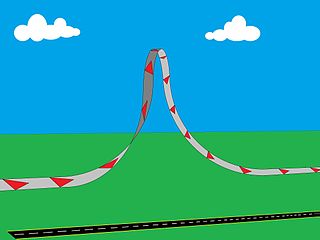
A barrel roll is an aerial maneuver in which an airplane makes a complete rotation on both its longitudinal and lateral axes, causing it to follow a helical path, approximately maintaining its original direction. It is sometimes described as a "combination of a loop and a roll". The g-force is kept positive on the object throughout the maneuver, commonly between 2 and 3g, and no less than 0.5g. The barrel roll is commonly confused with an aileron roll.
In aeronautics, inertia coupling, also referred to as inertial coupling and inertial roll coupling, is a potentially catastrophic phenomenon of high-speed flight in a long, thin aircraft, in which an intentional rotation of the aircraft about one axis prevents the aircraft's design from inhibiting other unintended rotations. The problem became apparent in the 1950s, when the first supersonic jet fighter aircraft and research aircraft were developed with narrow wingspans, and caused the loss of aircraft and pilots before the design features to counter it were understood.

Six degrees of freedom (6DOF), or sometimes six degrees of movement, refers to the six mechanical degrees of freedom of movement of a rigid body in three-dimensional space. Specifically, the body is free to change position as forward/backward (surge), up/down (heave), left/right (sway) translation in three perpendicular axes, combined with changes in orientation through rotation about three perpendicular axes, often termed yaw, pitch, and roll.
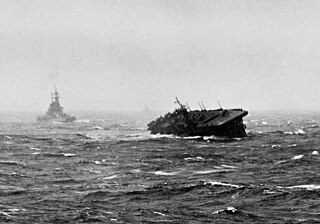
Ship motions are defined by the six degrees of freedom that a ship, boat, or other watercraft, or indeed any conveyance in a fluid medium, can experience.

Stability derivatives, and also control derivatives, are measures of how particular forces and moments on an aircraft change as other parameters related to stability change. For a defined "trim" flight condition, changes and oscillations occur in these parameters. Equations of motion are used to analyze these changes and oscillations. Stability and control derivatives are used to linearize (simplify) these equations of motion so the stability of the vehicle can be more readily analyzed.

A kayak roll or Eskimo roll is the act of righting a capsized kayak by use of body motion and/or a paddle. Typically this is done by lifting the torso towards the surface, flicking the hips to right the kayak, and applying a small force by means of the paddle to assist the torso back over the boat.
An aircraft in flight is free to rotate in three dimensions: yaw, nose left or right about an axis running up and down; pitch, nose up or down about an axis running from wing to wing; and roll, rotation about an axis running from nose to tail. The axes are alternatively designated as vertical, lateral, and longitudinal respectively. These axes move with the vehicle and rotate relative to the Earth along with the craft. These definitions were analogously applied to spacecraft when the first crewed spacecraft were designed in the late 1950s.
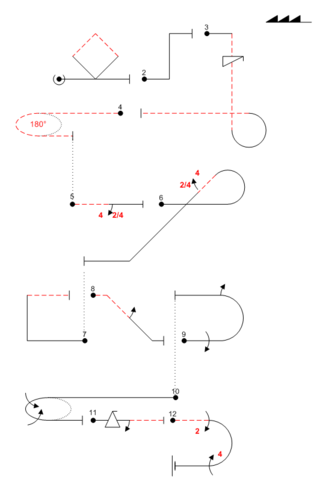
Radio-controlled aerobatics is the practice of flying radio-controlled aircraft in maneuvers involving aircraft attitudes that are not used in normal flight.

A yaw rotation is a movement around the yaw axis of a rigid body that changes the direction it is pointing, to the left or right of its direction of motion. The yaw rate or yaw velocity of a car, aircraft, projectile or other rigid body is the angular velocity of this rotation, or rate of change of the heading angle when the aircraft is horizontal. It is commonly measured in degrees per second or radians per second.
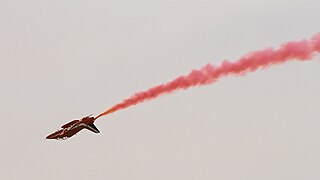
A slow roll is a roll made by an airplane, in which the plane makes a complete rotation around its roll axis while keeping the aircraft flying a straight and level flightpath. A slow roll is performed more slowly than an aileron roll; although it is not necessarily performed very slowly, it is performed slowly enough to allow the pilot to maintain balance, keeping a steady flightpath, pitch angle, and height (altitude) throughout the maneuver. The maneuver is performed by rolling the airplane at a controlled rate with the ailerons, and moving the elevators and rudder in opposition, or "cross-controlling," to keep the plane on a steady, level flightpath.

A falling leaf is a maneuver in which an aircraft performs a wings-level stall which begins to induce a spin. This spin is countered with the rudder, which begins a spin in the opposite direction that must be countered with rudder, and the process is repeated as many times as the pilot determines. During the maneuver, the plane resembles a leaf falling from the sky; first slipping to one side, stopping, and then slipping to the other direction; continuing a side-to-side motion as it drifts toward the ground.