Route knowledge

Last updated

Route knowledge is one of the core skills together with train handling (also known as brake handling) and a full understanding of railway rules, [1] which the operating crew must possess in order to be able to operate a train safely.

Contents

Content

The information that must be learnt and understood includes the following: [2]

Route characteristics

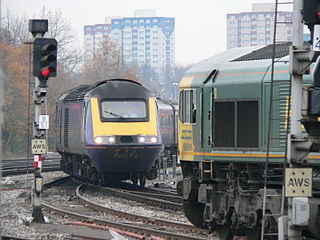
Where there is a risk that a signal may be "passed at danger"

Where more than one signal is located on a gantry there is a risk of reading across to an adjacent signal. Estacion La Plata, playa de maniobras, senales 02.JPG
Where more than one signal is located on a gantry there is a risk of reading across to an adjacent signal.

Other route risks

All lineside signs must be understood, as well as the action which must be taken when encountering them. Camden Road stn eastbound AC DC electrification warning.JPG
All lineside signs must be understood, as well as the action which must be taken when encountering them.

Methods and assessment

Route learning can consist of:

Related Research Articles

<span class="mw-page-title-main">Railway signal</span> Visual signal device for railway engineers

A railway signal is a visual display device that conveys instructions or provides warning of instructions regarding the driver’s authority to proceed. The driver interprets the signal's indication and acts accordingly. Typically, a signal might inform the driver of the speed at which the train may safely proceed or it may instruct the driver to stop.

<span class="mw-page-title-main">Railway signalling</span> The principle of signals used to control railway traffic

Railway signalling (BE), also called railroad signaling (AE), is a system used to control the movement of railway traffic. Trains move on fixed rails, making them uniquely susceptible to collision. This susceptibility is exacerbated by the enormous weight and inertia of a train, which makes it difficult to quickly stop when encountering an obstacle. In the UK, the Regulation of Railways Act 1889 introduced a series of requirements on matters such as the implementation of interlocked block signalling and other safety measures as a direct result of the Armagh rail disaster in that year.

The Train Protection & Warning System (TPWS) is a train protection system used throughout the British passenger main-line railway network, and in Victoria, Australia.

<span class="mw-page-title-main">Signal passed at danger</span> Train passing stop signal without authority

A signal passed at danger (SPAD), known in the United States as a stop signal overrun and in Canada as passing a stop signal, is an event on a railway where a train passes a stop signal without authority. In the United States and Canada, this may be known colloquially as running a red, though this idiom principally refers to automobiles passing red traffic signals.

<span class="mw-page-title-main">Southall rail crash</span> 1997 high-speed rail crash near London

The Southall rail crash occurred on 19 September 1997, on the Great Western Main Line at Southall, West London. An InterCity 125 high speed passenger train (HST) failed to slow down in response to warning signals and collided with a freight train crossing its path, causing seven deaths and 139 injuries.

<span class="mw-page-title-main">Automatic Warning System</span>

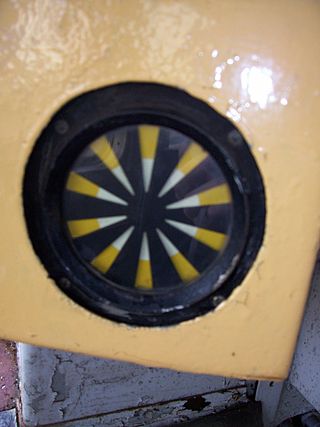
The Automatic Warning System (AWS) provides a train driver with an audible indication of whether the next signal they are approaching is clear or at caution. Depending on the upcoming signal state, the AWS will either produce a 'horn' sound, or a 'bell' sound. If the train driver fails to acknowledge a warning indication, an emergency brake application is initiated by the AWS. However if the driver correctly acknowledges the warning indication by pressing an acknowledgement button, then a visual 'sunflower' is displayed to the driver, as a reminder of the warning.

<span class="mw-page-title-main">Colwich rail crash</span> 1986 rail crash at Colwich Junction, England

The Colwich rail crash occurred on the evening of Friday 19 September 1986 at Colwich Junction, Staffordshire, England. It was significant in that it was a high speed collision between two packed express trains. One driver was killed, but no passengers died because of the great strength of the rolling stock involved, which included examples of Mk1, Mk2 and Mk3 coaches.

<span class="mw-page-title-main">Nuneaton rail crash</span> British rail disaster

The Nuneaton rail crash occurred on 6 June 1975, on the West Coast Main Line just south of Nuneaton railway station in Warwickshire, England, United Kingdom.

<span class="mw-page-title-main">Cab signalling</span> Railway safety system

Cab signaling is a railway safety system that communicates track status and condition information to the cab, crew compartment or driver's compartment of a locomotive, railcar or multiple unit. The information is continually updated giving an easy to read display to the train driver or engine driver.

<span class="mw-page-title-main">Linienzugbeeinflussung</span> In-cab signalling and train protection system

Linienzugbeeinflussung is a cab signalling and train protection system used on selected German and Austrian railway lines as well as on the AVE and some commuter rail lines in Spain. The system was mandatory where trains were allowed to exceed speeds of 160 km/h (99 mph) in Germany and 220 km/h (140 mph) in Spain. It is also used on some slower railway and urban rapid transit lines to increase capacity. The German Linienzugbeeinflussung translates to continuous train control, literally: linear train influencing. It is also called linienförmige Zugbeeinflussung.

<span class="mw-page-title-main">UK railway signalling</span> Rail traffic control systems used in the United Kingdom

The railway signalling system used across the majority of the United Kingdom rail network uses lineside signals to control the movement and speed of trains.

Australian railway signalling varies between the States of Australia, because the individual States are responsible for the railway systems within their own borders, with, historically, no need to co-ordinate between states except at the boundaries.

<span class="mw-page-title-main">Signalling block system</span>

Signalling block systems enable the safe and efficient operation of railways by preventing collisions between trains. The basic principle is that a track is broken up into a series of sections or "blocks". Only one train may occupy a block at a time, and the blocks are sized to allow a train to stop within them. That ensures that a train always has time to stop before getting dangerously close to another train on the same line. The block system is referred to in the UK as the method of working, in the US as the method of operation, and in Australia as safeworking.

<span class="mw-page-title-main">Grantham rail accident</span> Rail accident in Lincolnshire on 19 September 1906

The Grantham rail accident occurred on 19 September 1906. An evening Sleeping-Car and Mail train of the Great Northern Railway, running from London Kings Cross to Edinburgh Waverley hauled by Ivatt 'Atlantic' No 276 derailed, killing 14. The accident was never explained; the train ran through Grantham station, where it was scheduled to stop, and derailed on a set of points on a sharp curve at the end of the platform, which at the time had been set for a freight train. No reason was ever established as to why the train did not stop as scheduled, or obey the Caution and Danger signals.

<span class="mw-page-title-main">Japanese railway signals</span>

Japanese railway signals, according to the ministerial decree defining technical standards of railways, are defined as indicating operational conditions for railway staff driving trains.

Swiss railway signalling describes the railway signalling systems used in Switzerland by the different railway companies. There are two main types of signal, used up to 160 km/h, above which speed cab signalling is required.

<span class="mw-page-title-main">Application of railway signals</span> Overview of train traffic management

The application of railway signals on a rail layout is determined by various factors, principally the location of points of potential conflict, as well as the speed and frequency of trains and the movements they require to make.

<span class="mw-page-title-main">2015 Wootton Bassett rail incident</span> Charter train passed a signal at danger

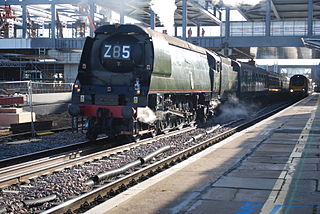
On 7 March 2015, a steam-hauled charter train passed a signal at danger and subsequently came to a stand across a high-speed mainline junction near Wootton Bassett Junction, Wiltshire, England. Another train, which had right of way, had passed through the junction 44 seconds earlier and no collision occurred nor was any damage done.

Automatic Train Protection (ATP) was a method of beacon based railway cab signalling developed by British Rail. The system never progressed beyond the pilot schemes installed on the Great Western Main Line between London Paddington and Bristol Temple Meads, and the Chiltern Main Line from London Marylebone to High Wycombe and Aylesbury.

Kavach is an automatic train protection (ATP) system indigenously developed by Indian Railways through Research Designs & Standards Organisation (RDSO). Initial development of Kavach started in 2012 under the name Train Collision Avoidance System (TCAS) and completed development in 2022.

References

  1. "UK Railway Rule Book". Railway Group Standards online. Archived from the original on 2008-12-14. Retrieved 2016-12-15.
  2. "Rail Industry Standard for Management of Route Knowledge for Drivers, Train Managers, Guards and Driver Managers" (PDF). Rail Safety and Standards Board. December 2014. Retrieved 14 December 2016.
  3. "Infrastructure Requirements for Personal Safety in Respect of Clearances and Access: Authorised Walking Routes" (PDF). RSSB. Rail Safety and Standards Board . Retrieved 2016-12-17.
  4. "Track Access Productions: List of Route learning DVDs" . Retrieved 19 December 2016.