
Vilnius, previously known in English as Vilna, is the capital of and largest city in Lithuania and the second-most-populous city in the Baltic states. The city's estimated July 2024 population was 605,270, and the Vilnius urban area has an estimated population of 708,627.
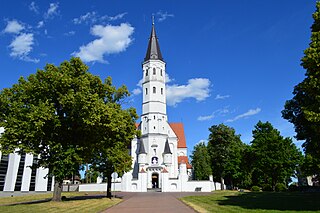
Šiauliai is a city in northern Lithuania, the country's fourth largest city and the sixth largest city in the Baltic States, with a population of 112 581 in 2024. From 1994 to 2010 it was the capital of Šiauliai County.

Vilnius District Municipality is one of the 60 municipalities in Lithuania. It surrounds the capital city of Vilnius on three sides. The municipality is also bordered by Trakai district and Elektrėnai municipality in the west, Astravyets and Ashmyany districts of Belarus in the east, Širvintos, Molėtai and Švenčionys districts in the north and Šalčininkai district in the south.
Russians in Lithuania number about 146,000 people, according to the Lithuanian estimates of 2023, or 5.1% of the total population of Lithuania.

Eišiškės is a city in southeastern Lithuania on the border with Belarus. It is situated on a small group of hills, surrounded by marshy valley of Verseka and Dumblė Rivers. The rivers divide the city into two parts; the northern part is called Jurzdika. As of the census in 2011, Eišiškės had a population of 3,416. It has a hospital and two high schools.
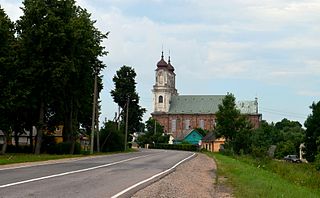
Dotnuva is a small town with a 2003 population of 775 in central Lithuania, 10 km northwest of Kėdainiai, in the Kėdainiai district municipality. It is located on the Dotnuvėlė River. The geographical center of Lithuania, in the village of Ruoščiai, is only a few kilometers away. There is a Catholic church, former Bernardine monastery, an abandoned sawmill and watermill in Dotnuva. The Dotnuva manor is in the nearby town of Akademija.

Perloja is a village in Varėna district, Lithuania. It is situated 19 km (12 mi) to the west from Varėna on the banks of Merkys River and on the Vilnius–Druskininkai road. According to the 2001 census, it had 774 inhabitants. The village is known for the so-called Republic of Perloja, an independent, albeit unrecognised microstate that was established in the aftermath of World War I and existed until 1923.
Didžiosios Kabiškės is a village in Vilnius district municipality, Lithuania. It is located about 24 km (15 mi) northeast of Vilnius, capital of Lithuania. The nearest city is Nemenčinė. A smaller village, known as Mažosios Kabiškės, is located nearby. Didžiosios Kabiškės has a bi-lingual Lithuanian and Polish kindergarten and a primary school, a postal office, and a library.
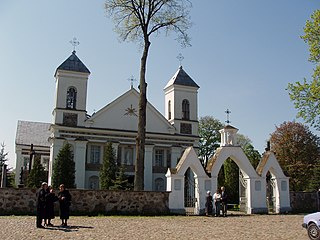
Valkininkai is a historic town in Valkininkų (Valkininkai) eldership, Varėna District Municipality, Alytus County, Lithuania, located about 22 km (14 mi) northeast from Varėna and about 55 km (34 mi) southwest from Vilnius. At the Lithuanian census of 2001, its population was 238 and at the census of 2011 it was 229.

Nemėžis is a village in the Vilnius district municipality, Lithuania, it is located only about 1 kilometre (0.62 mi) east of Vilnius. It is located south-east of Vilnius along a railway.

Bezdonys is a town in Lithuania, located to the north of Vilnius, within the Vilnius district municipality. It is best known for the 1908 Bezdany raid, one of the most daring and successful train robberies in history. According to the Lithuanian census of 2011, the town had 743 inhabitants.

Maišiagala is a historic town in Vilnius district municipality, Lithuania. It is located about 17 km (11 mi) northwest of Vilnius city municipality near the Vilnius–Panevėžys highway. According to the 2021 census, it had a population of 1 562, a decrease from 1,636, registered at the 2011 census.

Žilinai is a village in Jakėnų eldership, Varėna District Municipality, Alytus County, in southeastern Lithuania. As of the 2011 census, the population was 392.

Šlapaberžė is a village in Kėdainiai district municipality, in Kaunas County, in central Lithuania. According to the 2011 census, the village has a population of 616 people. The village is located by the Kruostas river, 7 km from Akademija. The village has the Catholic Church of Christ, a former manor with a park, and a wayside chapel.

Gražiškiai is a small town in Marijampolė County, Vilkaviškis District Municipality. The town is located in southwestern Lithuania. According to the 2011 census, the town has a population of 349 people.

Paberžė is a village in Vilnius District Municipality, Lithuania, it is located only about 21 kilometres (13 mi) north of Vilnius city municipality. According to the 2011 census, it had population of 919.

Dūkštos is a village in Vilnius District Municipality, Lithuania. According to the 2011 census, the village had a population of 311 people, up from 164 in 1979.

Sudervė is one of the oldest villages in Vilnius District Municipality, Lithuania, it is located only about 8 kilometres (5.0 mi) west of Vilnius city municipality. It is located just north of Vilnius, on the road from Vilnius to Kernavė and is the center of Sudervė eldership. At the 2011 census, the village had a population of 523 and grew to 588 as of 2021 census. That was an increase from the 1989 census which recorded the population of 393 inhabitants.

Pajieslys is a village in Kėdainiai district municipality, in Kaunas County, in central Lithuania. According to the 2011 census, the village had a population of 254 people. It is located 8 kilometres (5.0 mi) from Krakės, by the Jiesla rivulet, nearby its confluence with the Šušvė. There is a wooden Catholic church of St. Mary, a library, and a school. The Pajieslys Geomorphological Sanctuary is located nearby. Pajieslys hosts an ISKCON community.


 Lithuania
  Vilnius County


