
San Pietro in Ciel d'Oro is a Catholic basilica of the Augustinians in Pavia, Italy, in the Lombardy region. Its name refers to the mosaics of gold leaf behind glass tesserae that decorate the ceiling of the apse. The plain exterior is of brick, with sandstone quoins and window framing. The paving of the church floor is now lower than the modern street level of Piazza San Pietro in Ciel d'Oro, which lies before its façade.

Santa Maria del Carmine is a church in Pavia, Lombardy, northern Italy, considered amongst the best examples of Lombard Gothic architecture. It was begun in 1374 by Gian Galeazzo Visconti, Duke of Milan, on a project attributed to Bernardo da Venezia. The construction followed a slow pace, and was restarted in 1432, being finished in 1461.

Santa Maria di Canepanova is a Renaissance style Roman Catholic church located in central Pavia, region of Lombardy, Italy. Although in the past the design was popularly attributed to Bramante, the church was designed by Giovanni Antonio Amadeo.

Pavia Cathedral is a church in Pavia, Italy, the largest in the city and seat of the Diocese of Pavia. The construction was begun in the 15th century on the site of two pre-existing Romanesque, "twin" cathedrals. The cathedral houses the remains of St. Sirus, first Bishop of Pavia, and a thorn purported to be from the Crown of Thorns worn by Christ. The marble facing of the exterior was never completed.

The Civic Museums of Pavia are a number of museums in Pavia, Lombardy, northern Italy. They are housed in the Castello Visconteo, or Visconti Castle, built in 1360 by Galeazzo II Visconti, soon after taking the city, a free city-state until then. The credited architect is Bartolino da Novara. The castle used to be the main residence of the Visconti family, while the political capital of the state was Milan. North of the castle a wide park was enclosed, also including the Certosa of Pavia, founded 1396 according to a vow of Gian Galeazzo Visconti, meant to be a sort of private chapel of the Visconti dynasty. The Battle of Pavia (1525), climax of the Italian Wars, took place inside the castle park.
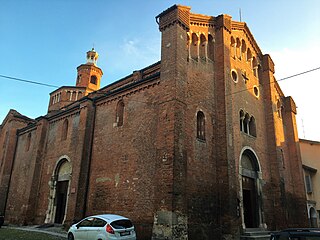
San Teodoro is a Romanesque-style Roman Catholic church in the town center of Pavia, Italy.

Santi Primo e Feliciano is a Romanesque-style Roman Catholic church in the town center of Pavia, Italy.

San Lanfranco is a Romanesque-style Catholic church and former abbey, located on via San Lanfranco Vescovo, 4/6, just west of the town center of Pavia, region of Lombardy, Italy.

Characteristic of the historic center of Pavia is the presence of medieval noble towers that survive in its urban fabric, despite having once been more numerous, as evidenced by the sixteenth-century representation of the city frescoed in the church of San Teodoro. They were mostly built between the 11th and 13th centuries when the Ghibelline city was at the height of its Romanesque flowering.

The church of San Francesco of Assisi is a Catholic religious building in Pavia, Lombardy, Italy.

The church of Sant'Eusebio was a church of Pavia, of which today only the crypt remains. The church was probably built by the Lombard king Rothari (636-652) as the city's Arian cathedral. It later became the fulcrum of the conversion to Catholicism of the Lombards initiated by Theodolinda and the monks of San Colombano and which later received, precisely in Pavia, a great impulse from King Aripert I (653-661) and from Bishop Anastasius.

The church of San Giovanni Domnarum is one of the oldest in Pavia. In the crypt, which was rediscovered after centuries in 1914, remains of frescoes are visible.

The monastery of San Felice was one of the main female Benedictine monasteries of Pavia; founded since the Lombard period, it was suppressed in the 18th century.Part of the church and the crypt survive from the original Lombard complex.

The church of San Marino is a Catholic church in Pavia, in Lombardy.

The Church of San Tommaso is a former Catholic church and monastery in the city of Pavia, Lombardy, Italy. It is located within the historic city center and belongs to the University of Pavia.

The monastery of Santa Maria Teodote, also known as Santa Maria della Pusterla, was one of the oldest and most important female monasteries in Pavia, Lombardy, now Italy. Founded in the seventh century, it stood in the place where the diocesan seminary is located and was suppressed in the eighteenth century.
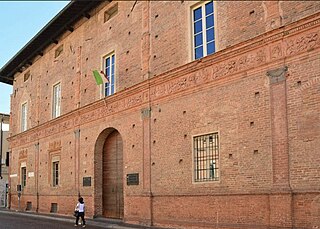
Palace Carminali Bottigella is a noble palace built by the ancient Beccaria family from Pavia. The original structure from the Sforza era was built between 1490 and 1499. The façade, which retains the original terracotta decorations, is one of the major examples of Renaissance civil building in Pavia.
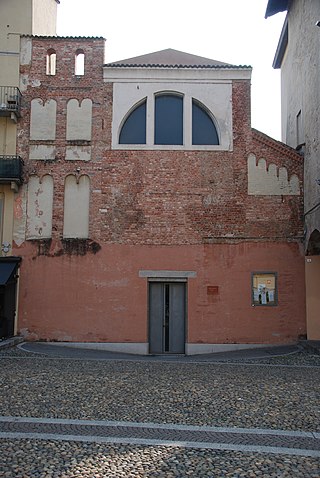
The church Santa Maria Gualtieri is a deconsecrated church in Pavia now used for exhibitions, concerts and conferences.

The Church of San Lazzaro is located on the eastern suburbs of Pavia. Built in the 12th century along the Via Francigena, it was equipped with a hospital dedicated to the care of pilgrims and lepers.
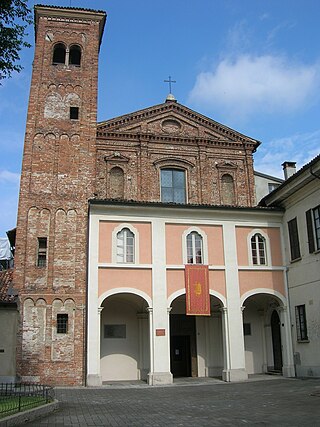
The Church of Santi Gervasio e Protasio is a church in Pavia, in Lombardy.


