Related Research Articles

Maqbool is a 2004 Indian Hindi-language crime drama film directed by Vishal Bhardwaj, starring Irrfan Khan, Tabu, Pankaj Kapur, Naseeruddin Shah, Om Puri, Piyush Mishra, Murali Sharma and Masumeh Makhija in an adaptation of the play Macbeth by Shakespeare.

Black Friday is a 2004 Indian Hindi-language crime film written and directed by Anurag Kashyap. Based on Black Friday: The True Story of the Bombay Bomb Blasts, a book by Hussain Zaidi about the 1993 Bombay bombings, it chronicles the events that led to the blasts and the subsequent police investigation. Produced by Arindam Mitra of Mid-Day, the film stars Pawan Malhotra, Kay Kay Menon, Aditya Srivastava, Kishor Kadam and Zakir Hussain.

Maachis (transl. Matchsticks) is a 1996 Indian period political thriller film written and directed by Gulzar. The film stars Chandrachur Singh, Om Puri, Tabu and Jimmy Sheirgill. The film is set against the backdrop of the Sikh insurgency in Punjab during the 1980s. The plot delves into the personal and political turmoil faced by individuals caught in violence and explores themes of state repression, vengeance and the radicalization of youth.
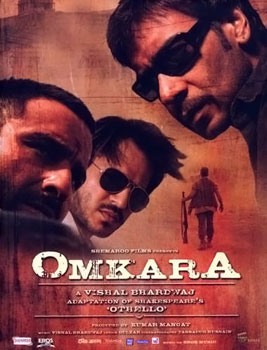
Omkara is a 2006 Indian Hindi-language crime drama film adapted from William Shakespeare's Othello, co-written and directed by Vishal Bhardwaj. It stars an ensemble cast of Ajay Devgn, Kareena Kapoor, Saif Ali Khan, Konkona Sen Sharma, Vivek Oberoi and Bipasha Basu in lead roles. Bhardwaj also composed music for the film, including the background score, with lyrics by Gulzar. The film is set in Meerut, a city in Uttar Pradesh. It is the second film in Bhardwaj's trilogy of Shakespeare adaptations, which began with Maqbool (2003) and completed with Haider (2014).

Satya (transl. Truth) is a 1998 Indian Hindi-language crime film, produced and directed by Ram Gopal Varma; written by Saurabh Shukla and Anurag Kashyap. It stars J. D. Chakravarthy, Urmila Matondkar and Manoj Bajpayee, alongside Saurabh Shukla, Aditya Shrivastava and Paresh Rawal. It is the first of Varma's Gangster trilogy about organised crime in India. The film follows Satya (Chakravarthy), an immigrant who comes to Mumbai looking for a job, befriends Bhiku Mhatre (Bajpayee) and is drawn into the Mumbai underworld.

No Smoking is a 2007 Indian Hindi-language thriller film written and directed by Anurag Kashyap and co-produced by Vishal Bhardwaj and Kumar Mangat. The film stars John Abraham, Ayesha Takia, Ranvir Shorey and Paresh Rawal in the lead roles, while Bipasha Basu appears in an Item number. The film is loosely based upon the 1978 short story "Quitters, Inc." by Stephen King, which was previously adapted as one of three segments featured in the Hollywood anthology film, Cat's Eye (1985). It became the second Indian film after Julie Ganapathi and the first Hindi-language film to be adapted from Stephen King's work. The story follows K (Abraham), a self-obsessed, narcissist chain smoker who agrees to kick his habit to save his marriage and visits a rehabilitation centre, but is caught in a labyrinth game by Baba Bengali (Rawal), the man who guarantees he will make him quit.

Amit Trivedi is an Indian music director, singer, film scorer, composer, music producer and lyricist who works primarily in Hindi films. After working as a theatre and jingle composer and composing for non-film albums, he debuted as a film composer in the 2008 Hindi film Aamir, he gained prominence for his work in the Hindi film Dev.D (2009).

Gulzar is an Indian Urdu poet, lyricist, author, screenwriter, and film director known for his works in Hindi cinema. He is regarded as one of greatest Urdu poets of this era. He started his career with music director S.D. Burman as a lyricist in the 1963 film Bandini and worked with many music directors including R. D. Burman, Salil Chowdhury, Vishal Bhardwaj and A. R. Rahman. Gulzar also writes poetry, dialogues and scripts. He directed films such as Aandhi and Mausam during the 1970s and the TV series Mirza Ghalib in the 1980s. He also directed Kirdaar in 1993.
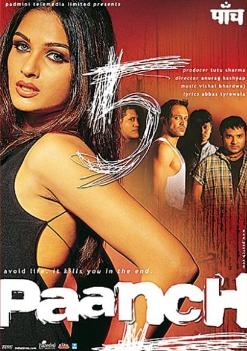
Paanch (transl. Five) is a 2003 Indian crime thriller film written and directed by Anurag Kashyap in his directing debut, starring Kay Kay Menon, Aditya Srivastava, Vijay Maurya, Joy Fernandes, and Tejaswini Kolhapure. The film is loosely based on the 1976–77 Joshi-Abhyankar serial murders in Pune.
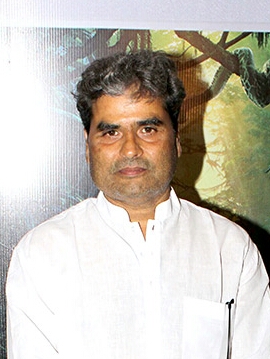
Vishal Bhardwaj is an Indian filmmaker, music composer and playback singer. He is known for his work in Hindi cinema, and is the recipient of nine National Film Awards and a Filmfare Award.

Prema Katha is a 1999 Indian Telugu-language romance drama film written by Vara Prasad Varma and directed by Ram Gopal Varma. It is the debut film of both Sumanth and Antara Mali as leads in the Telugu film industry. The film opened to positive reviews by critics but was commercially unsuccessful. It had a highly praised soundtrack by Sandeep Chowta including the hit song "Devudu Karunisthaadani". The film bagged six state Nandi Awards and was dubbed into Tamil as Kadhal Vanile.

"Horn OK Please" is the fifth single released from the soundtrack of the Dedh Ishqiya. The song is composed by Vishal Bhardwaj, the composer and co-producer of the film with the lyrics written by long-term collaborator Gulzar, performed by Yo! Yo! Honey Singh, Sukhwinder Singh and with backing vocals by Anushka Manchanda. The single has a theme of Babban searching for Khalujaan after separation being explored.
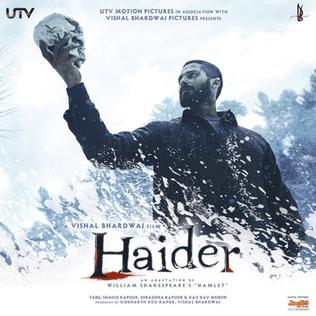
Haider is the soundtrack album, composed by Vishal Bhardwaj, to the 2014 Hindi film of the same name. The film, directed by Vishal Bhardwaj, stars Shahid Kapoor, Shraddha Kapoor, Tabu and Kay Kay Menon in key roles. The soundtrack album features nine tracks, and was released on 12 September 2014 on the record label Junglee Music. Vishal Bhardwaj and Sukhwinder Singh won the National Award for Best Music Direction of Songs and Best Male Playback Singer respectively.
Vishal Mishra is an Indian music composer and singer. He first appeared in a reality show aired on DD National. He also gave audition for Indian Idol but disqualified. In his initial days of the music industry, Mishra was guided by Lalit Pandit, of the Jatin–Lalit composer duo.
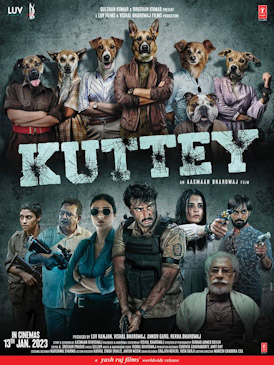
Kuttey (transl. Dogs) is a 2023 Indian Hindi-language action thriller film written and directed by debutante Aasmaan Bhardwaj. It is produced by Vishal Bhardwaj Films, T-Series Films and Luv Films. The film stars an ensemble cast of Tabu, Arjun Kapoor, Naseeruddin Shah, Radhika Madan, Konkona Sen Sharma and Kumud Mishra.
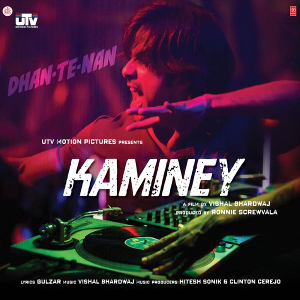
Kaminey is the soundtrack to the 2009 film of the same name directed by Vishal Bhardwaj, who also composed the film's musical score and soundtrack with lyrics written by Gulzar. The soundtrack featured eight tracks in total: five original songs, two remixes and a theme song; it was released by T-Series on 6 July 2009 and received critical and commercial success, especially "Dhan Te Nan", which topped the charts across various platforms.

Ishqiya is the soundtrack album to the 2010 film of the same name directed by Abhishek Chaubey and written and produced by Vishal Bhardwaj, starring Vidya Balan, Naseeruddin Shah and Arshad Warsi. Bhardwaj also composed the film's music with lyrics written by Gulzar and Hitesh Sonik and Clinton Cerejo produced the film's soundtrack, with the former also composed the film score. The seven-song soundtrack featured four original compositions and three remixes. The soundtrack was released under the T-Series label on 1 January 2010, coinciding New Year's Day. It received positive reviews from critics and Bhardwaj won his second National Film Award for Best Music Direction, after Godmother (1999).

Dedh Ishqiya (Original Motion Picture Soundtrack) is the soundtrack to the 2014 film of the same name, directed by Abhishek Chaubey and co-written and produced by Vishal Bhardwaj. A sequel to Ishqiya (2010), the film stars Naseeruddin Shah and Arshad Warsi reprising their roles from the previous film, alongside Madhuri Dixit and Huma Qureshi. Bhardwaj also composed and produced the eight-song soundtrack with lyrics written by Gulzar. The background score is composed by Clinton Cerejo. The soundtrack was released under the Shemaroo Entertainment Audios on 19 December 2013.

Mukkabaaz (Original Motion Picture Soundtrack) is the soundtrack album to the 2017 film of the same name directed by Anurag Kashyap, starring Vineet Kumar Singh and Zoya Hussain. The 11-song soundtrack features compositions from Rachita Arora, Nucleya and Singh, and lyrics written by Singh, Hussain Haidry and Sunil Jogi. The soundtrack was released through the Eros Music label on 23 December 2017.
References
- 1 2 "Satya". Saavn. 3 July 1998. Archived from the original on 1 December 2017. Retrieved 26 November 2017.
- ↑ "Vishal Bhardwaj recalls Satya days; says RGV used to prostrate before Anurag Kashyap: 'Anurag had no filters, would say anything'". The Indian Express. 23 October 2023. Archived from the original on 25 October 2023. Retrieved 15 October 2024.
- 1 2 "Vishal Bhardwaj confesses he's often undervalued as a composer: I want to make music for films that aren't mine". Firstpost. 4 July 2020. Archived from the original on 2 October 2023. Retrieved 15 October 2024.
- ↑ "Gulzar had a cutting response when Anurag Kashyap suggested alterations to his lyrics for Satya song; Vishal Bhardwaj refused to 'betray' his idol". The Indian Express. 22 October 2023. Archived from the original on 28 October 2023. Retrieved 15 October 2024.
- 1 2 ASC (13 November 1998). "Audioscan". The Tribune . Archived from the original on 7 April 2010. Retrieved 14 August 2010.
- ↑ "Satya: The Sound". Gaana. Archived from the original on 1 December 2017. Retrieved 26 November 2017.
- ↑ Gupta, Bhasker (1998). "Satya Review". AllMusic. Archived from the original on 24 September 2012. Retrieved 15 October 2024.
- ↑ Sebastian, Pradeep (10 May 2002). "Music, for the special touch". The Hindu . Archived from the original on 31 March 2008. Retrieved 17 June 2008.
- ↑ Joshi, Tushar (3 February 2004). "A different beat in Hindi cinema". Rediff.com. Archived from the original on 19 October 2012. Retrieved 30 July 2008.
- 1 2 "Bollywood Blockbusters: The Story Behind Satya". Bollywood Blockbusters. CNN-News18. 13 December 2009.