Seven Up is a solitairecard game which is played with a deck of 52 playing cards. The game is so called because the aim of the game is to eliminate cards in groups that total a multiple of seven (7, 14, 21, 28, 35, etc.). This game belongs to a family of value-adding row games which includes Decade.
In this game, the cards are dealt in a row. Spot cards (cards that value from ace to ten) are taken at face value, while jacks are valued at eleven, queens at twelve, and kings at thirteen. Groups of any number of cards that are next to each other and total to a multiple of seven can be discarded. A seven can be discarded on its own.
The game is won when all cards have been discarded. The game is lost if all cards have been dealt from the deck, no more matches are possible and cards are left on the row.
Klondike or Canfield (traditional) is a patience game. In the U.S. and Canada, Klondike is the best-known solitaire card game, to the point that the term "solitaire", in the absence of additional qualifiers, typically refers to Klondike. Equally in the UK, it is often just known as "patience". Meanwhile, elsewhere the game is known as American Patience. The game rose to fame in the late 19th century, being named "Klondike" after the Canadian region where a gold rush happened. It is rumored that the game was either created or popularized by the prospectors in Klondike.
Golf is a card game where players try to earn the lowest number of points over the course of nine deals.
Pyramid is a solitaire game where the object is to get all the cards from the pyramid to the foundation.
Rummy is a group of matching-card games notable for similar gameplay based on matching cards of the same rank or sequence and same suit. The basic goal in any form of rummy is to build melds which consists of sets, three or four of a kind of the same rank; or runs, three or more cards in sequence, of the same suit. If a player discards a card, making a run in the discard pile, it may not be taken up without taking all cards below the top one. The Mexican game of Conquian is considered by games scholar David Parlett to be ancestral to all rummy games, which itself is derived from a Chinese game called Khanhoo. The rummy principle of drawing and discarding with a view to melding appears in Chinese card games at least in the early 19th century, and perhaps as early as the 18th century.
Monte Carlo is a Patience pair-matching card game where the object is to remove pairs from the tableau. Contrary to its name, it has no relation to the city with the same name nor to any casino-related game.
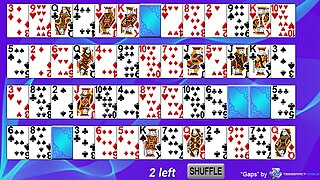
Gaps is a member of the Montana group of Patience games, where the arrangement of cards from Deuce to King is the object. Other games in the group include Spaces, Vacancies, Clown Solitaire, Paganini, Montana itself, Red Moon, and Blue Moon.
Aces Up is a solitaire card game using a deck of 52 playing cards. One advantage of this game is its minimal use of space: it requires only four piles of cards, and a place to discard cards to.
Nestor is a Patience game where the object is the removal of pairs.
Decade or Ten-Twenty-Thirty is a Patience game played with a traditional 52-card deck. It is akin to another solitaire game called Accordion. Like Accordion, it is traditionally played with the cards in a line; however due its minimal use of space, it can also be played in one hand by placing the deck face-down in the hand, and placing the line in a stack on top of the deck, with the discard pile face up on the bottom.
Hit or Miss is a solitaire card game which uses a deck of 52 playing cards. It is an unusual solitaire card games in that because the player deals the cards one at a time. As the player deals the cards, s/he says "ace" when drawing the first card, "two" for the second, then "three, four... nine, ten, jack, queen, king" then starts again with "ace." The player continues "counting" after the cards in the deck are used up, recollected and redealt.
Beleaguered Castle is a solitaire card game played with a deck of 52 playing cards. It is one of the card games touted as "Freecell without cells" because its game play is somewhat akin to the popular solitaire computer game but without extra empty spaces to maneuver. This game is also called Laying Siege and Sham Battle.
Virginia Reel is a solitaire card game which uses two decks of 52 playing cards mixed together. The object of the game is to place all the cards in the 24 foundations.
Diplomat is a solitaire card game which is played using two decks of playing cards shuffled together. Its layout is similar to that of Beleaguered Castle.
Baroness is a solitaire card game that is played with a deck of 52 playing cards. Also known as Five Piles and Thirteens, it is a game that has an arrangement that is almost like that of Aces Up but with the game play of Pyramid.
Kings in the Corner is a multi-player solitaire-style card game using one deck of standard playing cards with between two and four players participating.
British Constitution is a solitaire card game played with two decks of playing cards. It is a card game with a high chance in winning.
Yaniv, also known as "Dhumbal" or "Jhyap," is an Israeli card game popular in Nepal. It is similar to Blackjack, with several notable differences: one variation of the game involves five players, rather than the two-player standard of traditional Blackjack. the game is considered a backpackers game in Israel, and its popular among soldiers and young adults returning from long backpacking trips.
Jubilee is the name given to two solitaire card games, both played with two decks of playing cards. Both games are so-called because they were created during the time of the Golden Jubilee of Queen Victoria in 1887. One of the games has an ornate layout, while the other is simpler and it belongs to the family of games which include Sir Tommy, Strategy, and Calculation.
Troccas is a member of the Tarot family of card games. It is played in the Romansh speaking part of the canton Grisons of Switzerland. It is not known exactly how this game entered Switzerland but it is generally thought to have arrived from Italy during the 17th century.
Buraco is a Rummy-type card game in the Canasta family for four players in fixed partnerships in which the aim is to lay down combinations in groups of cards of equal rank and suit sequences, there being a bonus for combinations of seven cards or more. Buraco is a variation of Canasta which allows both standard melds as well as sequences. It originated from Uruguay and Argentina in the mid-1940s, with apparent characteristics of simplicity and implications that are often unforeseeable and absolutely involving. Its name derives from the Portuguese word "buraco" which means “hole”, applied to the minus score of any of the two partnerships. The game is also popular in the Arab world, specifically in the Persian Gulf; where it is known as 'Baraziliya' (Brazilian).
This page is based on this Wikipedia article Text is available under the CC BY-SA 4.0 license; additional terms may apply. Images, videos and audio are available under their respective licenses.