Sizun Parish close

Last updated
Map showing the location of Sizun Map commune FR insee code 29277.png
Map showing the location of Sizun

The Sizun Parish close (Enclos paroissial) is located at Sizun in the arrondissement of Morlaix in Brittany in north-western France. The "enclos paroissial" or parish close comprises the Église Saint-Suliau, a sacristy, an ossuary or funeral chapel and a "porte triomphale" giving access to the enclosure. The enclosure is a listed historical monument since 1943. [1]

Sizun Commune in Brittany, France

Sizun is a commune in the Finistère department of Brittany in north-western France.

Morlaix Subprefecture and commune in Brittany, France

Morlaix is a commune in the Finistère department of Brittany in northwestern France. It is a sub-prefecture of the department.

Brittany (administrative region) Administrative region of France

Brittany is one of the 18 regions of France. It is named after the historic and geographic region of Brittany, of which it constitutes 80%. The capital is Rennes. Bathed by the English Channel to the north and the Bay of Biscay to the south, it is located in the West of France, bordering the Normandy and Pays de la Loire regions. Bro Gozh ma Zadoù is the anthem of Brittany. It is sung to the same tune as that of the national anthem of Wales, Hen Wlad Fy Nhadau, and has similar words. As a region of France, Brittany has a Regional Council, which was most recently elected in 2015.

Contents

The entrance to the enclosure

The elaborate entrance to the Sizun enclosure Sizun arc triomphe.jpg
The elaborate entrance to the Sizun enclosure

Access to the Sizun "enclos paroissial" is through an "Arc de Triomphe" like structure with a total length of 15 metres, built between 1585 and 1590. A life size reproduction of the Sizun entrance was shown at the 1989 "Commémoration du Bicentenaire de la Révolution française" held in Paris' Jardins des Tuileries. The structure has three arches separated by fluted columns with Corinthian capitals and is surmounted by a double stone balustrade from which emerge the three crosses of a Calvary. At each corner of the balustrade is a "Lanteron" (a lantern-lke structure). The upper gallery of the "Arc de Triomphe" was accessed by a stone stairway so priests would have been able to preach from there in the open air but this was removed several years ago to assist the flow of traffic. [2] [3] [4] [5] [6] [7]

Fluting (architecture)

Fluting in architecture are the shallow grooves running along a surface.

The Pietà of the Église Saint-Suliau

The Pieta on the lawn outside the Eglise Saint-Suliau Pieta de l'eglise Saint-Suliau, Sizun, France.jpg
The Pietà on the lawn outside the Église Saint-Suliau

The enclosure was thought to have had the usual elaborate calvary in earlier times and a Pietà, as shown here, is thought to be what is left of that calvary apart from a head of a "bad" robber found in the ossuary. In the cemetery is an empty granite pedestal thought to have supported a Calvary, this inscribed "LAN MIL.V:XXXX:R.P.LA MISSION 1858". In the pietà, John the Evangelist puts one hand on Jesus' head and with his other hand wipes the tears from his cheek. Mary Magdalene is shown lifting the top from her pot of ointment. [2] There is also a small statue of Saint-Suliau outside the church. [2]

John the Evangelist author of the Gospel of John; traditionally identified with John the Apostle of Jesus, John of Patmos (author of Revelation), and John the Presbyter

John the Evangelist is the name traditionally given to the author of the Gospel of John. Christians have traditionally identified him with John the Apostle, John of Patmos, or John the Presbyter, although this has been disputed by modern scholars.

Mary Magdalene follower of Jesus

Saint Mary Magdalene, sometimes called simply the Magdalene, was a Jewish woman who, according to the four canonical gospels, traveled with Jesus as one of his followers and was a witness to his crucifixion, burial, and resurrection. She is mentioned by name twelve times in the canonical gospels, more than most of the apostles. Mary's epithet Magdalene most likely means that she came from the town of Magdala, a fishing town on the western shore of the Sea of Galilee.

One of the many statues of Saint Suliau, this located on the lawn outside the church Bretagne1986-003.jpg
One of the many statues of Saint Suliau, this located on the lawn outside the church

[3] [4] [5] [6]

The ossuary

The Sizun ossuary Ossarium Sizun.jpg
The Sizun ossuary

The ossuary chapel is located in the western part of the cemetery, and was built between 1585 and 1588. The ossuary door has decorated, fluted columns topped with Corinthian capitals on either side, and over this door is an entablature with the Rohan coat of arms in a triangular pediment and a small statue of Saint Suliau. Outside of the pediment are 1588 depictions of the Franciscans, Saint Francis of Assisi and Saint Anthony of Padua. Saint Francis shows his stigmata and Saint Anthony holds a chalice or ciborium. There are inscriptions by the Rohan coat of arms. One reads "Memento Mori", and the others in French remind visitors that they are in the presence of the dead ("Souviens-toi qu'il faut mourir" – Remember that you will die), and ("Vous nos enfants qui par ici passés, souvenez-vous que nous sommes trépassés" – You, our children who pass through here, remember that we are dead). The lower level of the building is built with yellow granite honeycomb stone and has arched windows separated by pilasters, some with caryatids depicting women who are naked apart from the scrolls they hold. Along the upper level of the building are twelve niches with fluted Doric pilasters between them and in these niches are statues of the twelve apostles, Saint Peter is depicted with a key, Saint Andrew with a cross, Saint James the Greater with a seashell, Saint John with a chalice, Saint James the Lesser with a stick, Saint Mathias with a pastoral staff, Saint Phillip with a cross, Saint Bartholomew with knife, Saint Matthew with some scales, Saint Simon with a saw, Judas Iscariot with a sword and Saint Thomas with a set-square. The ossuary is now used as a museum devoted to Breton Art and Culture. On a buttress on the south east corner there is a statue of Saint Suliau holding a cup. [3] [4] [5] [6]

Entablature architectural element

An entablature is the superstructure of moldings and bands which lies horizontally above columns, resting on their capitals. Entablatures are major elements of classical architecture, and are commonly divided into the architrave, the frieze, and the cornice. The Greek and Roman temples are believed to be based on wooden structures, the design transition from wooden to stone structures being called petrification.

Pediment element in classical, neoclassical and baroque architecture

A pediment is an architectural element found particularly in classical, neoclassical and baroque architecture, and its derivatives, consisting of a gable, usually of a triangular shape, placed above the horizontal structure of the entablature, typically supported by columns. The tympanum, the triangular area within the pediment, is often decorated with relief sculpture.

Stigmata crucifixion wounds of Jesus Christ

Stigmata is a term used in Christian mysticism to describe the manifestations of bodily wounds, scars and pain in locations corresponding to the crucifixion wounds of Jesus Christ, such as the hands, wrists, and feet. An individual bearing the wounds of stigmata is referred to as a stigmatist or a stigmatic.

This sculpture decorates the ossuary. The demon has the bust of a woman and the body of a serpent and is shown plucking the apple from the tree of the Temptation Sizun Schlange02.jpg
This sculpture decorates the ossuary. The demon has the bust of a woman and the body of a serpent and is shown plucking the apple from the tree of the Temptation

The church

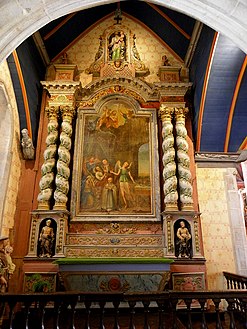
The Église St Suliau was constructed in stages between the 16th and 17th centuries. The church's best feature is the 16th century southern porch built in the flamboyant gothic style in 1514. The church boasts five altarpieces, a Thomas Dallam organ dating to 1683 and some exquisite furnishings and there is a showcase in the north transept containing many artifacts including the solid silver bust of Saint Suliau shown in the gallery of images at the end of the article. The main altar has twisted pink columns on either side and includes images of the Virgin Mary and Joseph with the baby Jesus and statues of Saint Peter and Saint Paul on either side of the tabernacle. There are also depictions of the four Evangelists with their attributes of a bull, a lion, a child and an eagle. Above Joseph and the baby Jesus is a statue of Saint Suliau. One of the altarpieces is dedicated to Saint Augustine and at the top of this altarpiece Jesus holds a terrestrial globe and turns his head to the main altar nearby. This altarpiece is carved from Lava limestone whilst all the other altarpieces in the church are carved from oak. Another of the altarpieces deals with Jesus' baptism and nearby are statues of Saint Yves, Saint Peter, Saint Guillaume and Saint Maudetz. The sabliéres, the beams that sit below the ceiling and above the stone walls of churches, are partly made of wood and richly decorated. In the corners angels are depicted holding some of the instruments of the passion, a traditional embellishment in the art of the area around the Elorn River. The altarpiece of the Rosary in the south transept is the work of the sculptor Jean Berthouloux and features statues of Saint Dominique and Saint Catherine of Siena. There is a depiction of the Virgin Mary and child in the upper part of the altarpiece surrounded by two angels. Opposite this altarpiece is the oldest statue of Saint Suliau in the church. The altarpiece known as the "Agonisants" in the north transept depicts the death of a believer in the presence of Dom Michel le Nobletz, the Breton missionary. The composition includes statues of Saint Peter and Saint Paul and is topped with a statue of Joseph. [3] [4] [5] [6]

Tabernacle portable earthly dwelling place for the Shekhinah during the Exodus

According to the Tanakh the tabernacle was the portable dwelling (temple) of Yahweh (God) used by the children of Israel from the Exodus until the conquest of Canaan. It was constructed of woven layers of curtains and wood and richly furnished with valuable materials taken from Egypt. Moses was instructed at Mount Sinai to construct and transport the tabernacle with the Israelites on their journey through the wilderness and their subsequent conquest of the Promised Land. After 440 years, Solomon's Temple in Jerusalem superseded it as the dwelling-place of God.

Four Evangelists authors of the four canonical gospels of the New Testament (Matthew, Mark, Luke, and John)

In Christian tradition, the Four Evangelists are Matthew, Mark, Luke, and John, the authors attributed with the creation of the four Gospel accounts in the New Testament that bear the following titles: Gospel according to Matthew; Gospel according to Mark; Gospel according to Luke and Gospel according to John.

Ivo of Kermartin Breton priest and saint

Saint Ivo of Kermartin, T.O.S.F., also known Yvo or Ives, was a parish priest among the poor of Louannec, the only one of his station to be canonized in the Middle Ages. He is the patron of Brittany, lawyers and abandoned children. His feast day is 19 May. Poetically, he is referred to as "Advocate of the Poor".

The Sacristy

View of sacristy Sizun (29) Eglise Saint-Suliau Exterieur 01.JPG
View of sacristy

The 17th century sacristy is located on the south side of the choir and is connected to the choir by a stone arch. The sacristy is octagonal in shape with a classical facade decorated with pilasters. The roofing slates are from the Monts d'Arré. [3] [4] [5] [6]

Choir ensemble of singers

A choir is a musical ensemble of singers. Choral music, in turn, is the music written specifically for such an ensemble to perform. Choirs may perform music from the classical music repertoire, which spans from the medieval era to the present, or popular music repertoire. Most choirs are led by a conductor, who leads the performances with arm and face gestures.

"Sculpteurs sur pierre en Basse-Bretagne. Les Ateliers du XVe au XVIIe Siècle" by Emmanuelle LeSeac'h. Published by Presses Universitaires de Rennes. ISBN   978-2-7535-3309-7.

Related Research Articles

Yann Larc'hantec or Yann Larhantec was a Breton sculptor born in Plougonven on 30 May 1829. He died in Landerneau on 11 January 1913.

Bodilis Parish close

The Bodilis Parish close of Bodilis is located in the arrondissement of Morlaix in Finistère department of Brittany in north-western France. Apart from the parish church, the Église Notre-Dame, the enclosure at Bodilis includes a perimeter wall with three entrance gates and a simple crucifixion cross. The ossuary was destroyed in 1825. The church is a listed historical monument since 1910. The choir and central nave date to 1567 and the bell tower was added in 1570. The porch was added in 1601 and the sacristy in 1682. From the beginning of the 16th century, Bodilis' burgeoning linen industry boosted the town's wealth. An important fair was staged there and there were frequent pilgrimages to the town to secure "pardons" from the Virgin Mary. Much of the wealth generated was channeled into enhancing the parish church and, as a result, it shows elements of Gothic, Renaissance, Classical and Baroque styles. The bell tower porch is of the late Gothic style and is forty metres high. The church also has a 1564 chevet built in the Beaumanoir style.

Dirinon Parish close church located in Finistère, in France

The Dirinon Parish close is located at Dirinon in the Brest arrondissement in Brittany in north-western France. The enclosure church is dedicated to Saint Nonne and her son Divy and was built between 1588 and 1714. It has a 1618 south porch with statues of the apostles inside as well as a statue of Christ giving a blessing and holding a globe in his left hand. Apart from the church there is a chapel, small ossuary and a calvary. The church contains some superb altarpieces and sablières. The church is a listed historical monument since 1916. The name Dirinon is derived from the Breton "diri" which means an oak (chênes) and Sainte Nonne.

St Thomas Church, Landerneau

St Thomas' Church is located at Landerneau in the arrondissement of Brest in Brittany in north-western France. The church, dedicated to Saint Thomas of Canterbury was built between 1607 and 1669. The church is a listed historical monument since 1932.

Le Tréhou Parish close church located in Finistère, in France

The Le Tréhou Parish close is located at Le Tréhou in the arrondissement of Brest in Brittany in north-western France. The parish close was first established in 1555 then reconstructed in the 17th Century and reworked in the 18th Century. The church, the Église Sainte-Pitère, is dedicated to Saint Pitère and is shaped in the form of a Latin cross. The south porch was added in 1610, with a statue of Saint Pitère over the entrance. The nave has six transepts and aisles with two lateral chapels forming a "faux" transept. The "enclos paroissial" is distinguished first and foremost by the architectural quality of the church with its 1649 Renaissance double galleried bell tower. The calvary is a listed historical monument since 1926.

Trémaouézan Parish close

Trémaouézan Parish close is located at Trémaouézan in the arrondissement of Brest in Brittany in north-western France. The enclosure includes the Notre-Dame church, ossuary and calvary. The church was built in the 15th Century and much enlarged in 1597 when the chapel was added. The Renaissance porch, located on the south side of the church, was added in 1610 with statues of the apostles. The calvary separates the church from the ossuary. Inside the church is a notable baptismal font and a number of wood carvings dating to the 17th century. The bell tower is of the "léonard" style. It was hit by lightning in 1702 but restored in 1714. There is a note in the church archives dated 1713, recording that many women sold their rings to help fund the reconstruction. It is a listed historical monument.
Saint Servais Parish close

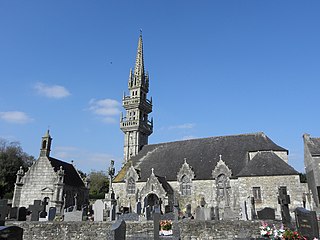
The Saint Servais Parish close is located at Saint-Servais in the arrondissement of Morlaix in Brittany in north-western France. It comprises the parish church of Saint Servais, with galleried bell tower, an ossuary, and calvary. The church was built in the 17th century on the ruins of an old 13th century chapel founded by the Duschastels, an old Breton family. It has three transepts and a chevet dating to 1688. The clock tower dates to 1610 and rises to 36 metres. It is a listed historical monument since 1914.

Plounéour-Ménez Parish close

The Plounéour-Ménez Parish close is located at Plounéour-Ménez in the arrondissement of Morlaix In Brittany in north-western France. The church Église Saint Yves was built in 1651 and there is evidence that it replaced an earlier and older church. The church and the "arc de triomphe" are a listed historical monument since 1914. The church at Plounéour-Ménez is dedicated to Saint Yves. Initially the enclos, constructed in granite, comprised the church itself, the cemetery situated around the church, an ossuary, a calvary positioned in the cemetery and a surrounding wall with several entrances, of which the main entrance is in the "Arc de Triomphe" style; the classic "enclos paroissial" in fact, but in time the cemetery was moved elsewhere and the ossuary destroyed. The church has nine transepts with large panelled aisles. The bell tower has no gallery and the clocheton on the spire was hit by lightning in 1847 and destroyed. The pulpit dates to the 17th Century and is richly decorated with carvings depicting the four evangelists and their attributes: an angel for Saint Matthew, a lion for Saint Mark, a bull for Saint Luke and an eagle for Saint John. Other carvings depict Abraham's sacrifice, the Pascal lamb, the Last supper and Saint Peter's denial.

Saint Divy Parish close

The Saint Divy Parish close is located at Saint-Divy in the arrondissement of Brest in Brittany in north-western France. This enclos paroissial is centered on the Église de Saint-Divy which was built in two stages, the first in 1531. It is a listed historical monument since 1995.

Lampaul-Guimiliau Parish close church located in Finistère, in France

The Lampaul-Guimiliau Parish close is located at Lampaul-Guimiliau in the arrondissement of Morlaix in Brittany in north-western France. It is a monumental churchyard belonging to the Église Notre-Dame in that town. This church was built in the late 16th century to replace an older one. The structures in the parish close date to the 16th and 17th century. It is a listed historical monument since 1910.

Plourin-lès-Morlaix Parish close

The Plourin-lès-Morlaix Parish close is located at Plourin-lès-Morlaix in the arrondissement of Morlaix in Brittany in north-western France. The Enclos paroissial comprises the Notre-Dame church, a cemetery, ossuary and retaining wall. The church is a listed historical monument since 1932.
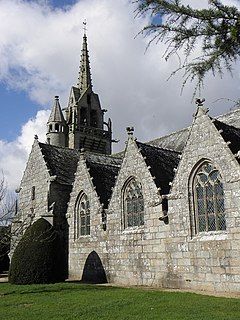
Plougonven Parish close parish close located in Finistère, in France

The Plougonven Parish close is located at Plougonven in the arrondissement of Morlaix in Finistère in Brittany in north-western France. The parish close comprises the church, an ossuary, the enclosure wall and the Calvary at Plougonven. It is a listed historical monument since 1916.

Saint-Thégonnec Parish close parish close located in Finistère, in France

The Saint-Thégonnec Parish close is located at Saint-Thégonnec in the arrondissement of Morlaix in Brittany in north-western France. The enclos paroissial comprises the parish church of Notre-Dame, a triumphal arch and enclosure wall, an ossuary and the famous calvary. It is a listed historical monument. There is a second calvary set into the enclosure wall and the war memorial dedicated to those lost in the 1914-1918 war is also set into another section of the wall.

Pleyben Parish close parish close located in Finistère, in France

The Pleyben Parish close is located at Pleyben within the Châteaulin arrondissement of Brittany in north-western France. The enclos paroissial comprises the parish church dedicated to Saint Germain of Auxerre, a funeral chapel/ossuary, a triumphal arch serving as the enclos entrance and the Calvary at Pleyben. The building is dominated by two bell-towers. One, that on the right, and known as the "Saint Germain", is in the Renaissance style and is topped by a lanterned dome whilst the second bell-tower has a Gothic style spire. Between the two bell-towers there is a stair turret with pinnacles and an ornate spire. It is a listed historical monument since 1846.

Commana Parish close parish district corresponding to the churchyard in Commana, Brittany, France

The Commana Parish close is located at Commana in the arrondissement of Morlaix in Brittany in north-western France. The parish church of Commana is dedicated to the 14th century Breton saint, Saint Derrien. The church was built in 1645. The church, the ossuary, the calvary and the triumphal arch are a listed historical monument since 1915.

Locmélar Parish close

The Locmélar Parish close is located at Locmélar in the arrondissement of Morlaix in Brittany in north-western France. It is a listed historical monument since 1934.

Plomodiern Parish close

The Plomodiern Parish close is located near the village Plomodiern in the arrondissement of Châteaulin, Brittany, north-western France. It is a listed historical monument since 1914.
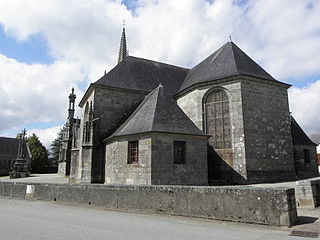
Brasparts Parish close

The Brasparts Parish close is located at Brasparts within Brittany's Châteaulin arrondissement in north-western France. The church is named the Église paroissial Notre-Dame-et-Saint-Tugen. Building started in 1551, a date which appears over the church's west door. The church is often called the "Église de Brasparts"' and is a listed historical monument since 1914. The church is dedicated to the Virgin Mary and Saint Tugen, the Breton saint, and is for the most part built in the Gothic style. It has a double galleried "léonard" style bell-tower with a conical side tower which contains a stairway to access the bells. The porch has statues of the twelve apostles. The north window of the choir dates to 1543. Two niches in the choir area depict the parish's two saints and protectors, the Virgin Mary and Saint Tujan or Tugan.
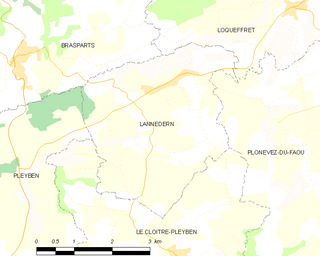
Lannédern Parish close

The Lannédern Parish close is located at Lannédern in the Châteaulin arrondissement within Brittany in north-western France. The parish close comprises the parish church of Saint-Edern dating to the 16th/17th century and the Saint Anne chapel, originally an ossuary. The church's south porch dates to 1662, the pulpit is 17th century as is the altar and altarpiece. The ossuary stands to the west of the church. The church, calvary and ossuary are listed historical monuments since 1915.
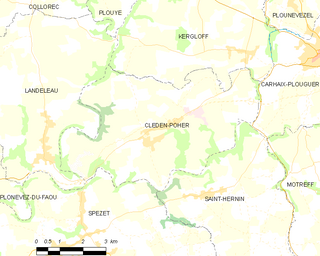
Cléden-Poher Parish close

The Cléden-Poher Parish close comprises the Église Notre-Dame de l'Assomption, a calvary and an ossuary, and is located in the arrondissement of Châteaulin in Finistère in Brittany in north-western France. It is a listed historical monument since 1983.

References

  1. Mérimée PA00090450 , Ministère français de la Culture. (in French) Eglise Saint-Suliau
  2. 1 2 3 Emmanuelle LeSeac'h. Sculpteurs sur pierre en Basse-Bretagne. Les Ateliers du XVe au XVIIe Siècle. Presses Universitaires de Rennes. ISBN   978-2-7535-3309-7.
  3. 1 2 3 4 5 "The Sizun enclosure" . Retrieved 6 March 2015.
  4. 1 2 3 4 5 "The Sizun enclosure" . Retrieved 6 March 2015.
  5. 1 2 3 4 5 "The Sizun enclosure" . Retrieved 6 March 2015.
  6. 1 2 3 4 5 "The Sizun enclosure" . Retrieved 6 March 2015.
  7. "The Sizun Parish close" . Retrieved 4 February 2016.

Coordinates: 48°24′21″N4°04′42″W / 48.4057°N 4.0782°W / 48.4057; -4.0782