
The Polygonaceae are a family of flowering plants known informally as the knotweed family or smartweed—buckwheat family in the United States. The name is based on the genus Polygonum, and was first used by Antoine Laurent de Jussieu in 1789 in his book, Genera Plantarum. The name may refer to the many swollen nodes the stems of some species have, being derived from Greek [poly meaning 'many' and gony meaning 'knee' or 'joint']. Alternatively, it may have a different origin, meaning 'many seeds'.
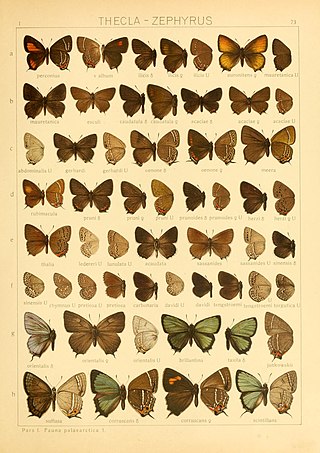
Satyrium ledereri, the orange banded hairstreak, is a butterfly in the family Lycaenidae.

Atraphaxis is a genus of flowering plants in the family Polygonaceae with about 40 species.

Aroga is a genus of moths in the family Gelechiidae.
Coleophora trivalvis is a moth of the family Coleophoridae.
Coleophora anthocalia is a moth of the family Coleophoridae. It is found in Tajikistan.
Coleophora ichthyura is a moth of the family Coleophoridae. It is found in Tajikistan.
Coleophora coriacea is a moth of the family Coleophoridae.
Augasma atraphaxidellum is a moth of the family Coleophoridae. It is found in Russia and Armenia.
Aroga atraphaxi is a moth of the family Gelechiidae. It is found in Tajikistan.
Aroga panchuli is a moth of the family Gelechiidae. It is found in Tajikistan.
Polygonum undulatum is a species of flowering plant in the family Polygonaceae, native to the Cape Provinces of South Africa. It was first described by Carl Linnaeus in 1753 as Atraphaxis undulata, and later transferred to Polygonum by Peter Jonas Bergius.
Neofriseria turkmeniella is a moth of the family Gelechiidae. It is found in the Uzbekistan, Turkmenistan, southern Kazakhstan and Tajikistan.
Aristotelia tyttha is a moth of the family Gelechiidae. It was described by Mark I. Falkovitsh and Oleksiy V. Bidzilya in 2003. It is found in Uzbekistan.
Spiniductellus is a genus of moths in the family Gelechiidae.
Spiniductellus flavonigrum is a moth of the family Gelechiidae. It is found in south-eastern Kazakhstan and Kyrgyzstan.
Athamanthia phoenicura is a butterfly of the family Lycaenidae. It was described by Julius Lederer in 1870 and is found in Armenia, Turkmenistan, Turkey, Iran, Afghanistan, Pakistan.
Calligonum junceum is a small shrub native to Central Asia and China, including the Kyzylkum Desert. It has been introduced to the Sahara. It is long fruiting.

Polygonoideae is a subfamily of plants in the family Polygonaceae. It includes a number of plants that can be highly invasive, such as Japanese knotweed, Reynoutria japonica, and its hybrid with R. sachalinensis, R. × bohemica. Boundaries between the genera placed in the subfamily and their relationships have long been problematic, but a series of molecular phylogenetic studies have clarified some of them, resulting in the division of the subfamily into seven tribes.

Duma is a genus of shrubby flowering plants in the family Polygonaceae, subfamily Polygonoideae. The genus was separated from Muehlenbeckia in 2011. The native range of the genus is Australia.


