
Watson Fothergill was a British architect who designed over 100 unique buildings in Nottingham in the East Midlands of England. His influences were mainly from the Gothic Revival and Old English vernacular architecture styles.
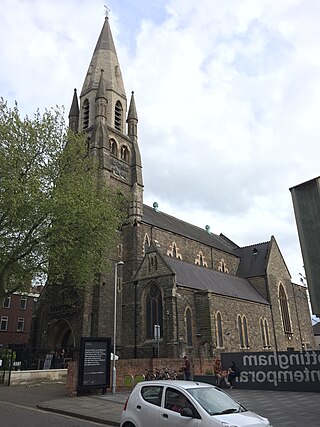
High Pavement Chapel is a redundant church building in Nottingham, Nottinghamshire, England. It is now the Pitcher and Piano public house and is Grade II listed. It was built as, and for most of its existence operated as, a Unitarian place of worship.

Thomas Chambers Hine was an architect based in Nottingham.

St. John the Baptist Church is an Anglican church in Beeston, Nottinghamshire, England.

St Stephen's Church, Sneinton is a parish church in the Church of England. It is the parish church of the Sneinton suburb of Nottingham, Nottinghamshire, England.
Richard Charles Sutton was an architect based in Nottingham. He was born 1834 and died on 18 October 1915.

St. Giles' Church, West Bridgford is an Anglican parish church in West Bridgford, Nottinghamshire.

Charles Lloyd was a pipe organ builder based in Nottingham who flourished between 1859 and 1908.
St. Paul's Church, George Street, was a Church of England church built as a chapel of ease to St. Mary's Church, Nottingham. It was opened in 1822 and closed in 1924.
St. James' Church, Standard Hill was a Church of England church in Nottingham.
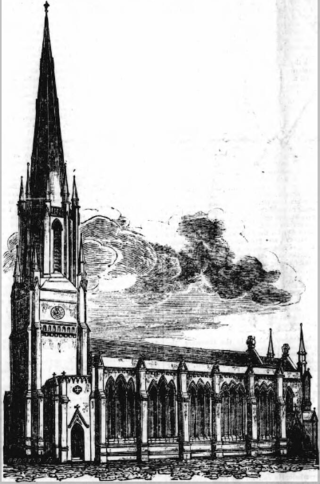
Holy Trinity Church, Nottingham was a Church of England church in Nottingham from 1841 to 1958.
St Mark's Church, Nottingham, was a Church of England church in Nottingham, Nottinghamshire, England between 1856 and 1958. The section of Huntingdon Street where the church was located was formerly called Windsor Street.
Emmanuel Church, Nottingham was a Church of England church in Nottingham on Woodborough Road between 1883 and 1972.

Lieutenant-Colonel Arthur William Lancelot Brewill was an architect based in Nottingham.
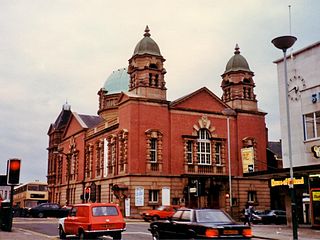
Arthur George Marshall ARIBA was an architect based in Nottingham from 1881.

Robert Evans FRIBA, JP was an English architect based in Nottingham.

Abraham Harrison Goodall LRIBA was a British architect based in Nottingham.

John Collyer was an architect based in Nottingham.
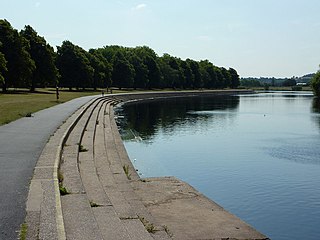
Arthur Brown M.Inst. C.E. was City Engineer for Nottingham, England from 1880 to 1919.

James Tait FRIBA FRIBA was an architect based in Leicester.

