
The lesser adjutant is a large wading bird in the stork family Ciconiidae. Like other members of its genus, it has a bare neck and head. It is however more closely associated with wetland habitats where it is solitary and is less likely to scavenge than the related greater adjutant. It is a widespread species found from India through Southeast Asia to Java.

The banteng, also known as tembadau, is a species of cattle found in Southeast Asia. The head-and-body length is between 1.9 and 3.68 m. Wild banteng are typically larger and heavier than their domesticated counterparts, but are otherwise similar in appearance. The banteng shows extensive sexual dimorphism; adult bulls are generally dark brown to black, larger and more sturdily built than adult cows, which are thinner and usually pale brown or chestnut red. There is a big white patch on the rump. Horns are present on both sexes, and are typically 60 to 95 cm long. Three subspecies are generally recognised.
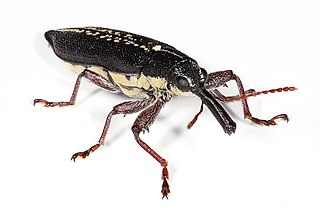
Belidae is a family of weevils, called belids or primitive weevils because they have straight antennae, unlike the "true weevils" or Curculionidae which have geniculate (elbowed) antennae. They are sometimes known as "cycad weevils", but this properly refers to a few species from the genera Parallocorynus and Rhopalotria.

The Orsodacnidae are a small family of leaf beetles, previously included as a subfamily within the Chrysomelidae. It is the smallest of the Chrysomeloid families in North America; Oxypeltidae is smaller, with only three species in South America. A fossil species of Aulacoscelis is known from the Early Cretaceous (Aptian-Albian) Santana Group of Brazil.
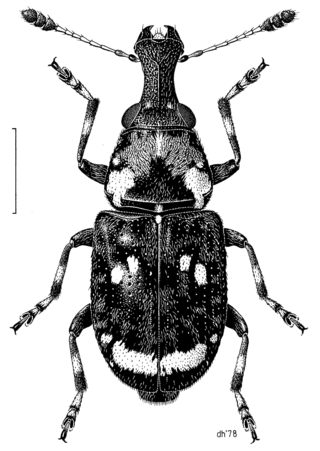
Anthribidae is a family of beetles also known as fungus weevils. The antennae are not elbowed, may occasionally be longer than the body and thread-like, and can be the longest of any members of Curculionoidea. As in the Nemonychidae, the labrum appears as a separate segment to the clypeus, and the maxillary palps are long and projecting.

Nemonychidae is a small family of weevils, placed within the primitive weevil group because they have straight rather than geniculate (elbowed) antennae. They are often called pine flower weevils. As in the Anthribidae, the labrum appears as a separate segment to the clypeus, and the maxillary palps are long and projecting. Nemonychidae have all ventrites free, while Anthribidae have ventrites 1-4 connate or partially fused. Nemonychidae lack lateral carinae on the pronotum, while these are usually present, though may be short, in Anthribidae.

The Java mouse-deer is a species of even-toed ungulate in the family Tragulidae. When it reaches maturity it is about the size of a rabbit, making it the smallest living ungulate. It is found in forests in Java and perhaps Bali, although sightings there have not been verified.
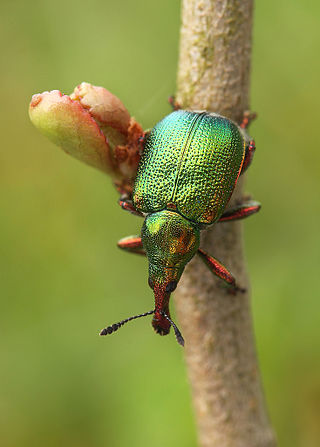
The tooth-nosed snout weevils, Rhynchitidae, are small beetles that are usually found in vegetation. They usually use buds, fruits, or seeds for oviposition. The tooth-nosed snout weevils receive this name due to the teeth on the edges of their mandibles.
Vladimir Vasilevich Zherikhin, of the Paleontological Institute, Russian Academy of Sciences, Moscow, was one of the world's leading paleoentomologists and coleopterists. He worked on the palaeontology of the Coleoptera (beetles) and of insects in general, and on the taxonomy of the weevils (Curculionoidea).
Catalabus is a genus of leaf rolling weevils in the beetle family Attelabidae. There are about nine described species in Catalabus.
Homapoderus is a genus of weevils in the family Attelabidae. The genus was named and described by Legalov in 2003.

Haplorhynchites is a genus of leaf and bud weevils in the beetle family Attelabidae. There are ten species recognised in the genus Haplorhynchites.
Caulophilus is a genus of true weevils in the beetle family Curculionidae. There are more than 20 described species in Caulophilus.
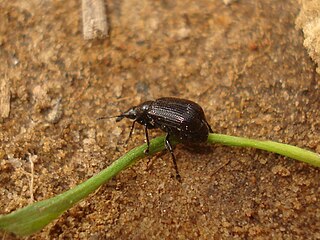
Deporaus is a genus of leaf and bud weevils in the beetle family Attelabidae. There are more than 200 described species in Deporaus.

Mesophyletidae is an extinct family of weevils known from a number of genera preserved in Cretaceous amber. The family was first described as a subfamily in the extant family Caridae, and subsequently raised to family status in 2018.

Apoderinae is a subfamily of leaf rolling weevils in the beetle family Attelabidae. There are at least 20 genera and more than 650 described species in Apoderinae, found in Europe, Asia, and Africa.
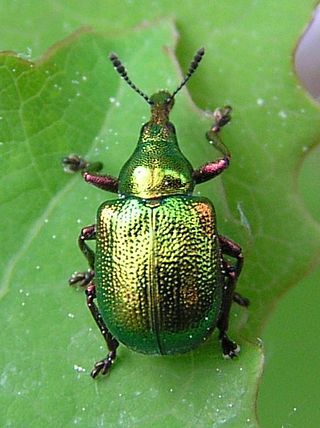
Byctiscus is a genus of beetles belonging to the family Attelabidae. Species of the genus are found in Europe and Japan.
Temnocerus is a genus of beetles belonging to the family Attelabidae.
