The Accipitriformes are an order of birds that includes most of the diurnal birds of prey – including hawks, eagles, and kites, but not falcons.

The red-legged tinamou or red-footed tinamou, is a ground-dwelling bird found in the tropics and lower subtropics of northern South America.
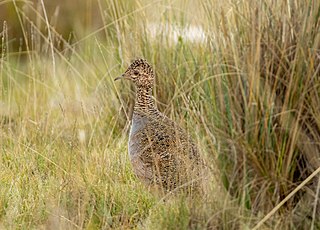
The ornate tinamou is a type of tinamou commonly found in the high altitude grassland and dry shrubland in subtropical and tropical regions of west central South America.
The Chaco nothura is a type of tinamou commonly found in brushland in Argentina and Paraguay.

The pale rockfinch or pale rock sparrow is a small sparrow found in the Middle East and Central Asia. It is the only member of the genus Carpospiza. Some authorities include it in the genus Petronia. Others have placed it in the finch family due to some similarities in behaviour and form, but the anatomy of its tongue exhibits characteristic sparrow features.

American sparrows are a group of mainly New World passerine birds, forming the family Passerellidae. American sparrows are seed-eating birds with conical bills, brown or gray in color, and many species have distinctive head patterns.

The glaucous-blue grosbeak, also known as the indigo grosbeak, is a species of bird in the family Cardinalidae. The South American Classification Committee of the American Ornithological Society assigns three more species to Cyanoloxia.

The Cuban nightjar, is a species of nightjar in the family Caprimulgidae. It is commonly found in Cuba, Cayo Coco and Isla de la Juventud. Its natural habitats are subtropical or tropical moist lowland forests and subtropical or tropical moist montane forests.

The Tumbes sparrow is a species of bird in the family Passerellidae found in Ecuador and Peru. Its natural habitats are subtropical or tropical dry forests and subtropical or tropical dry shrubland.

The black-capped donacobius is a conspicuous, vocal South American bird. It is found in tropical swamps and wetlands in Argentina, Bolivia, Brazil, Colombia, Ecuador, French Guiana, Guyana, Paraguay, Peru, Suriname, and Venezuela; also Panama of Central America.

The thrush-like antpitta is a species of bird in the family Grallariidae.

The wing-barred piprites is a species of bird which traditionally has placed in the family Pipridae, although it remains unclear if this is correct. It is therefore considered incertae sedis by recent authorities such as SACC.

The grey-headed piprites is a species of bird which traditionally has been placed in the family Pipridae, although it remains unclear if this is correct. It is considered incertae sedis by recent authorities such as SACC. It is found in Costa Rica, Guatemala, Honduras, and Nicaragua. Its natural habitat is subtropical or tropical moist lowland forest.

The white-winged tanager is a medium-sized American songbird. Formerly placed in the tanager family (Thraupidae), it and other members of its genus are now classified in the cardinal family (Cardinalidae). The species' plumage and vocalizations are similar to other members of the cardinal family. Along with the red-headed tanager and red-hooded tanager, it is sometimes placed in the genus Spermagra.

The rose-throated tanager is a medium-sized American songbird. Formerly placed in the tanager family (Thraupidae), it and other members of its genus are now classified in the cardinal family (Cardinalidae).

The black-and-rufous warbling finch is a species of bird in the family Thraupidae.

The white-throated thrush is a species of bird in the family Turdidae. It is found in Mexico and Central America, ranging south to central Panama. Its natural habitats are subtropical or tropical dry forests, subtropical or tropical moist lowland forests, and subtropical or tropical moist montane forests. It is common in its range and an extremely rare vagrant into Texas and Arizona; 3 sightings have been recorded.

Rhynchospiza is a genus of American sparrows. It was formerly included in Aimophila, but recent molecular studies show these two species to merit their own genus. Both species are distributed in South America.
The Tapajos antpitta is a species of bird in the family Grallariidae.