Proof using characteristic functions
The characteristic function
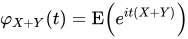
of the sum of two independent random variables X and Y is just the product of the two separate characteristic functions:

of X and Y.
The characteristic function of the normal distribution with expected value μ and variance σ2 is
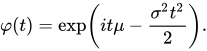
So
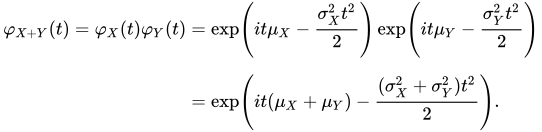
This is the characteristic function of the normal distribution with expected value  and variance
Finally, recall that no two distinct distributions can both have the same characteristic function, so the distribution of X + Y must be just this normal distribution.
Proof using convolutions
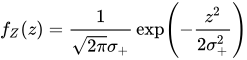
For independent random variables X and Y, the distribution fZ of Z = X + Y equals the convolution of fX and fY:

Given that fX and fY are normal densities,

Substituting into the convolution:
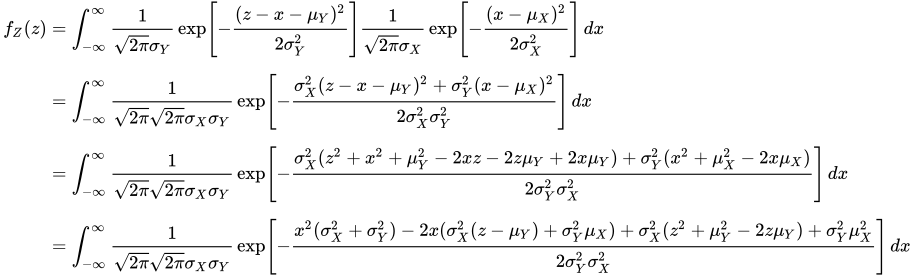
Defining 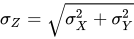 , and completing the square:
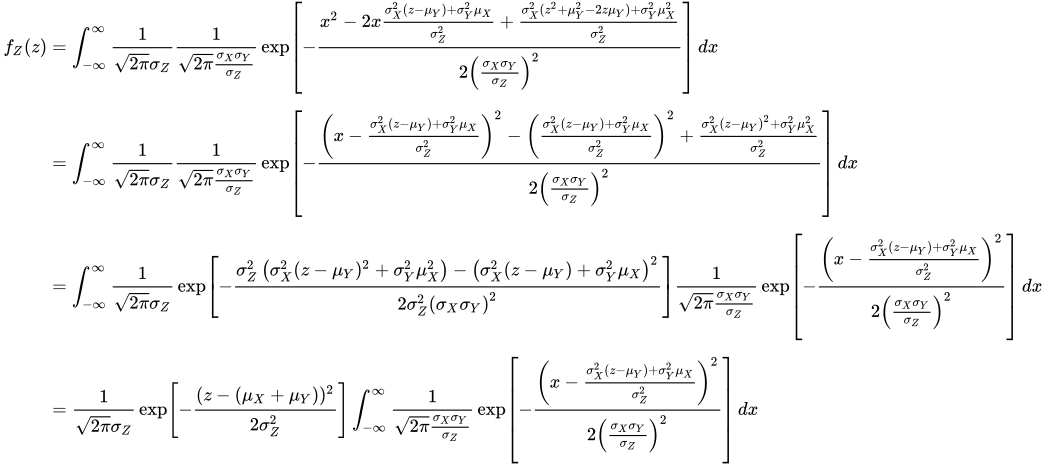
The expression in the integral is a normal density distribution on x, and so the integral evaluates to 1. The desired result follows:

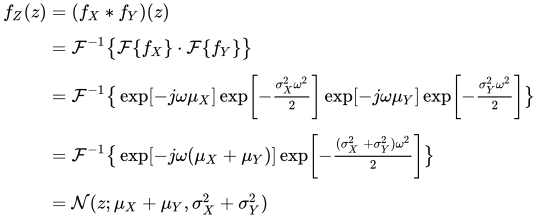
It can be shown that the Fourier transform of a Gaussian,  , is [3]

By the convolution theorem:
Geometric proof
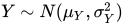
First consider the normalized case when X, Y ~ N(0, 1), so that their PDFs are
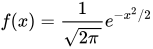
and
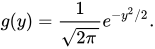
Let Z = X + Y. Then the CDF for Z will be
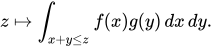
This integral is over the half-plane which lies under the line x+y = z.
The key observation is that the function
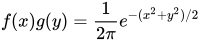
is radially symmetric. So we rotate the coordinate plane about the origin, choosing new coordinates  such that the line x+y = z is described by the equation
  where
where  is determined geometrically. Because of the radial symmetry, we have
  , and the CDF for Z is

This is easy to integrate; we find that the CDF for Z is
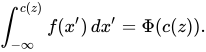
To determine the value  , note that we rotated the plane so that the line x+y = z now runs vertically with x-intercept equal to c. So c is just the distance from the origin to the line x+y = z along the perpendicular bisector, which meets the line at its nearest point to the origin, in this case
  . So the distance is
  , and the CDF for Z is
  , i.e.,
Now, if a, b are any real constants (not both zero) then the probability that  is found by the same integral as above, but with the bounding line
  . The same rotation method works, and in this more general case we find that the closest point on the line to the origin is located a (signed) distance

away, so that

The same argument in higher dimensions shows that if

then

Now we are essentially done, because

So in general, if

then