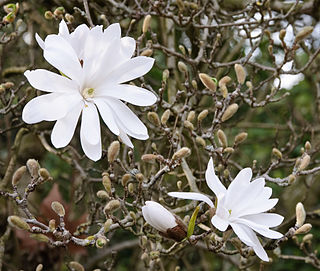
Magnolia stellata, sometimes called the star magnolia, is a slow-growing shrub or small tree native to Japan. It bears large, showy white or pink flowers in early spring, before its leaves open. This species is closely related to the Kobushi magnolia, and is treated by many botanists as a variety or even a cultivar of that. However, Magnolia stellata was accepted as a distinct species in the 1998 monograph by Hunt.

Quercus stellata, the post oak or iron oak, is a North American species of oak in the white oak section. It is a slow-growing oak that lives in dry areas on the edges of fields, tops of ridges also grows in poor soils, and is resistant to rot, fire, and drought. Interbreeding occurs among white oaks, thus many hybrid species combinations occur.

Tabernaemontana is a genus of flowering plants in the family Apocynaceae. It has a pan-tropical distribution, found in Asia, Africa, Australia, North America, South America, and a wide assortment of oceanic islands. These plants are evergreen shrubs and small trees growing to 1–15 m tall. The leaves are opposite, 3–25 cm long, with milky sap; hence it is one of the diverse plant genera commonly called "milkwood". The flowers are fragrant, white, 1–5 cm in diameter.

Voacangine is an alkaloid found predominantly in the root bark of the Voacanga africana tree, as well as in other plants such as Tabernanthe iboga, Tabernaemontana africana, Trachelospermum jasminoides, Tabernaemontana_divaricata and Ervatamia yunnanensis. It is an iboga alkaloid which commonly serves as a precursor for the semi-synthesis of ibogaine. It has been demonstrated in animals to have similar anti-addictive properties to ibogaine itself. It also potentiates the effects of barbiturates. Under UV-A and UV-B light its crystals fluoresce blue-green, and it is soluble in ethanol.

The Chyulu Hills is a mountain range in Makueni County, South Eastern Kenya. It forms a 100 kilometre long volcanic field in elongated NW-SE direction. Its highest peak is 2188 metres high.

Ibogamine is an anti-convulsant, anti-addictive CNS stimulant alkaloid found in Tabernanthe iboga and Crepe Jasmine . Basic research related to how addiction affects the brain has used this chemical.
Anthonius Josephus Maria "Toon" Leeuwenberg was a Dutch botanist and taxonomist best known for his research into the genus Buddleja at the Laboratory of Plant Taxonomy and Plant Geography, Wageningen. He was responsible for sinking many Asiatic species as varieties, notably within Buddleja crispa. In 1962, he worked with Jan de Wilde on the flora of the Ivory Coast.

Tabernaemontana divaricata commonly called pinwheel flower, crape jasmine, East India rosebay and Nero's crown is an evergreen shrub native to South Asia and now cultivated throughout South East Asia and the warmer regions of continental Asia. In zones where it is not hardy it is grown as a house/glasshouse plant for its attractive flowers and foliage. The stem exudes a milky latex when broken, whence the name milk flower.
Tabernaemontana coffeoides is a species of flowering plant in the Apocynaceae family. It grows as a shrub or small tree up to 10 metres (33 ft) tall, with a trunk diameter of up to 20 centimetres (8 in). Its fragrant flowers feature white corolla lobes. Its habitat is on dunes or on rocks in dry forest, bush or savanna from sea level to 1,300 metres (4,300 ft) altitude. Local medicinal uses include for weight loss and to combat fatigue. Tabernaemontana coffeoides is native to Seychelles, the Comoros and Madagascar. It is also rich in pharmacologically interesting indole alkaloids.

Tabernaemontana crassa is a plant in the dogbane family Apocynaceae, native to tropical Africa.

Tabernaemontana elegans, the toad tree, is a shrub or small tree in the family Apocynaceae. It is native to eastern Africa.
Tabernaemontana macrocarpa grows as a shrub or tree up to 30 metres (100 ft) tall, with a trunk diameter of up to 50 centimetres (20 in). The bark is yellowish brown, brown, grey-brown or grey. Its fragrant flowers feature combinations of cream, white and orange corolla lobes. The fruit is orange, with paired follicles, each up to 16 centimetres (6 in) in diameter. The specific epithet macrocarpa is from the Greek meaning "with large fruit". Its habitat is forests from sea level to 1,500 metres (5,000 ft) altitude. Tabernaemontana macrocarpa has been used as arrow poison. The species is native to Thailand and Malesia.

Tabernaemontana pandacaqui, known as windmill bush and banana bush, is a species of plant in the dogbane family Apocynaceae.
Tabernaemontana pauciflora is a species of plant in the family Apocynaceae. It grows as a shrub or small tree up to 6 metres (20 ft) tall, with a trunk diameter of up to 10 centimetres (4 in). The bark is pale grey to grey-brown. Inflorescences bear up to 15 flowers. The fragrant flowers feature white, sometimes yellow-throated, corolla lobes. The fruit is orange or yellow with paired follicles, up to 6 centimetres (2 in) in diameter.

Affinine is a monoterpenoid indole alkaloid which can be isolated from plants of the genus Tabernaemontana. Structurally it can be considered a member of the vobasine alkaloid family and may be synthesized from tryptophan. Limited pharmacological testing has indicated that it may be an effective inhibitor of both acetylcholinesterase and butyrylcholinesterase.

Affinisine is a monoterpenoid indole alkaloid which can be isolated from plants of the genus Tabernaemontana. Structurally it can be considered a member of the sarpagine alkaloid family and may be synthesized from tryptophan via a Pictet-Spengler reaction.
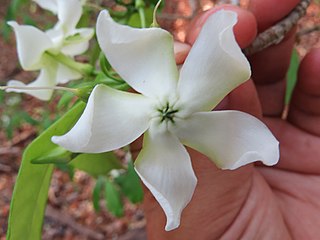
Tabernaemontana amygdalifolia is a species of plant in the family Apocynaceae. It is native to southern Mexico, Central America, Cuba, Haiti, and northwestern South America.
Tabernaemontana eglandulosa is a species of plant in the family Apocynaceae. It is found in Benin to Angola.

Apparicine is a monoterpenoid indole alkaloid. It is named after Apparicio Duarte, a Brazilian botanist who studied the Aspidosperma species from which apparicine was first isolated. It was the first member of the vallesamine group of alkaloids to be isolated and have its structure established, which was first published in 1965. It has also been known by the synonyms gomezine, pericalline, and tabernoschizine.

Tabernaemontanine is a naturally occurring monoterpene indole alkaloid found in several species in the genus Tabernaemontana including Tabernaemontana divaricata.

