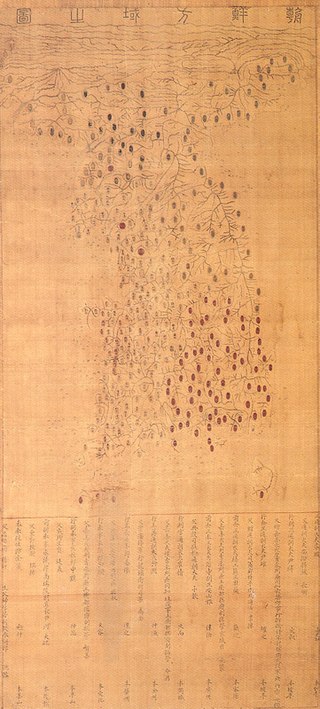
The history of South Korea formally begins with the Japanese surrender on 2 September 1945. Noting that, South Korea and North Korea are entirely different countries, despite still being the same people and on the same peninsula.

The president of the Republic of Korea, also known as the president of South Korea (Korean: 대통령), is the head of state and head of government of the Republic of Korea. The president leads the State Council, and is the chief of the executive branch of the national government as well as the commander-in-chief of the Republic of Korea Armed Forces.
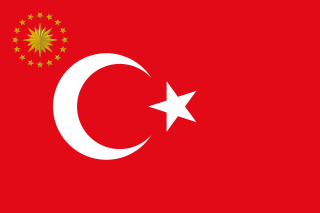
The president of Turkey, officially the president of the Republic of Türkiye, is the head of state and head of government of Turkey. The president directs the executive branch of the national government and is the commander-in-chief of the Turkish military. The president also heads the National Security Council.
The abolition of monarchy and anti-royalism is a legislative or revolutionary movement to abolish monarchical elements in government, usually hereditary.
A term limit is a legal restriction on the number of terms a person may serve in a particular elected office. When term limits are found in presidential and semi-presidential systems they act as a method of curbing the potential for monopoly, where a leader effectively becomes "president for life". This is intended to protect a republic from becoming a de facto dictatorship. Term limits may be a lifetime limit on the number of terms an officeholder may serve, or a limit on the number of consecutive terms.

The Supreme Council for National Reconstruction was the ruling military junta of South Korea from May 1961 to December 1963.
The second Republic of Korea was the government of South Korea from April 1960 to May 1961.
The Third Republic of South Korea was the government of South Korea from December 1963 to November 1972. The Third Republic was founded on the dissolution of the Supreme Council for National Reconstruction that overthrew the Second Republic and established a military government in May 1961. Park Chung-hee, the Chairman of the Supreme Council, was elected President of South Korea in the 1963 presidential election.
The fourth Republic of Korea was the government of South Korea from November 1972 to March 1981.

The fifth Republic of South Korea was the government of South Korea from March 1981 to December 1987.
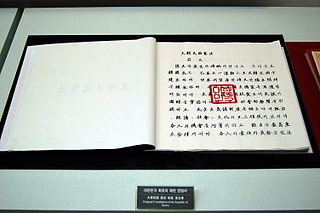
The Constitution of the Republic of Korea is the supreme law of South Korea. It was promulgated on July 17, 1948, and last revised on October 29, 1987.

The Democratic Justice Party was the ruling party of South Korea from 1981 to 1988.
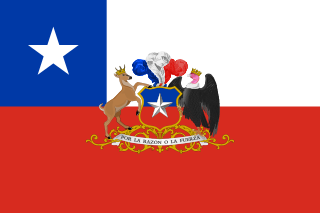
The president of Chile, officially known as the President of the Republic of Chile, is the head of state and head of government of the Republic of Chile. The President is responsible for both government administration and state administration. Although its role and significance have changed over time, and its position and relations with other actors in the national political organization have also evolved, it remains one of the most prominent political offices in the country. It is also considered one of the key institutions that form the "Historic Constitution of Chile," and is crucial to the country's political stability.

Presidential elections were held in South Korea on 16 December 1987. They marked the establishment of the Sixth Republic, as well as the end of the authoritarian rule that had prevailed in the country for all but one year since its founding in 1948. They were the first direct presidential elections since 1971. For the previous 15 years, presidents had been indirectly elected by the National Conference for Unification, an electoral college dominated by the governing party.
The October Yusin or October Restoration was an October 1972 South Korean self-coup in which President Park Chung Hee assumed dictatorial powers. Park had come to power as the head of the Supreme Council for National Reconstruction after the May 16 coup of 1961, and in 1963 he won elections and assumed office as civilian president.

Parliamentary elections were held in South Korea on 29 July 1960. They were the first and only direct elections of the Second Republic and saw the first election of members of the new House of Councillors, together with the fifth election of members of the House of Representatives. They were also the first relatively free and fair national elections held in the country, but would be the last free elections until the 1987 presidential elections. Voter turnout was 84.3%.

Park Chung Hee was a South Korean politician and army general who led South Korea from 1961 until his assassination in 1979; he ruled as a military strongman from 1961 to 1963, then as the third President of South Korea from 1963 to 1979.

Term limits in Russia are limitations set by the Constitution of Russia that limit how long an individual may hold a specific political office in Russia. The Russian government uses consecutive term limits, requiring officeholders to leave office after term limits have been reached, but allowing them to seek the office again after one term of separation. The President of Russia is limited to no more than two consecutive six year terms, and governors of all federal subjects are limited to no more than two consecutive five year terms.


 South Koreaportal


