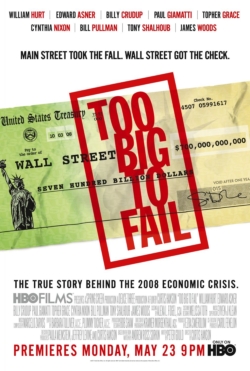
The film chronicles the 2008 financial crisis, focusing on the collapse of Lehman Brothers investment bank and the subsequent ripple effects on the global economy. As the firm's negotiations with potential buyers fail due to toxic assets and regulatory obstacles, the firm declares bankruptcy, triggering market chaos. Treasury Secretary Henry Paulson (Hurt) and Federal Reserve Chair Ben Bernanke (Giamatti) lead efforts to stabilize the system, including rescuing AIG and lobbying Congress to pass the Troubled Asset Relief Program (TARP).
In 2008, the subprime mortgage crisis is affecting investment banks that have amassed massive real estate holdings. The fifth-largest investment bank, Bear Sterns, is taken over by JPMorgan Chase after its sale is subsidised by Treasury Secretary, Henry Paulson. In the midst of an election year, Paulson is wary of funding more ‘bailouts’. Shares of the fourth largest bank, Lehman Brothers, have lost significant value. Despite this, CEO Richard Fuld turns down offers from Warren Buffett and South Korean investors, while holding out for favorable terms, At market close on Friday, September 12, shares of Lehman are trading in single-digits and the bank’s future seems uncertain.
Timothy Geithner, Chairman of the Federal Reserve Bank of New York, implores Paulson to allow federal guarantees towards expediting a merger of Lehman with Bank of America. Instead, Paulson wants the other affected banks to help rescue Lehman. Along with Geithner and SEC Chairman Christopher Cox, he convenes an emergency meeting of bank CEOs to resolve the Lehman issue. Banks discuss buying out Lehman’s devalued real estate assets, however, Bank of America announces a surprise merger with Lehman-rival Merrill Lynch instead. The main US buyer out, attention veers towards Barclays but British regulators refuse to relax restrictions, as they ‘do not want to import … [America’s] … cancer’. With no sale imminent by September 15, Lehman declares bankruptcy.
The fallout from the failure is immediate and far-reaching. The stock market crashes, leading investors to withdraw deposits. As a result, banks stop making new loans, freezing the credit market for businesses who cannot quickly borrow money for their operations. Even General Electric CEO Jeff Immelt feels their business affected. Amidst this, French Finance minister Christine Lagarde pressures Paulson to not let AIG fail like Lehman, since the firm is too interconnected in international business. AIG receives an $85 billion federal loan; banks Morgan Stanley and Goldman Sachs avoid Lehman’s fate, by striking deals with Mitsubishi and Buffett respectively.
Ben Bernanke believes unfreezing credit is a priority, else the situation could devolve into a generational crisis like the 1929 Depression. Paulson’s team of Neel Kashkari and Jim Wilkinson lobby Congress for blanket funds to deal with any developing situation. Their $700 billion proposal is rejected, and negotiations further stall when Republican Presidential nominee, John McCain, shows up mid-campaign to politicise the issue. Paulson talks down McCain from interfering, and a revised proposal called TARP is passed. Despite now having funds, the plan to buy out toxic assets from the system proves “too slow”. Advisor Dan Jester proposes injecting money into the system through the banks to unfreeze credit.
As part of the scheme, major banks are given loans worth $125 billion, to collectively lend out to borrowers. Very few restrictions are placed on them, however, since the government does not want to seem as if they are interfering with the banks. Realizing the irony of the situation, communications advisor Michele Davis laments that the same banks that caused the crisis are now also dictating terms. As credits roll, an epilogue reveals that credit conditions did not ease until 2009 when the market freefall was arrested. Meanwhile, the funds received by the banks facilitated new highs in Wall Street compensation, which rose to $135 billion by 2010.[1]
On review aggregator website Rotten Tomatoes, the film holds an approval rating of 74%, based on 27 reviews, and an average rating of 6/10.[3] On Metacritic, the movie received a weighted average score of 67/100 from 17 reviews, indicating "generally favorable reviews".[4]
This page is based on this Wikipedia article Text is available under the CC BY-SA 4.0 license; additional terms may apply. Images, videos and audio are available under their respective licenses.