Thanks to its coasts on the North Sea in the west and Baltic Sea in the east, Schleswig-Holstein has a great variety of beaches and water sports facilities. Due to its geographical location on the way to Scandinavia it is also a transit area for tourists from all over Europe.
Important tourist resorts
Statistics
In 2002 there were a total of 176,198 guest beds in Schleswig-Holstein, which were used that year by 2,968,406 visitors for 15,429,614 overnight stays. 278,786 der visitors came from abroad, which represents about 8.6% of all overnighting guests. The bathing resorts on the Baltic Sea had somewhat more visitors (720,115) than those on the North Sea (604,548), but on average the North Sea guests stayed longer, so that the total of overnight stays was greater (5,122,549) than on the Baltic Sea. Less important to tourism were the climatic spas (153,538 visitors with 592,705 overnight stays) and health spas (132,337 visitors with 755,153 overnight stays).
The most important destinations for tourists were, in order of the number of overnight stays:
Robbe & Berking Classic Week, Flensburg Fjord, biggest German regatta series for classic yachts (built before 1969, no yachts built with man-made materials)
A viewers' poll on holiday destinations in the NDR transmission area, that was carried out in 2007 for the NDR television with the title "The most beautiful holiday destinations in North Germany", resulted in the following rankings within Schleswig-Holstein:
Lübeck, officially the Hanseatic City of Lübeck, is a city in Northern Germany. With around 217,000 inhabitants, Lübeck is the second-largest city on the German Baltic coast and in the state of Schleswig-Holstein, after its capital of Kiel, and is the 35th-largest city in Germany. The city lies in Holstein, northeast of Hamburg, on the mouth of the River Trave, which flows into the Bay of Lübeck in the borough of Travemünde, and on the Trave's tributary Wakenitz. The city is part of the Hamburg Metropolitan Region, and is the southwesternmost city on the Baltic, as well as the closest point of access to the Baltic from Hamburg. The port of Lübeck is the second-largest German Baltic port after the port of Rostock. The city lies in the Northern Low Saxon dialect area of Low German.
Schleswig-Holstein is the northernmost of the 16 states of Germany, comprising most of the historical duchy of Holstein and the southern part of the former Duchy of Schleswig. Its capital city is Kiel; other notable cities are Lübeck and Flensburg.
Schleswig is a town in the northeastern part of Schleswig-Holstein, Germany. It is the capital of the Kreis (district) Schleswig-Flensburg. It has a population of about 27,000, the main industries being leather and food processing. It takes its name from the Schlei, an inlet of the Baltic sea at the end of which it sits, and vik or vig which means "bay" in Old Norse and Danish. Schleswig or Slesvig therefore means "bay of the Schlei".
Kiel is the capital and most populous city in the northern German state of Schleswig-Holstein, with a population of 249,023 (2016).
Nordfriesland is the northernmost district of Germany, part of the state of Schleswig-Holstein. It includes almost all of traditional North Frisia along with adjacent areas to the east and south and is bound by the districts of Schleswig-Flensburg and Dithmarschen, the North Sea and the Danish county of South Jutland. The district is called Kreis Nordfriesland in German, Kreis Noordfreesland in Low German, Kris Nordfraschlönj in Mooring North Frisian, Kreis Nuurdfresklun in Fering North Frisian and Nordfrislands amt in Danish.
Husum is the capital of the Kreis (district) Nordfriesland in Schleswig-Holstein, Germany. The town was the birthplace of the novelist Theodor Storm, who coined the epithet "the grey town by the sea". It is also the home of the annual international piano festival Raritäten der Klaviermusik founded in 1986.
Ostholstein is a district in Schleswig-Holstein, Germany. It is bounded by the districts of Stormarn, Segeberg and Plön, the Baltic Sea and the city of Lübeck.
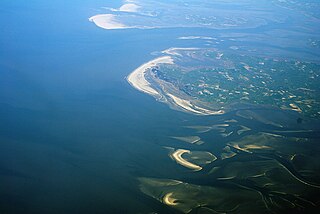
The Schleswig-Holstein Wadden Sea National Park is a national park in the Schleswig-Holstein area of the German Wadden Sea. It was founded by the Parliament of Schleswig-Holstein on 1 October 1985 by the National Park Act of 22 July 1985 and expanded significantly in 1999. Together with the Lower Saxon Wadden Sea National Park, the Hamburg Wadden Sea National Park and those parts of Elbe estuary which are not nature reserves, it forms the German part of the Wadden Sea.
The Bay of Kiel or Kiel Bay is a bay in the southwestern Baltic Sea, off the shores of Schleswig-Holstein in Germany and the islands of Denmark. It is connected with the Bay of Mecklenburg in the east, the Little Belt in the northwest, and the Great Belt in the North.
Wyk auf Föhr (help·info) is the only town on Föhr, the second largest of the North Frisian Islands on the German coast of the North Sea. Like the entire island it belongs to the district of Nordfriesland. Wyk includes the two minor town districts of Boldixum and Südstrand.
Westerland is a seaside resort and a former municipality located on the German North Sea island of Sylt. Since 1 January 2009, Westerland has been part of the municipality Gemeinde Sylt. Westerland is part of the Nordfriesland district in Schleswig-Holstein. It is the largest resort on the island, the local transportation hub and the centre of Sylt's tourist industry.
Heiligenhafen is a town in the district of Ostholstein, in Schleswig-Holstein, Germany. It is situated on the Baltic Sea coast, opposite the island Fehmarn, approx. 60 km northeast of Lübeck, and 55 km east of Kiel.
Schleswig-Holstein Police is a state law-enforcement agency in Schleswig-Holstein, Germany. They cover up to the border with Denmark.
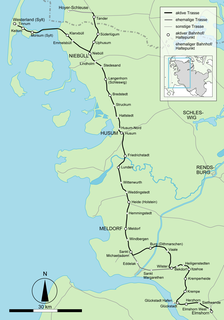
The Marsh Railway is a main line in the state of Schleswig-Holstein in Germany that links the stations of Elmshorn in the south and Westerland on the island of Sylt in the north. It is part of 237-kilometre long (147 mi) through route from Hamburg-Altona to Westerland (Sylt) and is listed in the Deutsche Bahn timetables as Kursbuchstrecke 130. The first part of it was opened in 1845 and is one of the oldest lines in Germany.
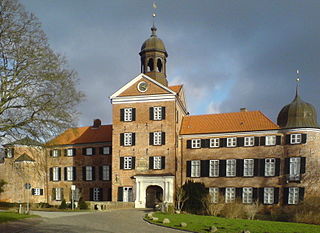
Eutin Castle in Eutin in the north German district of Ostholstein is the cultural centre and nucleus of the town. Taken together, this castle, Gottorf Castle and Glücksburg Castle, form the most important group of courtly secular buildings in the state of Schleswig-Holstein.
The Kiel–Flensburg railway is a single-track railway in Schleswig-Holstein, Germany. The railway connects the city of Kiel on the Baltic Sea with Eckernförde and Flensburg. Travel time over the 80 km (50 mi) railway is around 75 minutes with a maximum speed of 120 km/h (75 mph).
The Husum–Kiel railway is a main line railway in the German state of Schleswig-Holstein. While the central section of the line, which is shared with the Neumünster–Flensburg line, has two tracks and is electrified, its western and eastern sections are single track and are not electrified. It connects the cities of Husum and Kiel via Rendsburg and serves as an important east-west rail axis between the North Sea and the Baltic Sea.
The Flensburg–Husum–Tönning Railway Company built the first railway line in the Duchy of Schleswig. The line opened in 1854 and was one of the oldest railways in Germany.
This page is based on this Wikipedia article Text is available under the CC BY-SA 4.0 license; additional terms may apply. Images, videos and audio are available under their respective licenses.