
Seán O'Casey was an Irish dramatist and memoirist. A committed socialist, he was the first Irish playwright of note to write about the Dublin working classes.

Marmots are large ground squirrels in the genus Marmota, with 15 species living in Asia, Europe, and North America. These herbivores are active during the summer, when they can often be found in groups, but are not seen during the winter, when they hibernate underground. They are the heaviest members of the squirrel family.
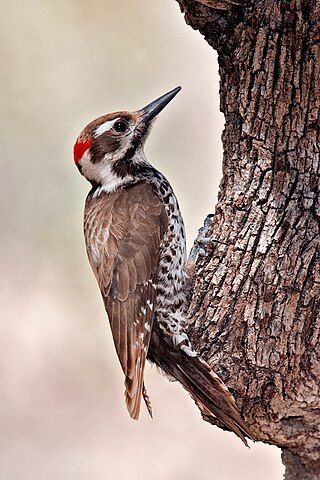
The Arizona woodpecker is a woodpecker native to southern Arizona and New Mexico and the Sierra Madre Occidental of western Mexico. The species' northernmost range in southeastern Arizona, extreme southwestern New Mexico, and northern Sonora is the region of the Madrean Sky Islands, a region of higher Sonoran Desert mountain ranges.

Joseph Edward Casey was a United States representative from Massachusetts. Born in Clinton, he attended the public schools, served as a private in the United States Army at Fort Lee, Virginia, in 1918, and graduated from the Boston University School of Law in 1920. He was admitted to the bar that year and commenced practice in Clinton. He was a delegate to the Democratic National Conventions in 1924, 1932, 1936, 1940, and 1944, and was elected as a Democrat to the Seventy-fourth and to the three succeeding Congresses. He was not a candidate for renomination in 1942 to the Seventy-eighth Congress and was an unsuccessful candidate for election to the United States Senate. He resumed the practice of law in Boston and in Washington, D.C., where he resided until his death. Interment was in Arlington National Cemetery, Section 1, Lot 761-B.

The Arizona cotton rat or Colorado River cotton rat is a species of rodent in the family Cricetidae. It is found in Mexico and the United States.

The Arizona shrew is a species of shrew native to North America.
The 1918 Brooklyn Robins finished the season in fifth place.

The Mexican whip-poor-will,, is a medium-sized nightjar of the southwestern United States, Mexico, and northern Central America.

Bembidion is the largest genus of beetles in the family Carabidae by number of species. All species are small and move very fast. Most of them live close to water. The genus has a biantitropical distribution, meaning they are found in both the Northern and Southern Hemispheres, but not in the tropics. In warmer regions it is substituted by closely related Tachys and other genera.

Trechus is a genus of ground beetle native to the Palearctic and the Near East. There are more than 1,000 described species in Trechus.

Apyrrothrix is a genus of skippers in the family Hesperiidae.

Stenus is a genus of semiaquatic rove beetles in the subfamily Steninae, and one of the largest genus in the kingdom Animalia, with some 2700 known species worldwide. They are predators of Collembola and other small arthropods. Adults have a protrusible labium with a sticky tip used in prey capture. To overcome the rapid escape of Collembola, the labium is protruded at high speed by hemolymph pressure, and immediately withdrawn, pulling the prey within the range of the mandibles. However, the labium tip does not easily stick to preys covered in scales or setae or that have a large body size. Stenus comma is more likely to catch such preys by lunging forward and grabbing them directly with its mandibles rather than using its labium. Stenus species are also known for "skimming" on the water surface using their pygidial gland secretions that act as a surfactant and rapidly propel the beetle fast forward, a phenomenon known as the Marangoni effect. Stenus comma has been seen to achieve a velocity of 0.75 m/s, and to cover a distance of up to 15 m if the secretion is continuous.
Trechus aethiopicus is a species of ground beetle in the subfamily Trechinae. It was described by Alluaud in 1918.
Bonagota arizonae is a species of moth of the family Tortricidae. It is found in the United States in Arizona where it was found in the Huachuca Mountains.
Evergestis angustalis is a moth in the family Crambidae. It was described by William Barnes and James Halliday McDunnough in 1918. It is found in North America, where it has been recorded from California and Arizona.
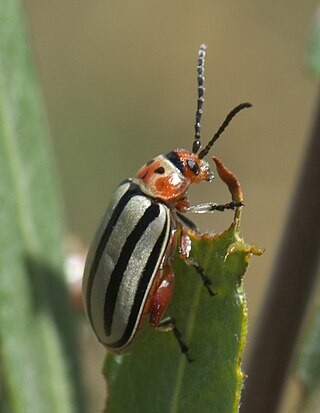
Disonycha is a genus of flea beetles in the family Chrysomelidae, containing some 170 species in the Nearctic and Neotropics.
Brachygluta is a genus of ant-loving beetles in the family Staphylinidae. There are more than 80 described species in Brachygluta.

Syzeton is a genus of ant-like leaf beetles in the family Aderidae. There are more than 10 described species in Syzeton.
Disonycha arizonae is a species of flea beetle in the family Chrysomelidae. It is found in Central America and North America.
Oulema arizonae is a species of leaf beetle in the family Chrysomelidae. It is found in North America.
