
Thomas Vernon Wollaston was an English entomologist and malacologist, becoming especially known for his studies of Coleoptera inhabiting several North Atlantic archipelagoes. He was well-placed socially. His religious beliefs effectively prevented him from supporting Charles Darwin's theories after 1859, but Darwin remained a close friend. Wollaston supported the theory that continental lands had once extended outward farther to encompass some of the island groups he studied.
Francis Wollaston was a British astronomer and Church of England priest. He was elected a Fellow of the Royal Society in 1769.

Pupillidae is a family of mostly minute, air-breathing, land snails, terrestrial pulmonate gastropod mollusks or micromollusks in the superfamily Pupilloidea.
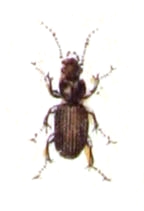
Olisthopus is a genus of ground beetle native to the Palearctic, the Near East and North Africa. It contains the following species:
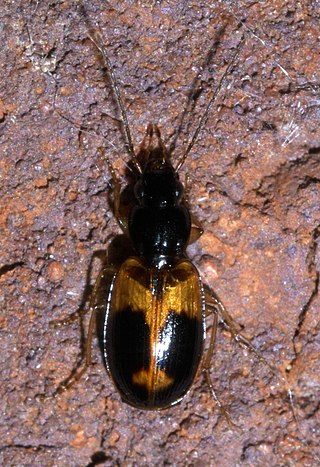
Licininae is a subfamily of in the beetle family Cicindelidae. There are more than 80 genera and 1,800 described species in Licininae.
Zargus is a genus of in the beetle family Carabidae. There are about six described species in Zargus.

Monotomidae is a family of beetles in the superfamily Cucujoidea. The family is found worldwide, with approximately 240 species in 33 genera. The ecological habits of the family are diverse, with different members of the group being found under tree bark, in decaying vegetation, on flowers and in ant nests. Their ecology is obscure, while at least some species are mycophagous, feeding on the fruiting bodies of ascomycete fungi, Rhyzophagus are predators on bark beetles and possibly Phoridae larvae, with the larvae of some species also being mycophagous.

Polydesma umbricola, the monkeypod moth or large tabby, is a species of moth in the family Erebidae. The species is found in southern Europe, Africa, Asia Minor to southern Asia, of India, Sri Lanka, Maldives, the Andaman Islands, including many Indian Ocean islands, like Coëtivy Island, Aldabra, Assumption Island, Madagascar and on Hawaii.

Ocypus is a genus of rove beetles in the subfamily Staphylininae.
Trechus alticola is a species of ground beetle in the subfamily Trechinae. It was described by Thomas Vernon Wollaston in 1854.
Trechus cautus is a species of ground beetle in the subfamily Trechinae. It was described by Thomas Vernon Wollaston in 1854.
Trechus custos is a species of ground beetle in the subfamily Trechinae. It was described by Thomas Vernon Wollaston in 1854.
Trechus dilutus is a species of ground beetle in the subfamily Trechinae. It was described by Thomas Vernon Wollaston in 1854.
Trechus flavomarginatus is a species of ground beetle in the subfamily Trechinae. It was described by Thomas Vernon Wollaston in 1854.
Trechus nigrocruciatus is a species of ground beetle in the subfamily Trechinae. It was described by Thomas Vernon Wollaston in 1854.

Cossoninae is a true weevil subfamily in the family Curculionidae.

Curimopsis is a genus of pill beetles in the family Byrrhidae. There are more than 30 described species in Curimopsis.
Sphaericus is a genus of spider beetles in the family Ptinidae. There are more than 30 described species in Sphaericus.
