
The Reduviidae is a large cosmopolitan family of the suborder Heteroptera of the order Hemiptera. Among the Hemiptera and together with the Nabidae almost all species are terrestrial ambush predators; most other predatory Hemiptera are aquatic. The main examples of non-predatory Reduviidae are some blood-sucking ectoparasites in the subfamily Triatominae, with a few species from South America noted for their ability to transmit Chagas disease. Though spectacular exceptions are known, most members of the family are fairly easily recognizable: they have a relatively narrow neck, sturdy build, and formidable curved proboscis. Large specimens should be handled with caution, if at all, because they sometimes defend themselves with a very painful stab from the proboscis.
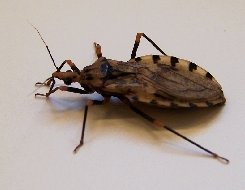
The members of the Triatominae, a subfamily of the Reduviidae, are also known as conenose bugs, kissing bugs, or vampire bugs. Other local names for them used in the Americas include barbeiros, vinchucas, pitos, chipos and chinches. Most of the 130 or more species of this subfamily feed on vertebrate blood; a very small portion of species feed on invertebrates. They are mainly found and widespread in the Americas, with a few species present in Asia and Africa. These bugs usually share shelter with nesting vertebrates, from which they suck blood. In areas where Chagas disease occurs, all triatomine species are potential vectors of the Chagas disease parasite Trypanosoma cruzi, but only those species that are well adapted to living with humans are considered important vectors. Also, proteins released from their bites have been known to induce anaphylaxis in sensitive and sensitized individuals.

Triatoma infestans, commonly called winchuka or vinchuca in Argentina, Bolivia, Uruguay and Chile, barbeiro in Brazil, chipo in Venezuela and also known as "kissing bug" or "barber bug" in English, is a blood-sucking bug and the most important vector of Trypanosoma cruzi which can lead to Chagas disease. It is widespread in the Southern Cone countries of South America. This region has joined the control intervention called Southern Cone Initiative managed by the PAHO.

Triatoma is a genus of assassin bug in the subfamily Triatominae. The members of Triatoma are blood-sucking insects that can transmit serious diseases, such as Chagas disease. Their saliva may also trigger allergic reactions in sensitive individuals, up to and including severe anaphylactic shock.

Rhodnius is a genus of assassin bugs in the subfamily Triatominae, and is an important vector in the spread of Chagas disease. The Rhodnius species were important models for Sir Vincent Wigglesworth's studies of insect physiology, specifically growth and development.
Parabelminus is a genus of bugs in the subfamily Triatominae. The species of this genus could be found in Brazil, specially in Rio de Janeiro and Bahia. It is a vector of Chagas disease.

Panstrogylus geniculatus is a blood-sucking sylvatic insect noted as a putative vector of minor importance in the transmission of Trypanosoma cruzi to humans; this is a parasite, which causes Chagas disease. The insect is described as sylvatic; subsisting primarily in humid forests, and is also known to inhabit vertebrate nesting places such as those of the armadillo, and is also involved in enzootic transmission of T. cruzi to those species. It has wide distribution throughout 16 Latin American countries.
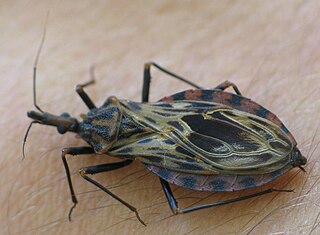
Triatoma nigromaculata is a sylvatic species of insect usually found in hollow trees, in vertebrate nests on trees and occasionally in human dwellings. It usually lives in relatively humid forests at high altitudes on mountain regions and foot hills. As all members of the subfamily Triatominae, T. nigromaculata is a blood-sucking bug and a potential vector of Chagas disease. This species is distributed mainly in Venezuela, but some specimens have also been found in Perú and Colombia (Cauca).

Triatoma brasiliensis is now considered the most important Chagas disease vector in the semiarid areas of northeastern Brazil. T. brasiliensis occurs in 12 Brazilian states, including Maranhão, Piauí, Ceará, Rio Grande do Norte, and Paraíba.
Triatoma juazeirensis is an assassin bug, a Chagas disease vector which occurs in the State of Bahia, Brazil. It is found in natural and artificial environments infesting mainly the peridomiciliary areas but it may also colonize the intradomicile. T. juazeirensis can be distinguished from the other members of the brasiliensis complex by its entire dark pronotum and legs.

Triatoma rubrovaria is a species of triatomine that is ubiquitous to Uruguay, neighboring parts of northeastern Argentina, and in the southern states of Paraná and Rio Grande do Sul in Brazil. It was earlier reported as T. (triatoma) rubrovaria, a sylvatic species believed to be a highly competent vector of Trypanosoma cruzi, the causative agent of Chagas disease.
Rhodnius nasutus is a Chagas disease vector native to the northeast of Brazil. It belongs to the family Reduviidae and subfamily Triatominae, which are commonly known as "kissing bugs" or "assassin bugs". They are considered a highly important species concerning the infectious Chagas disease as they carry the parasite Trypanosoma cruzi, that can be transmitted to the blood of mammals, including humans. This disease is an important issue in Brazil and central America due to the large number of Rhodnius species inhabiting these areas, however in recent efforts to reduce human infection, multiple variations of pesticides have dramatically reduced Triatomine populations. Therefore, the understanding and knowledge of Rhodnius nasutus greatly benefits our efforts in reducing life threatening infections.
Triatoma platensis is an ornitophilic species of triatomine in the family Reduviidae. It is found in Argentina, Bolivia, Brazil, Paraguay and Uruguay.

Triatoma gerstaeckeri is an assassin bug in the genus Triatoma. It is an important vector of Trypanosoma cruzi, the causative agent of Chagas disease. The range of T. gerstaeckeri is from the south-western United States to north-eastern Mexico. T. gerstaeckeri goes through three stages during its paurometabolous life cycle: egg, nymphal instars and adult.

Triatoma lecticularia is a species of kissing bug in the family Reduviidae. It is found in Central America and North America.
Triatoma recurva is a species of kissing bug in the family Reduviidae. It is found in Central America and North America. Like all of the kissing bugs in the genus Triatoma, it is an obligate blood feeder that primarily targets vertebrates. However, individuals can consume the hemolymph of arthropods, and can develop to maturity on a diet consisting entirely of cockroaches.
Triatoma rubida is a species of kissing bug in the family Reduviidae. It is found in Central America and North America.
Triatoma neotomae is a species of kissing bug in the family Reduviidae. It is found in Central America and North America.

Panstrongylus megistus is a blood-drinking insect in the subfamily Triatominae. It is found in the Guianas, Brazil, Bolivia, Paraguay, Uruguay and Argentina. It is an important vector of Trypanosoma cruzi, found particularly in Brazil. Besides humans, P. megistus is known to feed on birds, rodents, horses, dogs, opossums and bats.

Triatoma sordida is an assassin bug within the genus Triatoma. This species consists of three subspecies. Also referred to as kissing bugs, T.sordida are most well known for their role as a secondary vector of Chagas Disease. Inhabiting warm, dry climates, T.sordida are widely distributed throughout South America, occupying houses, farming structures, and wild habitats. Pest control is currently focused on insecticide application. However, biological controls utilizing fungi appear promising.


