Tricypha imperialis

Last updated

Tricypha imperialis
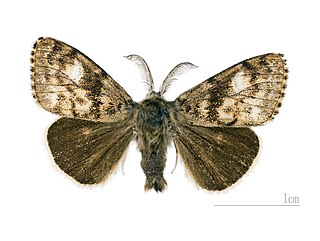
Tricypha imperialis.JPG
Scientific classification Red Pencil Icon.png
Kingdom: Animalia
Clade: Euarthropoda
Class: Insecta
Order: Lepidoptera
Superfamily: Noctuoidea
Family: Erebidae
Genus: Tricypha
Species:T. imperialis
Binomial name
Tricypha imperialis
(Heylaerts, 1884)
Synonyms
  • Romanoffia imperialisHeylaerts, 1884
  • Romanoffia imperialisHeylaerts, 1885

Tricypha imperialis is a moth in the family Erebidae. It was described by Heylaerts in 1884. It is found in Mexico, Panama, Peru, Ecuador and Brazil. [1]

Moth Group of mostly-nocturnal insects in the order Lepidoptera

Moths comprise a group of insects related to butterflies, belonging to the order Lepidoptera. Most lepidopterans are moths, and there are thought to be approximately 160,000 species of moth, many of which have yet to be described. Most species of moth are nocturnal, but there are also crepuscular and diurnal species.
Erebidae family of insects

The Erebidae are a family of moths in the superfamily Noctuoidea. The family is among the largest families of moths by species count and contains a wide variety of well-known macromoth groups. The family includes the underwings (Catocala); litter moths (Herminiinae); tiger, lichen, and wasp moths (Arctiinae); tussock moths (Lymantriinae), including the arctic woolly bear moth ; piercing moths ; micronoctuoid moths (Micronoctuini); snout moths (Hypeninae); and zales, though many of these common names can also refer to moths outside the Erebidae. Some of the erebid moths are called owlets.

Mexico country in the southern portion of North America

Mexico, officially the United Mexican States, is a country in the southern portion of North America. It is bordered to the north by the United States; to the south and west by the Pacific Ocean; to the southeast by Guatemala, Belize, and the Caribbean Sea; and to the east by the Gulf of Mexico. Covering almost 2,000,000 square kilometres (770,000 sq mi), the nation is the fifth largest country in the Americas by total area and the 13th largest independent state in the world. With an estimated population of over 120 million people, the country is the eleventh most populous state and the most populous Spanish-speaking state in the world, while being the second most populous nation in Latin America after Brazil. Mexico is a federation comprising 31 states and Mexico City, a special federal entity that is also the capital city and its most populous city. Other metropolises in the state include Guadalajara, Monterrey, Puebla, Toluca, Tijuana and León.

Related Research Articles

<i>Eacles imperialis</i> species of insect

Eacles imperialis, the imperial moth, is a Nearctic member of the family Saturniidae and subfamily Ceratocampinae. The species was first described by Dru Drury in 1773.

Cosmosoma is a genus of tiger moths in the subfamily Arctiinae. The genus was erected by Jacob Hübner in 1823.

<i>Cyanopepla</i> genus of insects

Cyanopepla is a genus of moths in the subfamily Arctiinae.

Melanaema is a genus of moths in the family Erebidae.

<i>Pseudosphex</i> genus of insects

Pseudosphex is a genus of tiger moths in the Erebidae family. These moths are mimics of a variety of Hymenoptera. The prefix "pseudo" means "false," and Sphex is a type genus of wasps.

Teulisna is a genus of moths in the family Erebidae. The genus was erected by Francis Walker in 1862. They are found in Sri Lanka, India, Myanmar, Borneo and Java.

Tricypha is a genus of arctiine tussock moths in the family Erebidae.

Podalia is a genus of moth in the family Megalopygidae.

Agylla gigas is a moth of the family Erebidae. It was described by Franciscus J. M. Heylaerts in 1891. It is found on Java.

Deborrea is a genus of moths of the Psychidae family.

Tricypha mathani is a moth of the subfamily Arctiinae. It was described by Walter Rothschild in 1909. It is found in Colombia.

Ceryx claremontii is a moth of the family Erebidae. It was described by Franciscus J. M. Heylaerts in 1890. It is found on Sumatra and Java.

Melanaema ni is a moth in the family Erebidae. It was described by Franciscus J. M. Heylaerts in 1891. It is found on Java.

Spilarctia brunnea is a moth in the family Erebidae. It was described by Franciscus J. M. Heylaerts in 1890. It is found on Sumatra.

Teulisna semibrunnea is a moth in the family Erebidae. It was described by Franciscus J. M. Heylaerts in 1891. It is found on Java.

Tricypha furcata is a moth in the family Erebidae. It was described by Möschler in 1878. It is found in French Guiana, Surinam, Brazil and Venezuela.

Tricypha proxima is a moth in the subfamily Arctiinae. It was described by Augustus Radcliffe Grote in 1867. It is found on Cuba.

<i>Psyche</i> (moth) genus of insects

Psyche is a genus of moths in the family Psychidae.

Podalia bolivari is a moth of the Megalopygidae family. It was described by Franciscus J.M. Heylaerts in 1884. It is found in Panama and Venezuela.

References