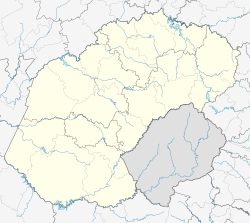
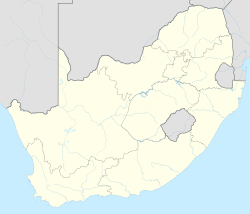
It serves as the administrative seat of the Kopanong Local Municipality within the Xhariep District. With a population of around 6000 residents in the town and associated townships of Noordmanville and Madikgetla, it remains a quiet rural center focused on farming, particularly sheep, cattle, and grain production.
History
The farm Middelwater, on which Trompsburg would later be established, was owned by Jan and Bastiaan Tromp[3]:352 in the mid-19th century. The Tromps were among the Voortrekker pioneers who settled the area after the Boers' victory over the Zulu at the Battle of Blood River in 1838.
The town was formally laid out in 1891 on portions of the farm Middelwater. It was originally known as Jagersfontein Road (reflecting its position on a route to the Jagersfontein diamond mines), then briefly Hamilton, in honour of Sir Hamilton John Goold-Adams, Lieutenant-Governor of the Orange River Colony from 1901 to 1910.[4] It was renamed Trompsburg in 1902 in honor of the Tromp family, coinciding with the granting of municipal status and the broader reconstruction efforts after the Second Boer War. This restored the Afrikaans-rooted name, emphasizing its Voortrekker heritage amid shifting colonial influences.
Trompsburg's development accelerated with the arrival of the railway in the 1890s, linking it to broader trade networks and positioning it as a key stopover on the Johannesburg-Cape Town route.
A school opened as early as 1893 with about 50 students. The Dutch Reformed Church heavily influenced it, using the building for church services and public gatherings. The early 1900s saw the building of the local Dutch Reformed Church and associated buildings. In the 1920s, efforts focused on establishing a school hostel, reflecting growing educational needs. The town hall was inaugurated in 1926.
By the mid-20th century, Trompsburg had become a major center for Merino sheep farming, renowned for wool production and hosting one of South Africa's largest shearing barns. Innovative farming practices in animal husbandry solidified its role in the national wool industry. The town's economy diversified slightly with grain and cattle farming, but it retained its rural character. In the apartheid era, Trompsburg mirrored broader Free State patterns of segregation and labor migration.
The town received its first municipal electricity supply in 1960. This was part of a broader rollout by the Electricity Supply Commission (ESCOM, now Eskom) to electrify towns in the Southern Orange Free State, including Trompsburg and nearby towns like Reddersburg, Bethulie, Edenburg, Philippolis and Springfontein. Prior to this, electricity was limited or absent in such non-urban, agricultural areas, with national electrification efforts initially prioritizing mining centers and larger cities from the 1880s onward.
A tornado struck Trompsburg on November 5, 1976. This was a notable long-track event. It started near Hanover, tracking approximately 175 km (one of the longest recorded tornado paths in South African history) through rural/farmland areas. It reached Trompsburg, with a F3 rating on the Fujita scale (strong/violent, with winds estimated at 158–206 mph / 254–332 km/h), causing 5 fatalities (primarily in rural areas), along with some injuries and damage to properties in the town, though impacts were relatively limited because much of the path went through open farmland rather than densely populated zones.
Post 1994, integration into democratic South Africa emphasized community development, with the Kopanong Municipality formed in 2000 through the amalgamation of nine towns to manage local services. This restructuring emphasized equitable development, including RDP housing programs that provided thousands of homes to previously disadvantaged residents since 1994. The Albert Nzula District Hospital serves as a key public health resource in the region, offering general wards, emergency services, dispensary, and specialized care to the underserved Xhariep community.
In early 1996 the town was the site of racial tensions and incidents related to school desegregation efforts following the end of apartheid. The key events centered on attempts by black parents and students to enroll in the local white-dominated Trompsburg Secondary School. Reports from February 1996 describe hundreds of black parents marching to demand access for their children to the school. On February 20, 1996, a group of white men attacked approximately 300 black students who were protesting outside the school after it refused to enroll them. Police reportedly stood by and watched during the incident.
This occurred amid broader national struggles over school integration. South Africa's post-apartheid constitution and policies aimed to end racial segregation in education, but resistance persisted in conservative rural areas like Trompsburg. White communities often opposed rapid integration, fearing loss of cultural control or standards in Afrikaans-medium schools. The key legislation addressing school desegregation in South Africa was enacted around the time of the 1996 Trompsburg incidents, rather than in direct response afterward. The South African Schools Act No. 84 of 1996 [5](often abbreviated as SASA) was the primary law that formalized the end of racial segregation in schools and established a unified, non-racial education system.
Today, it remains a peaceful stopover for travelers, while preserving its Voortrekker heritage amid the semi-arid landscapes of the Free State.
The coat of arms is from the era when Trompsburg was an independent municipality. It follows the classic European-influenced heraldic style common for South African towns and municipalities under apartheid-era local government structures - typical of registrations or usages overseen by the Bureau of Heraldry.
The shield prominently displays the local Dutch Reformed Church. The motto Fide et Labore translates to Faith and Labour.
In 2000, as part of post-apartheid local government reforms, Trompsburg was incorporated into the larger Kopanong Local Municipality (along with several other towns like Fauresmith, Jagersfontein, and Philippolis). Many smaller pre-1994 municipalities lost their individual coats of arms, and new or merged municipalities often adopted simpler logos or did not register traditional heraldic arms.
The current Kopanong Municipality does not have an official registered coat of arms in the traditional sense; its public branding focuses on modern municipal logos rather than heraldic designs.
This page is based on this Wikipedia article Text is available under the CC BY-SA 4.0 license; additional terms may apply. Images, videos and audio are available under their respective licenses.