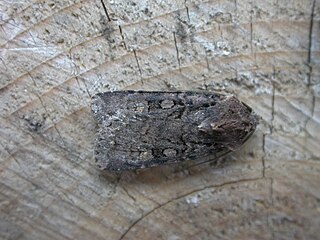
The garden dart is a moth of the family Noctuidae. It is distributed throughout much of the Palearctic. Temperate regions of Europe, Central Asia and North Asia, as well as the mountains of North Africa. Absent from polar regions, on Iceland and some Mediterranean islands, as well as in Macaronesia.

Apamea crenata, known as the clouded-bordered brindle, is a moth in the family Noctuidae. It is distributed throughout the Palearctic realm. In the North it crosses the Arctic Circle, in the Mediterranean it is found only in cool locations and mountains avoiding very hot areas. In the Alps, it rises to an altitude of about 2000 metres.

Appias lalage, the spot puffin, is a small butterfly of the family Pieridae, that is, the yellows and whites, which is found in India, Indochina and Hainan.

Appias indra, the plain puffin, is a small butterfly of the family Pieridae, that is, the yellows and whites, which is found in south and southeast Asia.

Logania distanti, the dark mottle, is a small but striking butterfly found in India that belongs to the lycaenids or blues. It was first described by Georg Semper in 1889.

Bindahara phocides, the plane, is a small butterfly found Indomalayan and Australasian realms that belongs to the lycaenids or blues family.

Agrochola lychnidis, the beaded chestnut, is a moth of the family Noctuidae. The species was first described by Michael Denis and Ignaz Schiffermüller in 1775. It is distributed throughout the whole of Europe from Ireland to the Urals. It also occurs in western North Africa and Asia Minor.

Apamea lithoxylaea, the light arches, is a moth of the family Noctuidae. The species was first described by Michael Denis and Ignaz Schiffermüller in 1775. It is distributed throughout Europe, the Caucasus, Armenia, Asia Minor and Turkey, and ranges east to the Altai Mountains.

Mesapamea secalis, the common rustic, is a moth of the family Noctuidae. The species was first described by Carl Linnaeus in his 1758 10th edition of Systema Naturae. It is found in Europe, north-west Africa, Turkey and northern Iran.

Grammodes stolida, the geometrician, is a moth of the family Erebidae. The species was first described by Johan Christian Fabricius in 1775. It is found in Africa, southern Europe, most of Asia and Australia. It migrates to central and northern Europe as far north as England, Denmark and Finland.

Acrapex atriceps is a species of moth of the family Noctuidae first described by George Hampson in 1910. It is found in India.
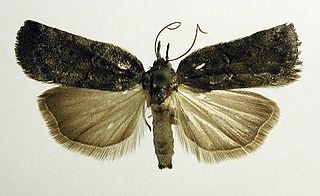
Nycteola revayana, the oak nycteoline, is a moth of the family Nolidae. The species was first described by Giovanni Antonio Scopoli in 1772. It is found from Europe and east across the Palearctic to Japan and India.
Lophocampa indistincta is a moth of the family Erebidae. It was described by William Barnes and James Halliday McDunnough in 1910. It is found in California, where it is only found on the Channel Islands.
Drapetodes interlineata is a moth in the family Drepanidae. It was described by Warren in 1896. It is found in Singapore, on Peninsular Malaya and in Indonesia (Java).
Nordstromia humerata is a moth in the family Drepanidae. It was described by Warren in 1896. It is found in north-eastern India.
Anacampsis phytomiella is a moth of the family Gelechiidae. It was described by August Busck in 1914. It is found in Panama.
Antaeotricha bicolor is a species of moth of the family Depressariidae. It is found in Brazil.
Odites perissa is a moth in the family Depressariidae. It was described by Alexey Diakonoff in 1968. It is found on Luzon in the Philippines.
Imma thyriditis is a moth in the family Immidae. It was described by Edward Meyrick in 1906. It is found on the Solomon Islands.
Moca aphrodora is a species of moth in the family Immidae first described by Edward Meyrick in 1922. It is found in Brazil and Peru.

