Related Research Articles

Sathya Sai Baba was an Indian guru and philanthropist. At the age of fourteen he claimed that he was the reincarnation of Shirdi Sai Baba, and left his home in order to serve the society and be an example to his followers.
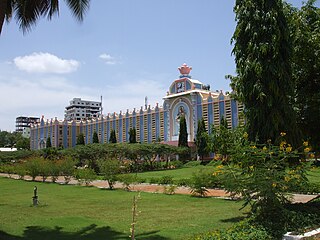
Sri Sathya Sai Institute of Higher Learning is a deemed-to-be-University located in Anantapur District, Andhra Pradesh, India. It was founded by Sri Sathya Sai Baba on 22 November 1981. There are four campuses of the university, three for men at Prashanthi Nilayam in Puttaparthi; Whitefield near Bangalore; and Muddenahalli, Karnataka and one for women at Anantapur.

Dame Mary Douglas, was a British anthropologist, known for her writings on human culture and symbolism, whose area of speciality was social anthropology. Douglas was considered a follower of Émile Durkheim and a proponent of structuralist analysis, with a strong interest in comparative religion.
Usha Sanyal is an American scholar and historian of repute who has authored five books and over a dozen journal and reference articles. She is a specialist in the history of South Asia, especially the history of the Ahl-e Sunnat movement during colonial India. Her PhD dissertation analysed the Ahl-e Sunnat movement of Islamic legal scholar Imam Ahmed Raza Khan Barelvi. She is Visiting Assistant Professor of History at Wingate University, North Carolina, where she teaches survey courses in World Civilizations, in addition to, at times, teaching various different Special Topics courses dealing with Middle Eastern History and Islam. She is also a certified reader for the AP World History Exam.
Kota Brahmins are a Hindu Brahmin subcaste mainly from the Indian state of Karnataka. Kota Brahmins take their name from their native village Kota. They speak a Kannada different from the other regional dialects. Kota Brahmins are mainly concentrated in the villages of Kota of Udupi district. Kotas follow Smarta tradition. The Guru Narasimha Temple, Saligrama is important to them.
In sociology, Sanskritisation or Sanskritization, is the process by which caste or tribes placed lower in the caste hierarchy seek upward mobility by emulating the rituals and practices of the dominant or upper castes. It is a process similar to "passing" in sociological terms. This term was made popular by Indian sociologist M. N. Srinivas in the 1950s.
S. N. Balagangadhara is a former professor of the Ghent University in Belgium, and director of the now derelict India Platform and the Research Centre Vergelijkende Cutuurwetenschap.
The Sathya Sai Baba movement is inspired by South Indian Hindu guru Sathya Sai Baba who taught the unity of all religions. Some of his followers have faith in his claim to be a purna Avatar of Shiva and Shakti, who is believed to have been predicted in the Bhagavad Gita. This means that some of his followers see him as a God. Devotees engage in singing devotional songs called "bhajans" and selfless service (seva). Its official organization is the Sathya Sai Organization. However the Sathya Sai Baba movement extends beyond the organization. An important aspect of the faith of adherents is the miracles attributed to Sathya Sai Baba. The number of adherents is estimated between 6 and 100 million.
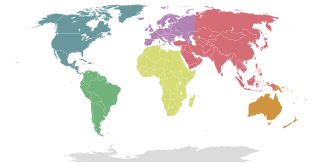
Hinduism was first introduced by Sindhi settlers who migrated to Ghana after India was divided in 1947. It was spread to Ghana actively by Ghana's Hindu Monastery headed by Swami Ghananand Saraswati and by the International Society for Krishna Consciousness (ISKCON). Hinduism is the fastest growing religion in Ghana.
Amrita Basu is an American academic and political scientist. She currently is a professor at Amherst College where she holds affiliations in the departments of Political Science, Sexuality, Women's, & Gender Studies, Asian Languages & Civilizations, and Black Studies.
Bhatraju is an Indian caste of Telugu-speaking poets, ballad reciters, panegyrists, and religious musicians. They are primarily found in the states of Telangana and Andhra Pradesh, and also in smaller numbers in the neighbouring states like Karnataka and Tamil Nadu. They are also known as Bhatt Murtis or Bhatrajulu or Rai Bhats or Bhat Rajah or Brahma Kshatriya or simply Rajus. The Bhatrajus were originally a caste of court bards, poets, eulogists, and reciters of family genealogy and tradition. After the fall of indigenous kingdoms, they migrated downward to South Indian regions in the search of livelihood. During the reign of Kakatiya rulers, they were allowed to integrate into the society by contributing their literary knowledge of Sanskrit. Eventually they instilled pious positions by devoting their duties as temple coordinators, priests and they switched to singing religious songs, poetry and praises of richer land lords and performing their respective Dharmic traditions in wedding and other auspicious occasions. They use Raju as their caste title.They hold the primary Brahman Gothras like Bharadwaja, Kashyapa, Athreyasa, Srivasta etc. It is one of the few Brahmanic castes that has maintained the continuity of Sacred Thread called as Upanayanam. The Bhatrajus wear the sacred thread like the Brahmins and are well versed in sacred literature. They call themselves Rajus (Rajputs) claiming half-decent from ancient Kshatriya clans. Bhatrajus are classified under the Other Backward Classes in most states of Southern India, with less than 500,000 living in AP/TS regions today.
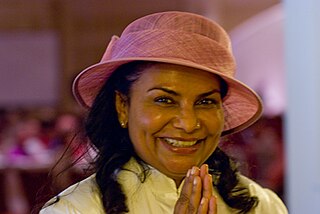
Sai Maa, also known as Her Holiness Sai Maa and Sai Maa Lakshmi Devi Mishra, is a guru/spiritual master, healer, humanitarian, and author. She has offered programs throughout North America, Europe, and Asia on personal transformation through practical spirituality, self-mastery, and energetic healing. In 2007, Sai Maa was honored with the title of Jagadguru, the highest title in the Hindu tradition. She is the first woman to receive this title in the 2,700 years of the Vishnuswami lineage.
The New Woodlands Hotel is an Udupi-style vegetarian restaurant in Chennai, India. Established in 1938 by Kadandale Krishna Rao, it is considered to be a pioneer in popularizing Udupi cuisine in the city. Since then, a large number of imitations and namesake Woodlands hotels have been established in various parts of Chennai.

R. S. Khare is a socio-cultural anthropologist and a Professor of Anthropology at the University of Virginia, U.S. He is known for studying “from within/without” India's changing society, religions, food systems, and political cultures, and for following the trajectories of contemporary Indian traditional and modern cultural discourses. His anthropology has endeavored to widen reasoned bridges across the India-West cultural, religious-philosophical, and literary distinctions and differences.

Charles Miller Leslie was an American medical anthropologist, who was an avid contributor of published works in his branch of anthropology. Leslie’s career was influential to the shaping of medical anthropology, as his works have inspired other medical anthropologists to further research and popularize anthropological concepts which includes medical pluralism, social relations of therapy management, the relationship between state and medical systems, and health discourse. Leslie’s main focus within medical anthropology has been the study of Asian medical systems, specifically Ayurvedic, Unani, and Chinese medicine.
Mona Bhan is a cultural anthropologist and associate professor of Anthropology at DePauw University. Her extensive research work on Ladakh on questions of identity, development, militarization, and counterinsurgency has been published in numerous journals such as the Journal of Asian Studies, Sociological Bulletin, Contemporary South Asia, and Cultural Anthropology. Her monograph on Ladakh entitled Counterinsurgency, Democracy and the Politics of Identity in India: From Warfare to Welfare? was published by Routledge in September 2013. She has also conducted ethnographic fieldwork in Kashmir where she focused on the relationship between violence, counterinsurgency, and environmental activism. Her current project examines the politics and contestations over water between India and Pakistan. At DePauw University, she teaches courses on Wars and Militarism, Anthropology of Development, Ethnography of Gender in South Asia, Cosmopolitanism, and Environmental Anthropology.
Tharailath Koshy Oommen is an Indian sociologist, author, educationist and Professor Emeritus at the Centre for the Study of Social Systems, Jawaharlal Nehru University. He was awarded Padma Bhushan, the third highest Indian civilian award in 2008 for his services to the fields of education and literature by the President of India.
Colleen Taylor Sen is a Canadian American translator and author specializing in Indian cuisine. She has written six books, several articles and has also contributed entries to many encyclopedias.
Gabriella Eichinger Ferro-Luzzi is an Italian anthropologist and dravidologist who has done field studies in India, mainly in the Tamil Nadu state.
Susan Snow Wadley is an American anthropologist.
References
- ↑ Bearer, Barry. "M. N. Srinivas Is Dead at 83; Studied India's Caste System". The New York Times.
- ↑ "Worlds of Wonder". Harvard University.
- ↑ "Tulasi Srinivas". Harvard University.
- ↑ "Tulasi Srinivas". Georgetown University.
- ↑ "Tulasi Srinivas". Emerson College.
- ↑ Huffer, Amanda (2011). "Review of Winged Faith: Rethinking Globalization and Religious Pluralism through the Sathya Sai Movement". The Journal of Asian Studies. 70 (3): 894–896. doi:10.1017/S0021911811001501. ISSN 0021-9118. JSTOR 41302451.
- ↑ LAHIRI, SMITA (2012). "Review of Winged Faith: Rethinking Globalization and Religious Pluralism through the Sathya Sai Movement". American Ethnologist. 39 (2): 465–467. doi:10.1111/j.1548-1425.2012.01374_22.x. ISSN 0094-0496. JSTOR 23250853.
- ↑ Sethi, Manisha (1 October 2019). "Book Review: Tulasi Srinivas. 2018. The Cow in the Elevator: An Anthropology of Wonder". Contributions to Indian Sociology. 53 (3): 441–443. doi:10.1177/0069966719860336. ISSN 0069-9667. S2CID 203454917.
- ↑ "THE COW IN THE ELEVATOR: An Anthropology of Wonder | By Tulasi Srinivas". Pacific Affairs. 14 January 2019.
- ↑ Dasgupta, Kaushik. "Food For Thought Curried Cultures". The Indian Express.
- ↑ "Book Review: Curried Cultures by Krishnendu Ray, Tulasi Srinivas". New Asian Writing. 20 November 2017.
- ↑ Srinivas, Tulasi. "Exploring Indian Culture through Food". The Association for Asian Studies.
- ↑ "Helaine and Stanley Miller Award for Outstanding Teaching". Academic Affairs, Emerson College. Emerson College.
- ↑ "What's the link between money and happiness?". World Economic Forum.
- ↑ Dunn, Laura M. (2020). "Review of The Cow in the Elevator: An Anthropology of Wonder". Asian Ethnology. 79 (1): 182–184. ISSN 1882-6865. JSTOR 26929497.
- ↑ Venkatesan, Soumhya (17 June 2020). "The Cow in the Elevator: An Anthropology of Wonder by Tulasi Srinivas (review)". Anthropological Quarterly. 93 (1): 1677–1681. doi:10.1353/anq.2020.0013. ISSN 1534-1518.
- ↑ Kent, Alexandra (2011). "Review of Winged faith: rethinking globalization and religious pluralism through the Sathya Sai movement". The Journal of the Royal Anthropological Institute. 17 (2): 428–429. doi:10.1111/j.1467-9655.2011.01698_28.x. ISSN 1359-0987. JSTOR 23011406.
- ↑ "CURRIED CULTURES: GLOBALIZATION, FOOD AND SOUTH ASIA, edited by Krishnendu Ray and Tulasi Srinivas. Berkeley, CA: University of California Press, 2012. 316 pp". Food and Foodways. 23 (1–2): 134–137. 3 April 2015. doi:10.1080/07409710.2015.1030978. ISSN 0740-9710. S2CID 216644499.
- ↑ "India's Goddesses of Contagion Provide Protection in the Pandemic". Henry Luce Foundation.