The Xavante language is a Jê language spoken by the Xavante people in the area surrounding Eastern Mato Grosso, Brazil. The Xavante language is unusual in its phonology, its ergative object–agent–verb word order, and its use of honorary and endearment terms in its morphology.
Ergative–absolutive languages, or ergative languages are languages that share a certain distinctive pattern relating to the subjects of verbs. Examples are Basque, Georgian, Mayan, Tibetan, a few Indo-European languages and, to some degree, the Semitic modern Aramaic languages.
In linguistics, a causative is a valency-increasing operation that indicates that a subject either causes someone or something else to do or be something or causes a change in state of a non-volitional event. Prototypically, it brings in a new argument, A, into a transitive clause, with the original S becoming the O.
The Kaska language originated from the family of Athabaskan languages. Traditionally Kaska is an oral aboriginal language that is used by the Kaska Dena people. The Kaska Dene region consists of a small area in the Southwestern part of the Northwest Territories, the Southeastern part of Yukon Territory, and the Northern part of British Columbia. The communities that are in the Kaska Dene region are Fort Ware in N.W.T.; Ross River and Watson Lake in Y.T.; Dease Lake, Good Hope Lake, Lower Post, Fireside, and Muncho Lake in B.C. Kaska is made up of eight dialects. All of which have similar pronunciations and expressional terms. The town of Watson Lake was established around the period of the second World War when the Alaska Highway was first build in 1942. A major consequence of colonization was Kaska language loss. Another major cause of Kaska language loss was due to the residential school. The effect that these schools had on the Kaska language have caused a language gap between two generations resulting in few young speakers.
The intransitive case, also denominated passive case or patient case is a grammatical case used in some languages to mark the argument of an intransitive verb, but not used with transitive verbs. It is generally seen in languages that display tripartite nominal morphologies; it contrasts with the nominative and absolutive cases employed in other languages' morphosyntax to mark the argument of intransitive clauses.
In linguistics, polypersonal agreement or polypersonalism is the agreement of a verb with more than one of its arguments. Polypersonalism is a morphological feature of a language, and languages that display it are called polypersonal languages.
The Nheengatu language, often spelled Nhengatu, is an indigenous language of the Americas from the Tupi–Guarani language family. The name of the language is derived from the words nheen and gatu. The name of the related language Ñheengatu, in Paraguay, is similarly derived. Nheengatu is referred to by a large variety of names in literature, including Nhengatu, Coastal Tupian, Geral, Yeral, Modern Tupí, Nyengato, Nyengatú, Waengatu, Neegatú, Is’engatu, Língua Brasílica and Tupi Amazônico. It is also commonly referred to as Língua Geral Amazônica (LGA) in Brazil.
The applicative voice is a grammatical voice that promotes an oblique argument of a verb to the core object argument. It is generally considered a valency-increasing morpheme. Applicative is often found in agglutinative languages, such as the Bantu languages and Austronesian languages. Other examples include Nuxalk, Ubykh, and Ainu.
Karitiana, otherwise known as Caritiana or Yjxa, is a Tupian language spoken in the State of Rondônia, Brazil, by 210 out of 320 Karitiana people, or 400 according to Cláudio Karitiana, in the Karitiana reserve 95 kilometres south of Porto Velho. The language belongs to the Arikém language family from the Tupi stock. It is the only surviving language in the family after the other two members, Kabixiâna and Arikém, became extinct.
In linguistics, volition is a concept that distinguishes whether the subject, or agent of a particular sentence intended an action or not. Simply, it is the intentional or unintentional nature of an action. Volition concerns the idea of control and for the purposes outside of psychology and cognitive science, is considered the same as intention in linguistics. Volition can then be expressed in a given language using a variety of possible methods. These sentence forms usually indicate that a given action has been done intentionally, or willingly. There are various ways of marking volition cross-linguistically. When using verbs of volition in English, like want or prefer, these verbs are not expressly marked. Other languages handle this with affixes, while others have complex structural consequences of volitional or non-volitional encoding.
Apurinã, or Ipurina, is a Southern Maipurean language spoken by the Apurinã people of the Amazon basin. It has an active–stative syntax. Apurinã is a Portuguese word used to describe the Popikariwakori people and their language. Apurinã indigenous communities are predominantly found along the Purus River, in the Northwestern Amazon region in Brazil, in the Amazonas state. Its population is currently spread over twenty-seven different indigenous lands along the Purus River. with an estimated total population of 9,500 people. It is predicted, however, that fewer than 30% of the Apurinã population can speak the language fluently. A definite number of speakers cannot be firmly determined because of the regional scattered presence of its people. The spread of Apurinã speakers to different regions was initially caused by conflict or disease, which has consequently led natives to lose the ability to speak the language for lack of practice and also because of interactions with other communities.
Nivaclé is a Matacoan language spoken in Paraguay and in Argentina by the Nivaclé. It is also known as Chulupí and Ashluslay, and in older sources has been called Ashluslé, Suhin, Sujín, Chunupí, Churupí, Choropí, and other variant spellings of these names. Nivaclé speakers are found in the Chaco, in Paraguay in Presidente Hayes Department, and Boquerón Department, and in Argentina in Salta Province.
Kwaza is an endangered Amazonian language spoken by the Kwaza people of Brazil. Kwaza is classified as a language isolate, meaning it shows no relation to other known languages or linguistic families.
Kurdish grammar has many Inflections, with prefixes and suffixes added to roots to express grammatical relations and to form words.
Ye'kuana, also known as Maquiritari, Dekwana, Ye'kwana, Ye'cuana, Yekuana, Cunuana, Kunuhana, De'cuana, De’kwana Carib, Pawana, Maquiritai, Maquiritare, Maiongong, or Soto is the language of the Ye'kuana people of Venezuela and Brazil. It is a Cariban language. It is spoken by approximately 5,900 people around the border of northwestern Brazilian state of Roraima and Venezuela – the majority in Venezuela. At the time of the 2001 Venezuelan census, there were at 6,523 Ye’kuana living in Venezuela. Given the unequal distribution of the Ye’kuana across two South American countries, Ethnologue lists two different vitality ratings for Ye’kuana: in Venezuela it is listed as Vigorous (6a), while in Brazil it is classified Moribund (8a) on the Graded Intergenerational Disruption Scale (GIDS).
Wayana is a language of the Cariban family, spoken by the Wayana people, who live mostly in the borderlands of French Guiana, Brazil, and Suriname.

Mekéns (Mekem), or Amniapé, is a nearly extinct Tupian language of the state of Rondônia, in the Amazon region of Brazil.
TheSabanê language is one of the three major groups of languages spoken in the Nambikwara family. The groups of people who speak this language were located in the extreme north of the Nambikwara territory in the Rondônia and Mato Grosso states of western Brazil, between the Tenete Marques and Juruena rivers. Today, most members of the group are found in the Pyreneus de Souza Indigenous Territory in the state of Rondonia.
Matis is a language spoken by the indigenous Matis people in the state of Amazonas in Brazil.
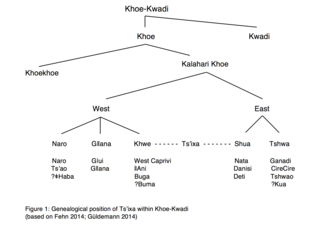
Tsʼixa is a critically endangered African language that belongs to the Kalahari Khoe branch of the Khoe-Kwadi language family. The Tsʼixa speech community consists of approximately 200 speakers who live in Namibia on the eastern edge of the Okavango Delta, in the small village of Mababe. They are a foraging society that consists of the ethnically diverse groups commonly subsumed under the sames "San", "Bushmen" or "Basarwa". The most common term of self-reference within the community is Xuukhoe or 'people left behind', a rather broad ethnonym roughly equaling San, which is also used by Khwe-speakers in Botswana. Atlhough the affiliation of Tsʼixa within the Khalari Khoe branch, as well as the genetic classification of the Khoisan languages in general, is still unclear, the Khoisan language scholar Tom Güldemann posits in a 2014 article the following genealogical relationships within Khoe-Kwadi, and argues for the status of Tsʼixa as a language in its own right. The language tree to the right presents a possible classification of Tsʼixa within Khoe-Kwadi: