Related Research Articles

Singh is a title, middle name, or surname that means "lion" in various South Asian and Southeast Asian communities. Traditionally used by the Hindu Kshatriya community, it was later mandated in the late 17th century by Guru Gobind Singh for all male Sikhs as well, in part as a rejection of caste-based prejudice and to emulate Rajput naming conventions. As a surname or a middle name, it is now found throughout the world across communities and religious groups, becoming more of a generic, caste-neutral, decorative name—similar to names such as Kumar and Lal.

Nomads are known as a group of communities who travel from place to place for their livelihood. Some are salt traders, fortune-tellers, conjurers, ayurvedic healers, jugglers, acrobats, actors, storytellers, snake charmers, animal doctors, tattooists, grindstone makers, or basketmakers. Some anthropologists have identified about 8 nomadic groups in India, numbering perhaps 1 million people—around 0.12 percent of the country's billion-plus population. Aparna Rao and Michael Casimir estimated that nomads make up around 7% of the population of India.
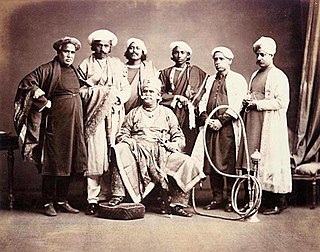
Bhumihar, also locally called Bhuinhar and Babhan, is a Hindu caste mainly found in Bihar, the Purvanchal region of Uttar Pradesh, Jharkhand, the Bundelkhand region of Madhya Pradesh, and Nepal.
The Patwa are a mainly Hindu community native to Hindi Belt.Traditionally, they were Hindu baniya.

Tailoring is the English translation of Darzi. In the Indian tradition, it was customary to wrap clothing over the body rather than wear stitched clothes. Used in Hindi and Urdu, the word Darzi comes from the Persian language.
The Bind are a caste found in Uttar Pradesh, Bihar, Madhya Pradesh, Assam, West Bengal, Chhattisgarh and Tripura. Bind are under the obc[Other backward caste] category of the central list. Bin/Bind is one of the Noniya communities. In Uttar Pradesh, they are known by the Noniya sub-caste. In Bihar Bind/Bin comes under EBC.
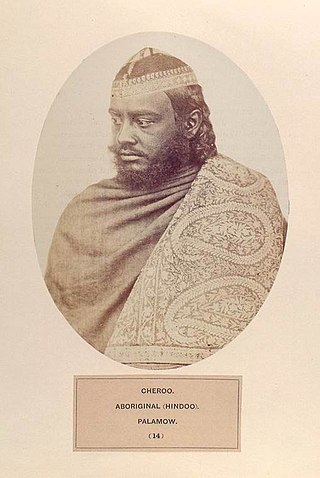
The Chero is a caste found in the states of Bihar, Jharkhand and Uttar Pradesh in India.
The Thori are a [Other Backward caste]] found in the states of Gujarat, Rajasthan and Haryana in India. They are also known as the Nayak.

Chhipi is a caste of people with ancestral roots tracing back to India. These people are basically Rajputs and used to wear Kshatriya attire. These people were skilled in the art of war, Later people of this caste started doing printing work. They are found in the states of Gujarat, Rajasthan, Madhya Pradesh, Haryana, Delhi, Uttar Pradesh of India.
The Rauniyar is a Bania caste mostly found in India and Nepal. They use Rauniyar, Mahajan, Shah, Anand, Ranjan, Rauniwal as their surnames.The Rauniyar is a sub-group within the Awadhi Bania community
The Patharkat are a Muslim caste found in Indian states of Uttar Pradesh and Bihar, although originating in Pakistan. They are also known as Sangtarash.

Musahar or Mushahar are a Dalit community found in the eastern Gangetic plain and the Terai. They are also known as Rishidev, Sada, Manjhi, Banbasi. The other names of the Musahar are Bhuiyan and Rajawar. Their name literally means 'rats-ridder' due to their main former occupation of catching rats, and there are many who are still forced to do this work due to destitution and poverty.
The Tiar are found in North India. They are also known as the Parihar.

Shershabadia, are a Bengali Muslim community found in the state of West Bengal, Bihar and Jharkhand in India. They belong to Shaikh community and also form a significant part of the Shaikhs of West Bengal and Bihar. Common surnames used by the community include Shekh, Sekh, Haque, Islam, Mondal. Most of them are Sunni Muslims who associate with the Ahl-i Hadith movement.
Sadgop, also spelled as Sadgope, is a Bengali Hindu Yadav (Gopa) caste. Traditionally they are engaged in cultivation. Since late mediaeval period Sadgops had established themselves as dominant political power in peripheral lateritic forest areas of Rarh region, now included in Birbhum, Burdwan and Midnapore districts. Karnagarh, Narajole, Narayangarh and Balarampur in Midnapore and several other zamindari estates in Burdwan, Hooghly, Birbhum belonged to them. As of late nineteenth century they were one of the fourteen castes belonging to 'Nabasakh' group.

The Nat are a caste found in northern India. Their traditional occupation has been that of entertainers and dancers.
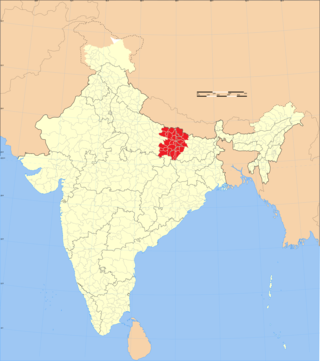
Bhojpur is a ethnolinguistic and cultural area in the Indian subcontinent where the Bhojpuri language is spoken as a mother tongue. The Bhojpuri region encompasses parts of the Indian states of Bihar, Uttar Pradesh, and Jharkhand, and the Madhesh, Gandaki and Lumbini provinces of Nepal.
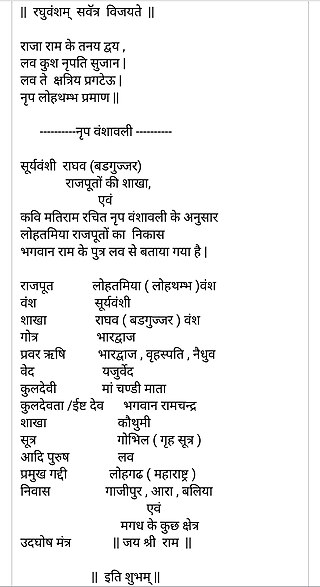
Lohtamia is a sub-clan of Badgujar Rajputs They are old Suryavanshi Kshatriya and descendants of Lav, they are also known as The Lohtambh Bargujars. They migrated from Lahore and established their kingdom Lohgadh and in 11th century. They settled around gangetic area in Bihar and U.P. It is said that they were such a courageous Rajput community who never made any matrimonial alliances with the Mughals in order to save their daughters from the eyes of Muslim invaders, they went and settled on the banks of Ganga in Bihar.
The Oiniwar dynasty, or Oiṇīvāra dynasty also known as the Sugauna dynasty, was a Maithil ruling dynasty of territories that form part of the Mithila region of the Indian subcontinent. They governed the area between 1325 and 1526, being preceded by the Karnat dynasty. Following the demise of the dynasty, emerged the dynasty of the Raj Darbhanga. One of the Oiniwar Dynasty's most notable rulers was Shivasimha who was known for his patronisation of the art as well as leading military campaigns against neighbouring polities.

The Zamindars of Bihar were the autonomous and semi-autonomous rulers and administrators of the subah of Bihar during Mughal rule and later during British rule. They formed the landed aristocracy that lasted until Indian independence in 1947. The zamindars of Bihar were numerous and could be divided into small, medium and large depending on how much land they controlled. Within Bihar, the zamindars had both economic and military power. Each zamindari would have their own standing army which was typically composed of their own clansmen.
References
- ↑ "List of caste wise population of Bihar". live Hindustan. Retrieved 7 October 2023.
- ↑ People of India Bihar Volume XVI Part Two edited by S Gopal & Hetukar Jha pages 945 to 947 Seagull Books
- ↑ People of India Bihar Volume XVI Part Two edited by S Gopal & Hetukar Jha pages 945 to 947 Seagull Books
- ↑ People of India Bihar Volume XVI Part Two edited by S Gopal & Hetukar Jha pages 945 to 947 Seagull Books