
Muscari is a genus of perennial bulbous plants native to Eurasia that produce spikes of dense, most commonly blue, urn-shaped flowers resembling bunches of grapes in the spring. The common name for the genus is grape hyacinth, but they should not be confused with hyacinths. A number of species of Muscari are used as ornamental garden plants.
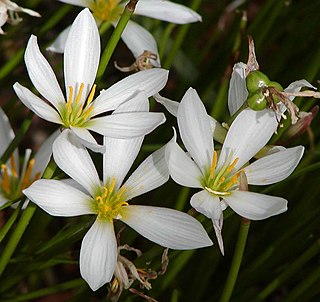
Zephyranthes is a genus of temperate and tropical plants in the Amaryllis family, subfamily Amaryllidoideae, native to the Western Hemisphere and widely cultivated as ornamentals. Following the expansion of the genus in 2019, which now includes the genera Habranthus and Sprekelia, there are about 200 recognized species, as well as numerous hybrids and cultivars. Common names for species in this genus include fairy lily, rainflower, zephyr lily, magic lily, Atamasco lily, and rain lily.

Hymenocallis (US) or (UK) is a genus of American plants in the amaryllis family.

Sprekelia is a genus of Mesoamerican plants in the Amaryllis family, subfamily Amaryllidoideae. Sprekelia plants are sometimes called Aztec lilies or Jacobean lilies although they are not true lilies. This genus has been submerged in Zephyranthes, but as of January 2023 is accepted by Plants of the World Online with a single species, Sprekelia formosissima, endemic to Mexico.

Zephyranthes robusta, synonym Habranthus robustus, commonly known as the Brazilian copperlily, pink fairy lily or the pink rain lily, is a species of herbaceous flowering bulb. It is native to Brazil, Argentina and Uruguay, but is now naturalized in Florida, Colombia, South Africa, and Mauritius.
Habranthus (copperlily) was a formerly recognized genus of tender herbaceous flowering bulbs in the subfamily Amaryllidoideae of the family Amaryllidaceae. It is now included within a more broadly circumscribed genus Zephyranthes. The genus was first identified by pioneering bulb enthusiast William Herbert in 1824.

Rhodophiala was a genus of herbaceous, perennial and bulbous plants in the Amaryllis family. It consisted of about 30 South American species distributed in southern Brazil, Argentina, and, specially, in Chile. Most of the species are known colloquially as añañuca. It has now been submerged in Zephyranthes.
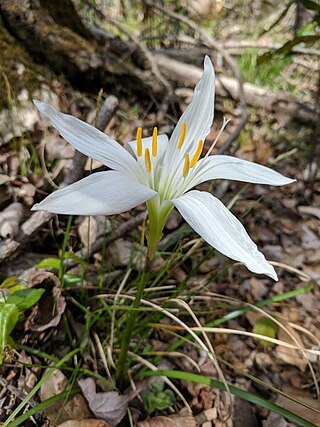
Zephyranthes atamasca, commonly known as the atamasco-lily or more generally a rain-lily, is native to the southeastern United States. It grows in swampy forests and coastal prairies, preferring acid boggy soils rich with leaf mold. Following the appearance of broad, grassy leaves in early winter, it blooms in March or April. It has several narrow, linear basal leaves about 0.5 in (13 mm) wide and 10–15 in (25–38 cm) long. Its native range extends from Florida north to Maryland and west to Mississippi. The species is also naturalized in Bermuda and in the Mariana Islands. Both its leaves and bulbs are poisonous.

Zephyranthes rosea, commonly known as the Cuban zephyrlily, rosy rain lily, rose fairy lily, rose zephyr lily or the pink rain lily, is a species of rain lily native to Peru and Colombia. They are widely cultivated as ornamentals and have become naturalized in tropical regions worldwide. Like all rain lilies, they are known for blooming only after heavy rains.
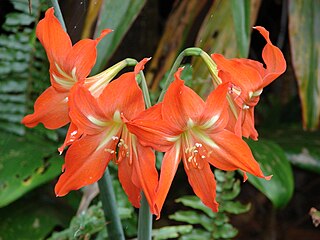
Hippeastreae is a tribe of plants belonging to the subfamily Amaryllidoideae of the Amaryllis family (Amaryllidaceae). Species in this tribe are distributed in South America. Flowers are large and showy, zygomorphic, with the stamens in varying lengths, inflorescence bracts are often fused basally. The seeds are flattened, winged or D-shaped. Reported basic chromosome numbers are x= 8-13, 17, and higher. All the species in this tribe present a remarkable aesthetic interest and horticultural value.

Pyrolirion, commonly known as fire lilies or flame lilies, is a small genus of herbaceous, bulb-forming South American plants in the Amaryllis family, native to Chile, Peru, and Bolivia.

Stenomesson is a genus of bulbous plants in the family Amaryllidaceae. All the species are native to western South America.

Hippeastrinae is a subtribe of plants classified under the tribe Hippeastreae. It belongs to the subfamily Amaryllidoideae of the Amaryllis family (Amaryllidaceae).
Pierfelice Ravenna is a Chilean botanist of Italian Jewish origin. His research interests are mainly in the field of South American Amaryllidaceae.

Famatina was a small genus of South American bulbous plants identified by the Chilean botanist Ravenna in 1972. Five species have been described. Molecular phylogenetic studies suggested the genus was polyphyletic, and species have been moved to other genera.

Zephyranthes martinezii, is a species of flowering plant in the rain lily genus Zephyranthes, family Amaryllidaceae, native to northern Argentina. As its synonym Habranthus martinezii it has gained the Royal Horticultural Society's Award of Garden Merit.
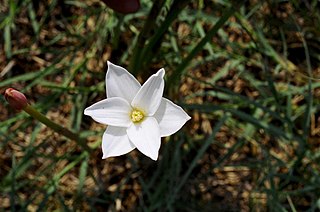
Zephyranthes chlorosolen, known by a number of common names including Drummond's rain‑lily, evening rain‑lily, evening star rain lily, Brazos rain‑lily, Texas rainlily, and cebolleta, is a species of flowering plant in the family Amaryllidaceae. It is found from Kansas to Mexico, and has been introduced to southern Brazil. A geophytic perennial typically 18 to 35 cm tall, its lone flower opens in the evening and lasts only a few days.
Zephyranthes pulchella, the showy zephyrlily, is a perennial species of flowering plant in the family Amaryllidaceae. It is found from Texas to northeast Mexico at elevations of 0 to 400 meters from sea level.


