
Jujube, sometimes jujuba, known by the scientific name Ziziphus jujuba and also called red date, Chinese date, and Chinese jujube, is a species in the genus Ziziphus in the buckthorn family Rhamnaceae.

Betula pendula, commonly known as silver birch, warty birch, European white birch, or East Asian white birch, is a species of tree in the family Betulaceae, native to Europe and parts of Asia, though in southern Europe, it is only found at higher altitudes. Its range extends into Siberia, China, and southwest Asia in the mountains of northern Turkey, the Caucasus, and northern Iran. It has been introduced into North America, where it is known as the European white birch or weeping birch and is considered invasive in some states in the United States and parts of Canada. The tree can also be found in more temperate regions of Australia.

Mabalacat, officially the City of Mabalacat, is a 3rd class component city in the province of Pampanga, Philippines. According to the 2020 census, it has a population of 293,244 people.

Pinus kesiya is one of the most widely distributed pines in Asia. Its range extends south and east from the Khasi Hills in the northeast Indian state of Meghalaya, to northern Thailand, Philippines, Burma, Cambodia, Laos, southernmost China, and Vietnam. It is an important plantation species elsewhere in the world, including in southern Africa and South America.
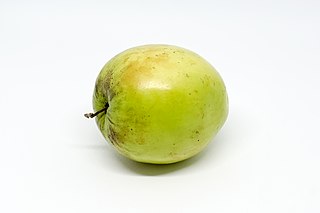
Ziziphus mauritiana, also known as Indian jujube, Indian plum, Chinese date, Chinese apple, and dunks is a tropical fruit tree species belonging to the family Rhamnaceae. It is often confused with the closely related Chinese jujube, but whereas Z. jujuba prefers temperate climates, Z. mauritiana is tropical to subtropical.

Gomortega keule is a tree native to Chile. It is the sole species of the genus Gomortega and, according to the APG IV system of 2016, of the monotypic family Gomortegaceae, assigned to the order Laurales in the clade magnoliids.
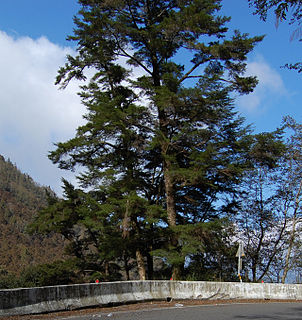
Tsuga chinensis, commonly referred to as the Taiwan or Chinese hemlock, or in Chinese as tieshan, is a coniferous tree species native to China, Taiwan, Tibet and Vietnam. The tree is quite variable and has many recognised varieties, though some are also maintained to be separate species by certain authorities. The tree was recently discovered in the mountains of northern Vietnam, making that the southernmost extension of its range.

The wandering salamander is a species of salamander in the family Plethodontidae. It is native to California in the United States and is thought to be introduced to British Columbia, Canada, possibly from the importation of oak bark for the tanning industry. Its natural habitat is temperate forests. It is threatened by habitat loss from logging.

Aglaia edulis is a tree species of plant in the family Meliaceae. It occurs in Tropical Asia from India to Yunnan and South-Central China. The wood and timber are used for various purposes.

Aloe comosa is a species of flowering plant in the Asphodelaceae family. It is commonly called Clanwilliam aloe) and is endemic to South Africa.
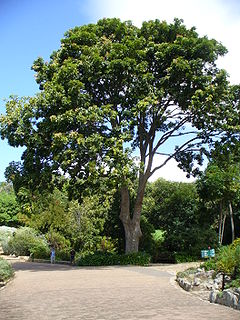
Khaya anthotheca, with the common name East African mahogany, is a large tree species in the Meliaceae family, native to tropical Africa.

Khaya ivorensis, also called African mahogany or Lagos mahogany, is a tall forest tree with a buttressed trunk in the family Meliaceae. It is found in Angola, Cameroon, Côte d'Ivoire, Gabon, Ghana, Liberia, and Nigeria where it grows primarily in lowland tropical rainforests. It is threatened by habitat loss.

Protea comptonii, also known as saddleback sugarbush, is a smallish tree of the genus Protea in the family Proteaceae. It is found in South Africa and Eswatini.
Shorea obtusa, the Siamese sal, is a species of hardwood tree in the family Dipterocarpaceae, native to Southeast Asia.

Vateria indica, the white dammar, is a species of tree in the family Dipterocarpaceae. It is endemic to the Western Ghats mountains in India. It is threatened by habitat loss. It is a large canopy or emergent tree frequent in tropical wet evergreen forests of the low and mid-elevations.

Ziziphus rugosa is a species of tree in the family Rhamnaceae. Ziziphus rugosa is also known as zunna berry.
Cinnamomum mercadoi (kalingag) is a small tree, about 6 to 10 metres high, with a thick, aromatic bark. The plant part of the family Lauraceae, which contains about 45 genera and 2000-2500 species, and is related to the culinary cinnamon, sassafras, and bay tree. The plant is indigenous to the Philippines, where it grows best in forests at low and medium altitudes that sometimes ascend to 2,000 metres (6,600 ft). C. mercadoi is unusual in the cinnamon family in that its essential oil consists large amounts of safrol, whereas other oils of cinnamon contain cinnamaldehyde. It is currently listed in the International Union for Conservation of Nature (IUCN) Red List as "vulnerable" due to the overharvesting and the continuous loss of the Philippine forests.

Antidesma ghaesembilla is a species of plant in the Phyllanthaceae family. It is native to an area from northern Australia to the Philippines, Zhōngguó/China, and west to India. The shrub or tree usually grows in moist soils in plant communities ranging from savannah to gallery forest to closed forest. It is associated with a number of species of fungus, insects and animals, including emus. Amongst the Mangarrayi and Yangman people of north Australia, the sweet ripe fruit of the tree are much appreciated and linked to the build-up season and to the koel. As well as food, the plant is used as a calendar-plant, for dyeing, in traditional medicine, in religious/magical practices, as fuel, and as an insecticide.
Ziziphus cambodiana is a deciduous thorny shrub, or vine, some 2-6 m tall, found growing in secondary undergrowth in Cambodia, Laos and Vietnam, and northern Thailand.

Gilbertiodendron dewevrei is a species of tree in the family Fabaceae, native to tropical rain forests in Central Africa. It is often the dominant tree species of the Guineo-Congolian rainforest. The timber is traded as limbali, and is used for construction, flooring and railway sleepers. It is also used for making boats, furniture, tool handles and joinery and for making charcoal.


