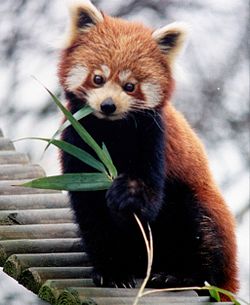
Georges Cuvier first described Ailurus as belonging to the raccoon family in 1825; this classification has been controversial ever since.[1] It was classified in the raccoon family because of morphological similarities of the head, colored ringed tail, and other morphological and ecological characteristics. Somewhat later, it was assigned to the bear family.[2]
Molecular phylogenetic studies had shown that, as an ancient species in the order Carnivora, the red panda is relatively close to the American raccoon and may be either a monotypic family or a subfamily within the procyonid family.[1][3][4] An in-depth mitochondrial DNA population analysis study stated: "According to the fossil record, the Red Panda diverged from its common ancestor with bears about 40 million years ago."[1][5] With this divergence, by comparing the sequence difference between the red panda and the raccoon, the observed mutation rate for the red panda was calculated to be on the order of 109, which is apparently an underestimate compared with the average rate in mammals.[6] This underestimation is probably due to multiple recurrent mutations as the divergence between the red panda and the raccoon is extremely deep.[citation needed]
The most recent molecular-systematic DNA research places the red panda into its own independent family, Ailuridae. Ailuridae are, in turn, part of a trichotomy within the broad superfamily Musteloidea[7] that also includes the Procyonidae (raccoons), the Mephitidae (skunks), and Mustelidae (weasels); but it is not a bear (Ursidae).[8]
Ailurids appear to have originated during the Late Oligocene to Early Miocene in Europe. The earliest known member, Amphictis, was likely an unspecialised carnivore, based on its dentition. Ailurids subsequently dispersed into Asia and North America. The puma-sized Simocyon found in Middle Miocene-Early Pliocene of Europe, North America and China was likely a hypercarnivore. Like modern red panda it had a "false thumb" to aid in climbing. Members of the subfamily Ailurinae, which includes the modern red panda as well as the extinct genera Pristinailurus and Parailurus, developed a specialised dental morphology with blunted cusps, creating an effective grinding surface to process plant material.[9]
Classification
The relationship of the Ailuridae with other carnivorans is shown in the following phylogenetic tree, which is based on the molecular phylogenetic analysis of six genes in Flynn (2005),[10] with the musteloids updated following the multigene analysis of Law et al. (2018).[11]
In addition to Ailurus, the family Ailuridae includes seven extinct genera, most of which are assigned to three subfamilies: Amphictinae, Simocyoninae, and Ailurinae.[12][13][14][15][16]
Ailurus fulgens styaniThomas, 1902 – Eastern red panda
Ailurus fulgens fulgensF. Cuvier, 1825 – Western red panda
In 2025, a comprehensive study describing new material of Magerictis imperialensis also reviewed the phylogeny of the entire family; it placed Magerictis and the new genus Rothictis in the new subfamily Magerictinae, recovered Simocyoninae as paraphyletic to the Ailurinae, and resurrected the family Amphictidae for Amphictis and the new genus Bonisictis.[19]
Family †Amphictidae Winge, 1895
AmphictisPomel, 1853
Amphictis antiquusPomel, 1853
Amphictis schlosseriHeizmann & Morlo, 1994
The remaining species A. borbonica, A. ageniensis, A. cuspida, A. timicua were stated to be of indeterminate generic status.
Bonisictis
Bonisictis ambiguusGervais, 1872
Bonisictis milloquensis(Helbing, 1928)
Family Ailuridae Gray, 1843
Subfamily †Magerictinae
MagerictisGinsburg, Morales, Soria, and Herráez, 1997
Magerictis imperialensisGinsburg, Morales, Soria, and Herráez, 1997
Rothictis
Rothictis prolongata(Morlo, 1996)
Rothictis wintershofensis(Heizmann and Morlo, 1994)
In 1940 the new genus Alopecocyon was described.[26]
In 1947 the new genus Actiocyon was described.[27]
In 1976 the new genus Protursus was described.[28]
In 1997 the new genus Magerictis was described.[29]
An additional, unnamed taxon called only "Ailurinae indet." was described in 2001 based on an upper molar from Four, a Middle Miocene-age locality near Isère, France.[30]
The new genera Bonisictis and Rothictis were described in 2025, both for species previously assigned to Amphictis. That genus along with Bonictis were assigned to the ressurected family Amphictidae, while Rothictis and Magerictis were assigned to the new ailurid subfamily Magerictinae.[19]
↑Salesa, Manuel J.; Peigné, Stéphane; Antón, Mauricio; Morales, Jorge (2022). "Evolution of the family Ailuridae: origins and Old-World fossil record". Red Panda: Biology and Conservation of the First Panda (2nded.). Elsevier. pp.15–29. doi:10.1016/b978-0-12-823753-3.00007-7. ISBN978-0-12-823753-3. S2CID243825496.
↑Morlo, Michael; Peigné, Stéphane (2010). "Molecular and morphological evidence for Ailuridae and a review of its genera". In Goswami, Anjali; Friscia, Anthony (eds.). Carnivoran Evolution: New Views on Phylogeny, Form, and Function. pp.92–140. doi:10.1017/CBO9781139193436.005. ISBN978-0-521-73586-5.
12Morales, Jorge; Abella, Juan; Caballero, Oscar; Demiguel, Daniel; Peláez-Campomanes, Pablo; Valenciano, Alberto (2025). "The enigmatic ailurid Magerictis imperialensis (Mammalia: Carnivora) unveiled: A systematic approach to the early Ailuridae". Journal of Systematic Palaeontology. 23 (1) 2571254. Bibcode:2025JSPal..2371254M. doi:10.1080/14772019.2025.2571254.
↑Cuvier, F. (1825). Panda. In: G. Saint-Hillaire (Ed.), Histoire naturelle des Mammiferes, avec des figures originales, colorees, desinees d’apres des animaux vivants (pp. 1–3). Chez A. Belin.
↑Gray, J. E. (1843). List of the specimens of Mammalia in the collection of the British Museum. British Museum (Natural History) Publications, The Trustees.
↑Pomel, A. (1853). Catalogue methodique et descriptif desvertebres fossiles decouverts dans le bassin hydrographique superieur de la Loire et surtout dans la vallee de son affluent principal l'Allier. In Libraire de L'academie Imperiale de Medecine, Paris (pp. 3–193). Libraire de L’academie Imperiale de Medecine
↑Wagner, A. (1858). Geschichte der Urwelt, mit besonderer Ber€ucksichtigung der Menschenrassen und des mosaischen Sch€opfungsberichtes (2nd ed.). Leopold Voss.
↑Dawkins, W. B. (1868). Fossil animals and geology of Attica, by Albert Gaudry. (Critical summary). Quarterly Journal of the Geological Society of London, 24, 1–7.
↑Schlosser, M. (1899). Parailurus anglicus und Ursus b€ockhi aus den Ligniten von Baroth-K€opecz, Comitat Haromszek in Ungarn. Mitt Jahrbuche K€oniglich Ungarischen Geol Anstalt, 13, 66–95.
↑Camp, C. L., & Vanderhoof, V. L. (1940). Bibliography of fossil vertebrates 1928–1933. Geological Society of America, Special Paper, 27, 1–503
↑Crusafont Pairo M., & Kurten B. (1976). Bears and bear-dogs from the Vallesian of the Valles-Penedes Basin, Spain. Acta Zoologica Fennica, 144, 1–29.
↑Ginsburg, Léonard; Morales, Jorge; Soria, Dolores; Herraez, Esther (1997). "Découverte d'une forme ancestrale du Petit Panda dans le Miocène moyen de Madrid (Espagne)". Comptes Rendus de l'Académie des Sciences - Series IIA - Earth and Planetary Science. 325 (6): 447–451. Bibcode:1997CRASE.325..447G. doi:10.1016/S1251-8050(97)81163-9.
Decker, D. M.; Wozencraft, W. C. (1991). "Phylogenetic Analysis of Recent Procyonid Genera". Journal of Mammalogy. 72 (1): 42–55. doi:10.2307/1381979. JSTOR1381979.
Flynn, J. J.; Hunt, G. D. Wesley (2005). "Carnivora". In Archibold, D.; Rose, K. (eds.). The Rise of Placental Mammals: Origin, Timing and Relationships of the Major Extant Clades. Baltimore: JHU Press. ISBN0-8018-8022-X.
Gregory, W. K. (August 8, 1936). "On the Phylogenetic Relationships of the Giant Panda (Ailuropoda) to other Arctoid Carnivores". American Museum Novitates (878): 1–29. hdl:2246/4138.
Hu, J. C. (1990). 關於小熊貓的研究論文集[Proceedings of studies of the red panda] (in Chinese). Beijing: Chinese Scientific Publishing.
Wilson, Don E.; Reeder, DeeAnn M. (2005). Mammal Species of the World: A Taxonomic and Geographic Reference. Vol.1. JHU Press. ISBN0-8018-8221-4.
This page is based on this Wikipedia article Text is available under the CC BY-SA 4.0 license; additional terms may apply. Images, videos and audio are available under their respective licenses.