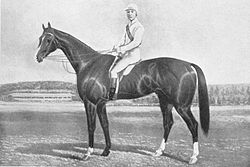
This year was the twenty-fourth running of the Melbourne Cup. The race was won by five-year-old stallion Malua, owned by John Ord Inglis.[2]
Entries and odds
Praised before the race as "the greatest horse in the country" and as "having the greatest dash of foot of any horse we have seen this season,"[3]Malua was the pundits pick to win the race after winning the Melbourne Stakes on the Saturday before the race.[3] The only query was whether it could finish strongly across the two miles.[4]
Finishing a strong second in the Hotham Handicap, Hastings was seen as a strong chance across the two mile distance, with the horse eventually starting as the 5/1 favourite. Coming off a third placed finish in the Victoria Derby, Bargo was considered the strongest colt in the field following good form in Sydney, including winning the AJC Derby.[5] After winning the Caulfield Cup at long odds, Tasmanian horse Blink Bonny showed that it would be hard to beat in the race, having beaten short-priced favourite Vergy.[6] Of the other runners, there was some support for Off Colour, Hilltop and Claptrap.[7][4]
Missing from the field were 1883 runners Le Grand, Despot and winner Martini-Henry,[7] with Martini-Henry retired to stud after being injured running unplaced in the 1884 Caulfield Cup.[8][9] Also not in the field was 1884 Metropolitan Handicap winner Sir Modred,[4] while five-time winning trainer Etienne de Mestre was a notable absentee after financial and health problems saw his estate auctioned off in late 1883.[10]
For the second year in a row, Commotion was the top-weighted runner, carrying 9st 12lb (62.6kg), slightly less than what it had been handicapped when finishing third in 1883.[4]
From the initial entry of 134 runners,[11] 24 horses headed to the start under cloudless skies with a hint of a breeze.[12][13]
An even start saw Hill Top find its way to the front of the field, in front of Vergy, Signor and Anchorite.[14] Off Colour and Plausible brought up the rear of the field. Signor led the field past the stands and around the first turn, maintaining a lead of a length ahead of The Broker down the riverside part of the course.[14] The Plunger made a move at the top of the course, but was running against Lord Clifden while trying to go forward. Able to shake loose, The Plunger took the lead as Signor faded, leading a pack which included Bargo, Hill Top, The Broker, Commotion, Plausible, Malua and Hastings. At the final turn, The Plunger led by three lengths from Commotion.[12][14] Down the Flemington straight, The Plunger tired badly with Commotion taking the lead ahead of Plausible.[12]To some observers it looked like Commotion had the race in its control,[12] but down the outside Malua came with a rush, taking the lead in the final stages to win by half a length from a gallant Commotion.[15] Plausible was third by more than two lengths having lost ground by swerving on the straight,[12] heading a large group of runners. Bristol, Tremando, Claptrap and Merrimu the last to cross the line.[2] The finishing time was the third fastest in the Melbourne Cup's history.[12]
A brown-bay five-year-old stallion, Malua was bred in Tasmania and purchased by Thomas Reibey as a yearling where it raced under the moniker of Bagot.[12][16] The horse was sold at auction to John Ord Inglis for £500 in November 1882. Malua won the Newmarket Handicap earlier in 1884, also winning the Oakleigh Handicap and Adelaide Cup, then the Spring Stakes at Randwick in the spring season before the Melbourne Cup.[12]
As described in The Leader:
The Melbourne Cup of 1884 will long remain memorable for being associated with the victory of one of the best, if not the best, racehorses that ever tred Australia's turf. The performance was an equine triumph of the most pronounced order, and the style in which Malua cut down his field at the end of a severe two mile struggle under the crushing impact of 9st 9lb will not easily be obliterated from the memories of the thousands and tens of thousands who witnessed the spectacle. It was the conquest of a great horse in a great race and under what more judges of racing considered an annihilating burden. Nevertheless Malua accomplished the task assigned to him with comparitive ease, for there can be no mistaking that electric dash of his when he cut down the stable associates Commotion and Plausible in the last furlong, as if they were nothing more than a pair of common hacks.[15]
It was the first Melbourne Cup win for owner John Ord Inglis, trainer Isaac Foulsham and jockey Alec Robertson. It was reported that Robertson rode "with commendable patience" to win the race in the final stages.[14]
It was again estimated that a crowd of over 100,000 patrons attended the racecourse, with the "national holiday... rapidly becoming of wide intercolonial significance."[14] At least half of those in attendance had made their way to the racecourse via railway using Melbourne's Spencer Street railway station.[14]
This page is based on this Wikipedia article Text is available under the CC BY-SA 4.0 license; additional terms may apply. Images, videos and audio are available under their respective licenses.