1948 Republic of China legislative election

Last updated
Republic of China legislative election

The First Legislative Representative Election of the Republic of China, and the preceding 1947 National Assembly Election were the Republic of China's first public direct elections since its founding. At the time most of China's territory was under the control of the Government of the Republic of China, using a direct voting system elected 759 Legislative Representatives. Using the Republic's then 461 million population [1] to calculate, on average 600,000 people elected one representative in the Legislature. The election along with the one held for the National Assembly also made China the largest democracy at the time.

Contents

Background

In 1928, the National Government completed the Northern Expedition and after achieving unification in the name of China, initiated the "Political Tutelage" period and created the Legislative Yuan. But the Legislative Representatives at the time were not elected, but appointed by the National Government for a 2-year term. There were initially 49 seats, but it was increased to the 194 seats before the Second Sino-Japanese War. However, during the Second World War, the 194 Legislative Representatives selected in 1934's terms were extended until after WWII in 1947.

On January 1, 1947, the "Constitution of the Republic of China" was published, and in the same year on December 25 promulgated. In April 1947, according to the Political Consultative Conference, the National Government was reorganized to allow other political parties (e.g. Youth Party, Democratic Socialist Party) to enter. In the beginning of 1948, according to the Constitution's Article 64, the first Constitutional Legislative Election was held. Because of the large size of the provinces, not all of the elections in the various provinces were held on the same date. The starting and ending dates were from January 21 to January 23.

Because of the problems that took place during the 1947 National Assembly Election (i.e. Party candidates were not nominated by their political parties, but by self-gathering voter signatures), the Nationalist Party Central Government strengthened the requirements for party member candidates.

Election

Elected Government Officials of the Republic of China
TitleRole in Government Constitutional Provisions Amended Provisions
President Head of StateIndirectly Elected by the National AssemblyElected Directly by the Citizens in the Free Area
National Assembly DelegateOrgans of State PowerDirectly Elected by the CitizensInstitution Suspended, with its powers transferred to the Legislative Yuan
Legislative RepresentativeLegislatureDirectly Elected by the CitizensElected Directly by the Citizens in the Free Area
Control Yuan MembersMonitoring AuthorityIndirectly elected by Provincial CouncilsAppointed by the President and confirmed by the Legislature

In accordance to the Constitution of the Republic of China, members of the Legislative Yuan shall be elected in accordance with the following provisions:

  1. Those to be elected from the provinces and by the municipalities under the direct jurisdiction of the Executive Yuan shall be five for each province or municipality with a population of not more than 3,000,000, one additional member shall be elected for each additional 1,000,000 in a province or municipality whose population is over 3,000,000
  2. Those to be elected from Mongolian Leagues and Banners
  3. Those to be elected from Tibet
  4. Those to be elected by various racial groups in frontier regions
  5. Those to be elected by Chinese citizens residing abroad
  6. Those to be elected by occupational groups

The number of women to be elected under the provinces, municipalities, and other items shall be prescribed by law. Based on the census calculations, at the time the citizen population of China numbered at 461 million, [2] in this election 773 representatives were elected. Their numbers are as follows

  1. Elected representatives from the provinces and municipalities: 622
  2. Elected representatives from the Mongolian Leagues: 22
  3. Elected representatives from Tibet: 15
  4. Elected representatives by various racial groups in frontier regions: 6
  5. Elected representatives by Chinese citizens residing abroad: 19
  6. Elected representatives by occupational groups: 89 [3]

Campaigning: Legislative Election and Recall Law Article XII, when generating the candidates for the election, once a Candidate has over 3000 voters' signatures or been nominated by the party as candidates, he may begin campaigning. Those who have failed will not be allowed to campaign. Overseas Chinese and Occupational Groups can only campaign if they have the required number of voters. Because the constitution has just been promulgated, opposition was small, and most of the nominated candidates were from the Nationalist Party.

Election process

As a process of constitutional succession, before the establishment of the elected government, in accordance with the "End of Political Tutelage Procedure Law," the first Legislative and National Assembly election is to be organized by the National Government. In accordance with the "National Assembly and Legislative Yuan Election Ordinance" from June 25, 1947, the National Government are to establish general elections at the central government office and around the various provinces, municipalities, and counties. In 1948, from January 21 to January 23, the country's 47 provinces, municipalities, 18 Mongolian Leagues, Tibetan area, domestic occupational groups, women's organisations, and overseas Chinese regions, making up nearly 200 million voters voted for their legislators. Because of the Chinese Civil War, the elections could not be held in Communist controlled areas, the National Government, through the supplementary regulations, had the people living nearest to the areas elect representation for the areas.

Because the Chinese Communist Party refused to participate in the election, only the Chinese Nationalist Party, China Democratic Socialist Party, Chinese Youth Party, and other small party and independents participated. In the election, all Citizens who had gone through citizen registration at least 20 years old could vote using the "Radio, anonymous, secret" voting system. Not counting the small groups like the occupational groups and the ethnic minority groups, only those who were close to the ballot offices could participate. If using an average 30% between all of the provinces of citizens who have registered, it is estimated that 150 million people participated. Although the turn-out rate was low, this session of the Legislative Yuan and National Assembly remains to date the only session of the Greater China region that has been directly elected.

Also, Sinkiang Province had 6 seats, but 1 seat of the Yitaasan district was reserved to elected, so only 5 were elected from the Province; Tibet Area originally were given 5 seats, but because the Kashag did not report the list on time, 3 of the Tibetan representatives in the Capital filled in the seats, and Tibet had 2 vacant seats; Overseas Chinese Citizens had 19 seats, but only districts 6 to 13's votes were counted, electing 8 representatives with 11 vacancies. In total, there were 14 vacancies.

Representatives

Aftermath

Site of Legislative Yuan Meetings in Nanjing from 1946-1949 Former Legislative Yuan & Control Yuan in Nanjing 2011-10.JPG
Site of Legislative Yuan Meetings in Nanjing from 1946-1949

In 1948, 759 members were elected to the First Legislative Yuan under the rule of the recently promulgated Constitution of the Republic of China. The members convened of their own accord on May 8 in the National Assembly Hall of Nanking and held six preparatory meetings during which Dr. Ko Sun (son of Sun Yat-sen) and Mr. Li-fu Chen were elected President and Vice President respectively. On May 18, the first meeting of the first session of the First Legislative Yuan officially inaugurated 21 standing committees in operation.

1950

Owing to the Chinese Civil War between the Nationalists, led by the Kuomintang, and the Communists, led by the Chinese Communist Party, the central government was moved to Taipei in 1950. Of the 759 legislators, 380 followed the government to Taiwan. On February 24 of the same year, the remaining legislators gathered for its first meeting of the fifth session at the Sun Yat-sen Hall in Taipei. Before long the Legislative Yuan voted to revise its organization law and reduced the number of the standing committees to 12; at the same time, it set up other ad hoc committees. In 1960, the Legislative Yuan moved to its current location on Chungshan South Road.

1951

The term of the First Legislative Yuan members was supposed to have expired by May 1951, had it not been for a major national conflict that made impossible an election as required by law for the next Legislative Yuan. Accordingly, the Council of Grand Justices of the Judicial Yuan passed the No. 31 Interpretation of the Constitution to justify and legalize continuous performance of these members elected in 1948. During this extended tenure, however, 11 additional members were elected in 1969 to the Legislative Yuan according to the "Temporary Provisions Effective During the Period of Communist Rebellion" to perform their functions together with those remaining members elected in 1948. This situation resulted in a de facto dictatorship led by President Chiang Kai-shek and his cabinet, which lasted until his death and continued under Yen Chia-kan and Chiang Ching-kuo. While the Legislative Yuan seldom rejected measures proposed by the Executive Yuan, it became on the few places where political dissension was formally permitted (as guaranteed by the Constitution). Besides members of the Kuomintang, only members of political parties formed before 1948, such as (Chinese Youth Party and China Democratic Socialist Party) or independents were allowed to be candidates. Organized independents ( Tangwai , "who are outside the party") where not tolerated during this period of time.

1972

In December 1972, the Legislative Yuan was invigorated with 51 additional members of three-year term elected in accordance with the amended "Temporary Provisions...". Subsequently, in December 1975, 52 members were elected and sworn in on February 1 in the following year. The election slated for December 1978 was suspended until November 20, 1980 because of the severance of diplomatic relations between the Republic of China and the United States of America. Yet the number of members elected in that election was increased to 97 in accordance with the "Election and Recall Law During the Period of General National Mobilization for the Suppression of Communist Rebellion". From then onward, 98 members in 1983, 100 members in 1986 and 130 members in 1989 were elected respectively and sworn in on February 1, 1984, 1987 and 1990.

1991

On December 31, 1991, all remaining veteran members elected in 1948 finally retired, and the legislative power was taken over by the 130 additional members elected in 1989.

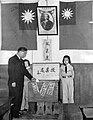
Because the election dates of the two elections are almost the same, it is difficult to determine which election is depicted in the pictures, as a result the pictures are placed together into the same gallery.

See also

Related Research Articles

Democratic Progressive Party Political party in Taiwan

The Democratic Progressive Party (DPP) is a Taiwanese nationalist and liberal political party in Taiwan. Controlling both the Taiwan Presidency and the unicameral Legislative Yuan, it is the majority ruling party and the dominant party in the Pan-Green Coalition.

Politics of the Republic of China Politics of the ROC, which is de facto located in Taiwan

The politics of the Republic of China take place in a framework of a representative democratic republic, whereby the President is head of state and the Premier is head of government, and of a multi-party system. Executive power is exercised by the government. Legislative power is vested in primarily with the parliament and limited by government. The Judiciary is independent of the executive and the legislature. The party system is dominated by the Kuomintang, which favors closer links to mainland China, and the Democratic Progressive Party, which favors Taiwanese independence.

President of the Republic of China Head of state of the Republic of China

The President of the Republic of China is the head of state of the Republic of China (Taiwan). Since 1996, the President is directly elected by plurality voting to a four-year term, with at most one re-election. The incumbent, Tsai Ing-wen, succeeded Ma Ying-jeou on 20 May 2016 as the first female president in the Country history. Originally established in Nanking in 1912, the government and its president relocated to Taipei in 1949 after losing the Chinese Civil War. Since the 1996 Taiwanese presidential election the President has been democratically elected.

Legislative Yuan National legislature of Republic of China

The Legislative Yuan is the unicameral legislature of the Republic of China (Taiwan). It is one of the five branches of government stipulated by the Constitution of the Republic of China, which follows Sun Yat-sen's Three Principles of the People.

National Assembly (Republic of China) various parliamentary bodies in China

The National Assembly of the Republic of China was a group of related parliamentary government organizations of the Republic of China, both in Mainland China and Taiwan.

Constitution of the Republic of China constitution

The Constitution of the Republic of China is the fifth and current Chinese constitution, ratified by the Kuomintang during the Constituent National Assembly session on December 25, 1946, in Nanjing, and adopted on December 25, 1947. Since 1949, the constitution, along with its Additional Articles, remains effective in ROC-controlled territories.

Elections in Taiwan Overview of elections in Taiwan

There are eleven types of elections in Taiwan which, since 2012, have been unified into general and local elections, each held every four years, typically in January and November respectively. There may also be by-elections. Electoral systems include first-past-the-post, proportional representation, single non-transferable voting, and a parallel mixture of the above.

Civil Party (Taiwan) minor political party in the Republic of China on Taiwan

The Civil Party is a minor political party in Taiwan. It has no representation in the Legislative Yuan, but won one seat in the National Assembly election of 2005. In the 2008 legislative election it had the following policies in its manifesto: establishing a Zhonghua minzu Taiwan Grand Republic (中華民族台灣大公國), being a federation of seven or ten small constituent republics; developing nuclear weapons; releasing all prisoners except those convicted of grave offences; legalization of euthanasia and prostitution.

Vice President of the Republic of China position

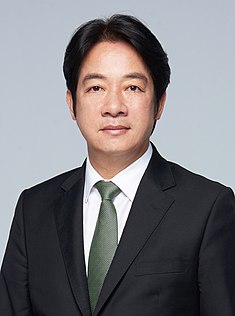
The Vice President of the Republic of China is the second-highest executive official of the Republic of China (Taiwan). The existing office was created in 1948 under the 1947 Constitution of the Republic of China. After the Kuomintang lost mainland China to the Chinese Communists during the Chinese Civil War, the government, along with its presidency, retreated to Taiwan. The Communist Party of China has since established the People's Republic of China on the mainland side. Lai Ching-te is the current Vice President of the Republic of China.

Nationalist government Government of the Republic of China between 1925 and 1948

The Nationalist government, officially the National Government of the Republic of China, also known as Second Republic of China but most commonly known as the Republic of China, refers to the government of the Republic of China between 1 July 1925 and 20 May 1948, led by the Kuomintang. The name derives from the Kuomintang's translated name "Nationalist Party". The government was in place until it was replaced by the current Government of the Republic of China in the newly promulgated Constitution of the Republic of China.

Government of the Republic of China ROC government since 1948

The Government of the Republic of China, commonly known as the Government of Taiwan, is the democratic, constitutional government that exercises control over Taiwan and other islands in the free area. The president is the head of state. The government consists of Presidency and five branches (Yuan): the Executive Yuan, Legislative Yuan, Judicial Yuan, Examination Yuan, and Control Yuan.

China Democratic Socialist Party political party

The China Democratic Socialist Party was founded in Shanghai on 15 August 1946. It was formed through the merger of the former Chinese National Socialist Party and the Democratic Constitutionalist Party, both of which had survived the years of Japanese aggression by generally supporting the Kuomintang-led national government. The new party's first head was Carsun Chang.

The Progressive Party was a political party in the Republic of China from 1913 to 1916.

Provisional Government of the Republic of China (1912) Provisional government established during the Xinhai Revolution in 1912

The Provisional Government of the Republic of China was a provisional government established during the Xinhai Revolution by the revolutionaries in 1912. After the success of the Wuchang uprising, revolutionary provincial assembly representatives held a conference in the district of Wuchang, China, which framed the organizational outline of the Provisional Government.

1911 Republic of China provisional presidential election

The 1911 Republic of China Provisional Presidential and Vice-Presidential Election was the election held on 29 December 1911 during the Xinhai Revolution for the First Provisional President and Vice President of the Provisional Government of the Republic of China. Sun Yat-sen and Li Yuan-hung were elected as President and Vice-President respectively. Sun sworn in at midnight on 1 January 1912 and declared the official establishment of the Republic of China.

National Peoples Congress highest organ of state power and legislature of the Peoples Republic of China

The National People's Congress of the People's Republic of China, normally referred to as the National People's Congress, is the highest organ of state power and the national legislature of the People's Republic of China. With 2,980 members in 2018, it is the largest parliamentary body in the world. The National People's Congress meets in full session for roughly two weeks each year and votes on important pieces of legislation. Members are considered to be part-time legislators and are not paid.

Additional Articles of the Constitution of the Republic of China Constitutional revisions and amendments that serve as the Constitution of Taiwan

The Additional Articles of the Constitution of the Republic of China are the revisions and constitutional amendments to the original constitution to meet the requisites of the nation and the political status of Taiwan. The Additional Articles are usually attached after the original constitution as a separate document. It also has its own preamble and article ordering different from the original constitution.

1912 Republic of China provisional presidential election

The 1912 Republic of China Provisional Presidential and Vice-Presidential Elections were the elections held on 15 February and 20 February 1912 in Nanjing for the second provisional President and Vice President of the Republic of China respectively.

The Unity Party was a short-lived political party in the early of the Republican period of China from 1912 to 1913.

References

  1. China's Population Reaches 461,000,000 The Washington Post (1877–1954). Washington, D.C.: November 22, 1947. p. 2 (1 page)
  2. China's Population Reaches 461,000,000 The Washington Post (1877-1954). Washington, D.C.: November 22, 1947. p. 2 (1 page)
  3. 《中華民國選舉概況》,中央選舉委員會,1984年6月,第562頁

Further reading