| This article does not cite any sources .(June 2019) (Learn how and when to remove this template message) |
 | |||||||||||||||||
574 seats to the National Assembly (168 seats to the Senate + 406 seats to the House of Representatives) | |||||||||||||||||
|---|---|---|---|---|---|---|---|---|---|---|---|---|---|---|---|---|---|
| |||||||||||||||||


The Republic of China National Assembly elections, 1918, held in May to June, were the elections for the second National Assembly of the Republic of China. The bicameral assembly consisted of a senate and a house of representatives. Representatives were directly elected while senators were elected by provincial assemblies.
The first National Assembly elected in 1912 was dismissed by President Yuan Shikai in 1914 followed by the proclamation of emperor himself. After Yuan died, Vice President Li Yuanhong succeeded the office and reconvened the National Assembly on 1 August 1916 under the pretext that its three-year term was suspended not expired. Li Yuanhong was forced to disband it due to the Manchu Restoration on 13 June 1917. Duan Qirui, the former Premier dismissed by his rival Li Yuanhong and the head of Anhui clique defeated the Restoration armies in Beijing and resumed his post as Premier, which made him the most powerful leader in China.

Yuan Shikai was a Chinese military and government official who rose to power during the late Qing dynasty. He tried to save the dynasty with a number of modernization projects including bureaucratic, fiscal, judicial, educational, and other reforms, despite playing a key part in the failure of the Hundred Days' Reform. He established the first modern army and a more efficient provincial government in North China in the last years of the Qing dynasty before the abdication of the Xuantong Emperor, the last monarch of the Qing dynasty, in 1912. Through negotiation, he became the first official president of the Republic of China in 1912.

Li Yuanhong was a Chinese politician during the Qing dynasty and the Republic of China. He was the President of the Republic of China between 1916 and 1917, and between 1922 and 1923.
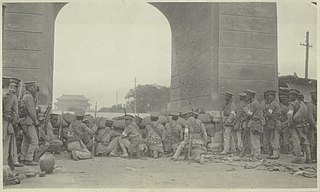
The Manchu Restoration of July 1917 was an attempt to restore monarchy in China by General Zhang Xun, whose army seized Beijing and briefly reinstalled the last emperor of the Qing dynasty, Puyi, to the throne. The restoration lasted only a few days, from July 1 to July 12, and was quickly reversed by Republican troops. Despite the uprising's popular name, almost all reactionary putschists were ethnic Han Chinese.
Duan Qirui initiated elections for a new assembly to consolidate his power. Seventeen provinces responded, five southern provinces under the Southern militant governments (Guangdong, Guangxi, Guizhou, Yunnan, and Sichuan) boycotted, and the delegates for Tibet, Xinjiang, and Qinghai were chosen by Beijing. While there were 574 seats available, the southern boycott left 104 seats vacant leading to the actual total of 470. Votes were bought and sold in an open market with prices fluctuating constantly and fraud and abuse was widespread. Duan dominated this assembly with his Anhui clique's political wing, the Anfu Club, which won 342 of the 470 seats with the rest going to Liang Shiyi's Communications Clique, Liang Qichao's Research Clique or to independents. Only 98, about one-fifth, of those elected had prior legislative experience.

Guangdong is a coastal province in South China on the north shore of South China Sea. Its capital of the province is Guangzhou. With a population of 113.46 million across a total area of about 179,800 km2 (69,400 sq mi), Guangdong is the most populous province of China and the 15th-largest by area. Its economy is larger than that of any other province in the nation and the 6th largest sub-national economy in the world with a GDP size of 1.47 trillion US dollars in 2018. The Pearl River Delta Economic Zone, a Chinese megalopolis, is a core for high technology, manufacturing and foreign trade. Located in this zone are two of the four top Chinese cities and the top two Chinese prefecture-level cities by GDP; Guangzhou, the capital of the province, and Shenzhen, the first special economic zone in the country. These two are among the most populous and important cities in China, and have now become two of the world's most populous megacities.
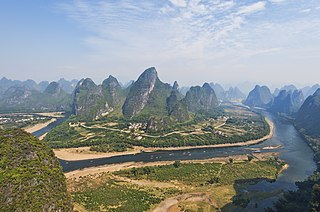
Guangxi, officially the Guangxi Zhuang Autonomous Region (GZAR), is an autonomous region of the People's Republic of China, located in South China and bordering Vietnam and the Gulf of Tonkin. Formerly a province, Guangxi became an autonomous region in 1958. Its current capital is Nanning.

Guizhou, is a landlocked province in Southwest China. Its capital and largest city is Guiyang, in the central part of the province. Guizhou borders the autonomous region of Guangxi to the south, Yunnan to the west, Sichuan to the northwest, the municipality of Chongqing to the north, and Hunan to the east. The population of Guizhou stands at 34 million, ranking 19th among the provinces in China.
It met on 12 August 1918 to elect Xu Shichang to the presidency in the 1918 presidential election. Though the Anfu Club promised the vice-presidency to Cao Kun, the Communications clique prevented the two-thirds quorum required for his election and left the office vacant. This assembly met until 30 August 1920 when the Anhui clique was defeated by the Zhili clique in the Zhili–Anhui War. Xu held national elections in 1921 but only eleven provinces responded so that assembly never convened.
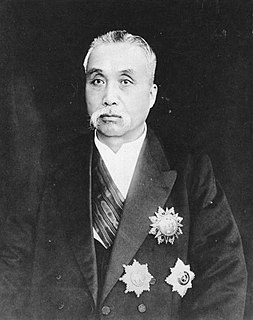
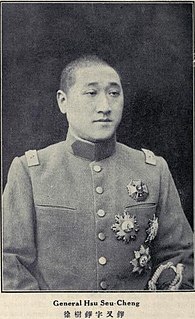
Xu Shichang was the President of the Republic of China, in Beijing, from 10 October 1918 to 2 June 1922. The only permanent president of the Beiyang government to be a civilian, his presidency was also the longest of the warlord era.
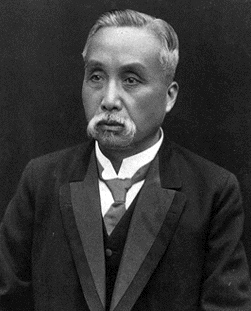
The 1918 Republic of China Presidential and Vice-Presidential Elections were the elections held on 4 September 1918 in Beijing for the second term of the President of the Republic of China. Xu Shichang was elected by two houses of the National Assembly which were controlled by the Anfu Club formed in the National Assembly election in the same year.

General Cao Kun was a Chinese warlord and politician, who served the President of the Republic of China from 1923 to 1924, as well as the military leader of the Zhili clique in the Beiyang Army; he also served as a trustee of the Catholic University of Peking.
After Duan dismissed the old assembly, 130 members (mostly Kuomintang) moved to Guangzhou where they held an "extraordinary session" on 25 August under a rival government led by Sun Yat-sen, another 120 quickly followed. After the Old Guangxi clique became disruptive, the assembly temporarily moved to Kunming and later Chongqing under Tang Jiyao's protection until Guangzhou was liberated. Lacking a quorum, they selected new members in 1919.

Sun Yat-sen was a Chinese philosopher, physician, and politician, who served as the first president of the Republic of China and the first leader of the Kuomintang. He is referred as the "Father of the Nation" in the Republic of China due to his instrumental role in the overthrow of the Qing dynasty during the Xinhai Revolution. Sun is unique among 20th-century Chinese leaders for being widely revered in both mainland China and Taiwan.
After the founding of the Republic of China, Guangxi served as the base for one of the most powerful warlord cliques of China: the Old Guangxi Clique. Led by Lu Rongting (陆荣廷), the clique was able to take control of neighbouring Hunan and Guangdong provinces as well. Along with the Yunnan clique, they formed the core of opposition to Yuan Shikai's monarchist ambitions during the National Protection War. With Yunnan and Sun Yat-sen's Chinese Revolutionary Party, they started the Constitutional Protection Movement. They quickly came to disagree with Sun and squeezed him out of power. Sun, Chen Jiongming, and the Yunnan clique defeated them in the Guangdong-Guangxi War. The Old Guangxi Clique crumbled in the early 1920s, and was replaced by the pro-Sun New Guangxi Clique.

Kunming is the capital and largest city of Yunnan province in southwest China. Known as Yunnan-Fu until the 1920s, today it is a prefecture-level city and the political, economic, communications and cultural centre of the province as well as the seat of the provincial government. The headquarters of many of Yunnan's large businesses are in Kunming. It was important during World War II as a Chinese military center, American air base, and transport terminus for the Burma Road. Located in the middle of the Yunnan–Guizhou Plateau, Kunming is located at an altitude of 1,900 metres above sea level and at a latitude just north of the Tropic of Cancer. As of 2014, Kunming has a population of 6,626,000 with an urban population of 4,575,000, and is located at the northern edge of Dian Lake, surrounded by temples and lake-and-limestone hill landscapes.