Related Research Articles
Arianism is a Christological doctrine which rejects the traditional notion of the Trinity and considers Jesus to be a creation of God, and therefore distinct from God. It is named after its major proponent, Arius. It is considered heretical by most modern mainstream branches of Christianity. It is practiced by a minority of modern denominations, although some of these denominations practice related doctrines such as Socinianism, and some shy away from use of the term Arian due to the term's historically negative connotations. Modern mainstream denominations sometimes connected to the teaching include Jehovah's Witnesses, the Church of Jesus Christ of Latter-day Saints, some individual churches within the Churches of Christ, as well as some Hebrew Roots Christians and Messianic Jews.
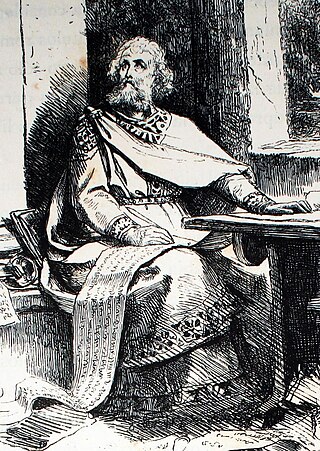
Ulfilas (Greek: Οὐλφίλας; c. 311 – 383), known also as Wulfila(s) or Urphilas, was a 4th-century Gothic preacher of Cappadocian Greek descent. He was the apostle to the Gothic people.

A pseudepigraph is a falsely attributed work, a text whose claimed author is not the true author, or a work whose real author attributed it to a figure of the past. The name of the author to whom the work is falsely attributed is often prefixed with the particle "pseudo-", such as for example "pseudo-Aristotle" or "pseudo-Dionysius": these terms refer to the anonymous authors of works falsely attributed to Aristotle and Dionysius the Areopagite, respectively.

The Johannine Comma is an interpolated phrase (comma) in verses 5:7–8 of the First Epistle of John. The text in the King James Version of the Bible reads:
7For there are three that beare record [in heaven, the Father, the Word, and the Holy Ghost: and these three are one.] 8[And there are three that beare witnesse in earth], the Spirit, and the Water, and the Blood, and these three agree in one.

Lucian of Antioch, known as Lucian the Martyr, was a Christian presbyter, theologian and martyr. He was noted for both his scholarship and ascetic piety.
Homoiousios is a Christian theological term, coined in the 4th century to identify a distinct group of Christian theologians who held the belief that God the Son was of a similar, but not identical, essence with God the Father.
Gothic Christianity refers to the Christian religion of the Goths and sometimes the Gepids, Vandals, and Burgundians, who may have used the translation of the Bible into the Gothic language and shared common doctrines and practices.
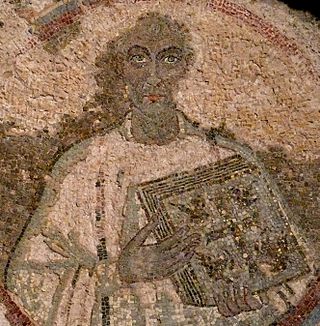
Quodvultdeus was a fifth-century Church Father and Bishop of Carthage who was exiled to Naples. He was known to have been living in Carthage around 407 and became a deacon in 421 AD. He corresponded with Augustine of Hippo, who served as Quodvultdeus' spiritual teacher. Augustine also dedicated some of his writings to Quodvultdeus.

Subordinationism is a Trinitarian doctrine wherein the Son is subordinate to the Father, not only in submission and role, but with actual ontological subordination to varying degrees. It posits a hierarchical ranking of the persons of the Social Trinity, implying ontological subordination of the persons of the Son and the Holy Spirit. It was condemned as heretical in the Second Council of Constantinople.
Heresy in Christianity denotes the formal denial or doubt of a core doctrine of the Christian faith as defined by one or more of the Christian churches.

Against Heresies, sometimes referred to by its Latin title Adversus Haereses, is a work of Christian theology written in Greek about the year 180 by Irenaeus, the bishop of Lugdunum.

In the history of Christianity, the first seven ecumenical councils include the following: the First Council of Nicaea in 325, the First Council of Constantinople in 381, the Council of Ephesus in 431, the Council of Chalcedon in 451, the Second Council of Constantinople in 553, the Third Council of Constantinople from 680 to 681 and finally, the Second Council of Nicaea in 787. All of the seven councils were convened in what is now the country of Turkey.

Jacobus Latomus was a Catholic Flemish theologian, a distinguished member of the Faculty of Theology at the University of Leuven. Latomus was a theological adviser to the Inquisition, and his exchange with William Tyndale is particularly noted. The general focus of his academic work centered on opposing Martin Luther and the Protestant Reformation, supporting the papacy and the hierarchy of the Catholic Church. Etymology: Latinized Latomus = Masson from Greek lā-tómos 'stone-cutter, quarryman', thus 'mason'.
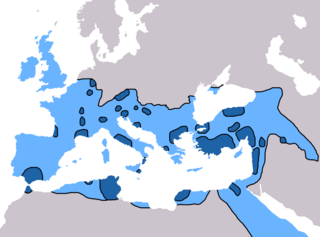
Christianity in the 4th century was dominated in its early stage by Constantine the Great and the First Council of Nicaea of 325, which was the beginning of the period of the First seven Ecumenical Councils (325–787), and in its late stage by the Edict of Thessalonica of 380, which made Nicene Christianity the state church of the Roman Empire.
In the 5th century in Christianity, there were many developments which led to further fracturing of the State church of the Roman Empire. Emperor Theodosius II called two synods in Ephesus, one in 431 and one in 449, that addressed the teachings of Patriarch of Constantinople Nestorius and similar teachings. Nestorius had taught that Christ's divine and human nature were distinct persons, and hence Mary was the mother of Christ but not the mother of God. The Council rejected Nestorius' view causing many churches, centered on the School of Edessa, to a Nestorian break with the imperial church. Persecuted within the Roman Empire, many Nestorians fled to Persia and joined the Sassanid Church thereby making it a center of Nestorianism. By the end of the 5th century, the global Christian population was estimated at 10-11 million. In 451 the Council of Chalcedon was held to clarify the issue further. The council ultimately stated that Christ's divine and human nature were separate but both part of a single entity, a viewpoint rejected by many churches who called themselves miaphysites. The resulting schism created a communion of churches, including the Armenian, Syrian, and Egyptian churches, that is today known as Oriental Orthodoxy. In spite of these schisms, however, the imperial church still came to represent the majority of Christians within the Roman Empire.

Christianity in late antiquity traces Christianity during the Christian Roman Empire — the period from the rise of Christianity under Emperor Constantine, until the fall of the Western Roman Empire. The end-date of this period varies because the transition to the sub-Roman period occurred gradually and at different times in different areas. One may generally date late ancient Christianity as lasting to the late 6th century and the re-conquests under Justinian of the Byzantine Empire, though a more traditional end-date is 476, the year in which Odoacer deposed Romulus Augustus, traditionally considered the last western emperor.

Traditionally in Christianity, orthodoxy and heresy have been viewed in relation to the "orthodoxy" as an authentic lineage of tradition; other forms of Christianity were viewed as deviant streams of thought and therefore "heterodox". This view was challenged by the publication of Walter Bauer's Rechtgläubigkeit und Ketzerei im ältesten Christentum in 1934. Bauer endeavored to rethink early Christianity historically, independent from the views of the current church. He stated that the 2nd-century church was very diverse and included many "heretical" groups that had an equal claim to apostolic tradition. Bauer interpreted the struggle between the orthodox and heterodox to be the "mainstream" Church of Rome struggling to attain dominance. He presented Edessa and Egypt as places where the "orthodoxy" of Rome had little influence during the 2nd century. As he saw it, the theological thought of the "Orient" at the time would later be labeled "heresy". The response by modern scholars has been mixed. Some scholars clearly support Bauer's conclusions and others express concerns about his "attacking [of] orthodox sources with inquisitional zeal and exploiting to a nearly absurd extent the argument from silence." However, modern scholars have critiqued and updated Bauer's model.

The Church Fathers, Early Church Fathers, Christian Fathers, or Fathers of the Church were ancient and influential Christian theologians and writers who established the intellectual and doctrinal foundations of Christianity. The historical period in which they worked became known as the Patristic Era and spans approximately from the late 1st to mid-8th centuries, flourishing in particular during the 4th and 5th centuries, when Christianity was in the process of establishing itself as the state church of the Roman Empire.
Vigilius of Thapsus also known as Vigilius Tapsensis, Vigilius Afer, or Vergil of Tapso, was a 5th-century Bishop of Thapsus in the province Byzacium, in what is now Tunisia, and as well as a theological writer and polemicist.
Pseudo-Vigilius is the name conventionally given to the anonymous authors of the Latin pseudepigrapha of Vigilius of Thapsus. Two of such works are:
References
- 1 2 3 Caroline Humfress, Orthodoxy and the Courts in Late Antiquity (Oxford University Press, 2007), pp. 231–232.
- 1 2 3 Judith McClure, "Handbooks against Heresy in the West, from the Late Fourth to the Late Sixth Centuries," Journal of Theological Studies30 (1979): 186–197, at 194–195.
- 1 2 Robin Whelan, Being Christian in Vandal Africa (University of California Press, 2017), pp. 55–60.
- ↑ This is according to Whelan. Humfress hedges by saying that he was "possibly" writing in Naples and McClure considers him a bishop.
- 1 2 H. A. G. Houghton, The Latin New Testament: A Guide to Its Early History, Texts, and Manuscripts (Oxford University Press, 2016), pp. 61–62.
- ↑ Bronson Brown-deVost, "4QENC (4Q204) Column I: A New Reconstruction", in Lorenzo DiTommaso and Gerbern S. Oegema (eds.), New Vistas on Early Judaism and Christianity: From Enoch to Montréal and Back (Bloomsbury, 2016), pp. 60–84, at 61.