Related Research Articles
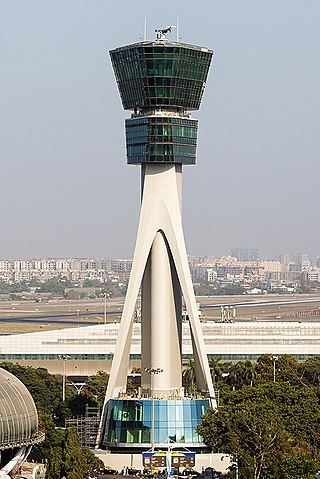
Air traffic control (ATC) is a service provided by ground-based air traffic controllers (people) who direct aircraft on the ground and through a given section of controlled airspace, and can provide advisory services to aircraft in non-controlled airspace. The primary purpose of ATC worldwide is to prevent collisions, organise and expedite the flow of traffic in the air, and provide information and other support for pilots.

In aviation, the instrument landing system (ILS) is a precision radio navigation system that provides short-range guidance to aircraft to allow them to approach a runway at night or in bad weather. In its original form, it allows an aircraft to approach until it is 200 feet (61 m) over the ground, within a 1⁄2 mile (800 m) of the runway. At that point the runway should be visible to the pilot; if it is not, they perform a missed approach. Bringing the aircraft this close to the runway dramatically increases the range of weather conditions in which a safe landing can be made. Other versions of the system, or "categories", have further reduced the minimum altitudes, runway visual ranges (RVRs), and transmitter and monitoring configurations designed depending on the normal expected weather patterns and airport safety requirements.
Airspace is the portion of the atmosphere controlled by a country above its territory, including its territorial waters or, more generally, any specific three-dimensional portion of the atmosphere. It is not the same as outer space which is the expanse or space outside the Earth and aerospace which is the general term for Earth's atmosphere and the outer space within the planet's vicinity.
Automatic terminal information service, or ATIS, is a continuous broadcast of recorded aeronautical information in busier terminal areas. ATIS broadcasts contain essential information, such as current weather information, active runways, available approaches, and any other information required by the pilots, such as important NOTAMs. Pilots usually listen to an available ATIS broadcast before contacting the local control unit, which reduces the controllers' workload and relieves frequency congestion. ATIS was developed and adopted by the FAA in the mid-1960s and internationally beginning in 1974. Before the adoption of ATIS, this information was routinely disseminated to each aircraft separately, increasing controller workload during periods of high traffic density.
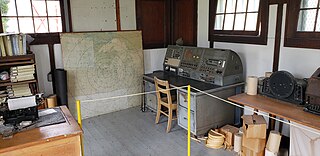
A flight service station (FSS) is an air traffic facility that provides information and services to aircraft pilots before, during, and after flights, but unlike air traffic control (ATC), is not responsible for giving instructions or clearances or providing separation. They do, however, relay clearances from ATC for departure or approaches. The people who communicate with pilots from an FSS are referred to as flight service specialists.

The Canada Flight Supplement (CFS) is a joint civil/military publication and is a supplement of the Aeronautical Information Publication. It is the nation's official airport directory. It contains information on all registered Canadian and certain Atlantic aerodromes and certified airports.
The Airport/Facility Directory, now identified as Chart Supplement in the U.S., is a pilot's manual that provides comprehensive information on airports, large and small, and other aviation facilities and procedures.

In air traffic control, an area control center (ACC), also known as a center or en-route center, is a facility responsible for controlling aircraft flying in the airspace of a given flight information region (FIR) at high altitudes between airport approaches and departures. In the US, such a center is referred to as an air route traffic control center (ARTCC).
Ford Airport is a county-owned public-use airport in Dickinson County, Michigan, United States. It is located three miles west of the central business district of Iron Mountain, in the central Upper Peninsula of Michigan. The airport offers scheduled passenger service by one commercial airline, SkyWest Airlines, an affiliate of Delta Connection, which is subsidized by the Essential Air Service program. It is also a hub for FedEx Feeder operator CSA Air.

Raleigh Exec: The Raleigh Executive Jetport or Raleigh Exec Jetport at Sanford-Lee County is a public use airport located seven nautical miles northeast of the central business district of Sanford, a city in Lee County, North Carolina, United States. It is owned by the Sanford-Lee County Regional Airport Authority and was previously known as Sanford-Lee County Regional Airport. This airport is included in the National Plan of Integrated Airport Systems for 2011–2015, which categorized it as a reliever airport for Raleigh-Durham International Airport.
Iowa City Municipal Airport, is two miles southwest of downtown Iowa City, in Johnson County, Iowa. It is the oldest civil airport west of the Mississippi River still in its original location.
Leesburg Executive Airport at Godfrey Field is a town-owned public-use airport located three nautical miles south of the central business district of Leesburg, a town in Loudoun County, Virginia.
An aeronautical chart is a map designed to assist in the navigation of aircraft, much as nautical charts do for watercraft, or a roadmap does for drivers. Using these charts and other tools, pilots are able to determine their position, safe altitude, best route to a destination, navigation aids along the way, alternative landing areas in case of an in-flight emergency, and other useful information such as radio frequencies and airspace boundaries. There are charts for all land masses on Earth, and long-distance charts for trans-oceanic travel.

Virginia Tech Montgomery Executive Airport is a public airport named for nearby Virginia Tech and located three miles (5 km) south of the central business district of Blacksburg, a town in Montgomery County, Virginia, United States.
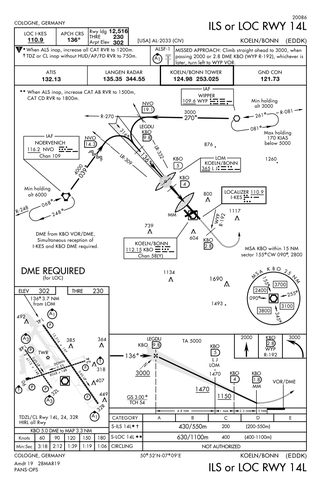
Approach plates are the printed or digital charts of instrument approach procedures that pilots use to fly instrument approaches during instrument flight rules (IFR) operations. Each country maintains its own instrument approach procedures according to International Civil Aviation Organization (ICAO) standards.

Cape May Airport or Cape May County Airport is a public use airport in Lower Township, Cape May County, New Jersey, United States. Owned by the Delaware River and Bay Authority, the airport is four nautical miles (7 km) northwest of the central business district of Wildwood.

Washington County Airport is three miles (5 km) southwest of Washington in South Franklin Township, Pennsylvania. It is owned and operated by Washington County and is in the Greater Pittsburgh metropolitan area.
The National Airspace System (NAS) is the airspace, navigation facilities and airports of the United States along with their associated information, services, rules, regulations, policies, procedures, personnel and equipment. It includes components shared jointly with the military. It is one of the most complex aviation systems in the world, and services air travel in the United States and over large portions of the world's oceans.
AirNav Systems is a Tampa-based global flight tracking and data services company founded in 2001. The company operates a flight tracking website and mobile app called Radarbox which offers worldwide tracking of commercial and general aviation flights. AirNav Systems also owns and operates a ground-based ADS-B tracking network that is supported by over 20,000 active volunteer ADS-B data feeders from over 180 countries. The company's real-time tracking and data services are also used by 25,000 aviation related businesses, government agencies, airlines, media channels and airports in over 60 countries.
Owosso Community Airport is a public-use airport located in Caledonia Charter Township, two miles (3 km) east of Owosso, between the cities of Owosso and Corunna, in Shiawassee County, Michigan, United States. It is owned by the Shiawassee Airport Board, a multi-government authority with five voting members from Shiawassee County, the cities of Owosso and Corunna, and the townships of Owosso and Caledonia. It is included in the Federal Aviation Administration (FAA) National Plan of Integrated Airport Systems for 2017–2021, in which it is categorized as a local general aviation facility.

